
Legal disclaimer: This guide is for informational purposes only and should not be considered legal advice. Requirements vary by state, county, and city and change frequently. Always verify current requirements with your local licensing office, zoning department, and legal counsel before placing a vending machine.
Can you put a vending machine anywhere? The short answer is no. Every placement requires permission from whoever controls the property, the right local business permits, and in some cases federal compliance depending on what the machine sells. The good news is that the legal framework is navigable, the permits are generally obtainable, and the actual process of finding and securing a compliant placement is straightforward once you understand what’s required.
This guide covers everything you need to know: property rights, zoning laws, permits and licenses, federal requirements, and which types of locations are off-limits or heavily restricted.
Key Takeaways
- ✅ You always need explicit permission from the property owner before placing any machine
- ✅ Most operators need a business license, seller’s permit, and food handler’s permit
- ✅ Residential zones typically prohibit commercial vending — even on your own property
- ✅ Public sidewalks and parks usually require a government permit and often aren’t permitted at all
- ✅ Schools and healthcare facilities have additional regulations beyond standard permits
- ✅ ADA accessibility and FDA calorie-labeling rules may apply depending on your operation
- ✅ Tobacco, vape, alcohol, and cannabis vending carry strict product-specific restrictions
Quick Answer: Where Can You Put a Vending Machine?
| Location Type | Generally Allowed? | What’s Required |
|---|---|---|
| Private commercial property (offices, warehouses, malls) | ✅ Yes | Property owner permission + business license |
| Schools (public K-12) | ✅ With conditions | District approval + USDA Smart Snacks compliance |
| Hospitals and healthcare facilities | ✅ Yes | Property owner permission + food permit if selling food |
| Public sidewalks and streets | ⚠️ Rarely | Government permit required — often not permitted at all |
| Public parks | ⚠️ Sometimes | Municipal permit — competitive process in many areas |
| Residential zones | ❌ Usually no | Zoning typically prohibits commercial vending |
| Outside your own home | ⚠️ Depends | Local zoning must allow commercial use in residential area |
| Tobacco/vape vending — any location | ❌ Adults-only only | Federal law restricts these to adult-only establishments |
So, Can You Put a Vending Machine Anywhere in the US?
The direct answer is no — but with the right permissions and permits, the vast majority of commercial locations are accessible. Most operators who ask “can you put a vending machine anywhere” are really asking whether the process is complicated. It isn’t, once you understand the four layers of rules that govern every placement: property rights, zoning, permits, and product-specific regulations.
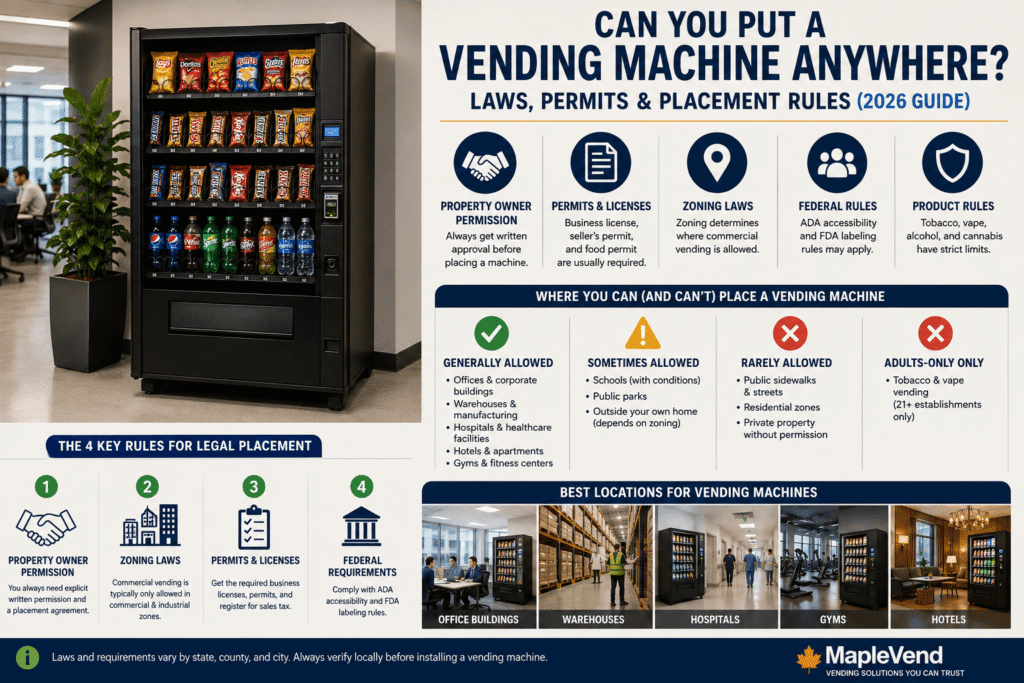
Rule 1: You Always Need Property Owner Permission
Every vending machine sits on property that someone owns or controls. Before anything else — before permits, before choosing a machine, before anything — you need explicit permission from the person or entity that controls the property. According to Daedalus Distribution’s 2026 vending placement legal guide, placing a machine without written consent can result in trespassing charges, fines, or seizure of the equipment — regardless of whether the location looks obviously available.
That permission should always be documented in a written placement agreement that both parties sign, covering:
- Which specific location on the property the machine occupies
- The term of the agreement and how either party can end it
- Revenue sharing or site fee arrangement (if any)
- Who is responsible for maintenance and restocking
- Liability and insurance responsibilities
A handshake agreement is not sufficient — a property owner who later decides they want the machine gone can remove it without recourse if there’s no written agreement in place.
Rule 2: Zoning Laws Determine What’s Commercially Viable
Zoning ordinances divide land into categories — commercial, industrial, residential, institutional, mixed-use — and commercial vending activity is typically only permitted in commercial and industrial zones. This has two practical implications:
You generally cannot place a vending machine in a residential area, even if you own the property. A machine on your front lawn or driveway in a residentially zoned neighborhood almost certainly violates local zoning ordinances — and can result in a code enforcement order to remove it.
Commercial zones welcome machines but still regulate them. In retail centers, office parks, and commercial corridors, vending machines are typically permitted but may require compliance with local business licensing, health department rules, and ADA accessibility standards.
Zoning rules vary significantly by city and county. Before committing to any placement, confirm with your local planning or zoning office that vending is a permitted commercial use at the specific address. The question of whether you can put a vending machine anywhere in a commercial zone is usually yes — but only after confirming these details locally.
Rule 3: Permits and Licenses Are Almost Always Required
According to VendSoft’s 2026 50-state vending permit directory, most U.S. states require vending machine operators to register a business and collect sales tax — though the specifics vary widely by state and locality, and some products or jurisdictions have exemptions. The U.S. Small Business Administration’s licensing guide confirms that most vending operators need a combination of federal, state, and local licenses depending on their business structure and product type. The core permits most operators need:
- General business license — required in nearly every state and municipality. Applied for through your local city clerk or county office.
- Seller’s permit / sales tax registration — required in most states for any business that collects sales tax. Register with your state’s revenue department.
- Food handler’s permit or health department license — required in most states if your machine dispenses food or beverages. Some states add a specific vending machine permit on top of this.
- Vending machine-specific permit — some cities and counties require a permit specifically for vending machine operation, separate from a general business license.
The good news is that these permits are generally obtainable and not prohibitively expensive for most operators. The process is more administrative than substantive — the main risk is operating without them and getting fined or shut down, not being denied them outright.
Rule 4: Federal Requirements Apply Nationwide
On top of state and local rules, two federal requirements apply to vending machine operators regardless of location:
ADA Section 4.27 accessibility standards. According to ADA.gov, vending machines that are bolted down or permanently installed must comply with Americans with Disabilities Act reach and operating standards — meaning the controls and payment interface must be reachable from a wheelchair and operable without tight grasping, pinching, or twisting. Most current commercial machines are designed to meet these standards, but older machines may not.
FDA calorie labeling requirements. Under the FDA’s vending machine labeling requirements, operators who own or operate 20 or more vending machines may be subject to calorie-labeling requirements for food items sold from those machines, subject to specific conditions and exemptions. This generally applies to larger chain operators and route businesses — single-machine or small-route operators are typically exempt, but confirm with the FDA’s guidance for your specific situation.
Where Vending Machines Cannot Go
Some locations are effectively off-limits regardless of how strong the foot traffic looks:
- Public sidewalks and streets — technically owned by the city or municipality, which typically doesn’t allow private commercial vending without a competitive permit process. Even where permits exist, they’re limited and competitive.
- Residential zones — commercial vending is generally not a permitted use. Even placing a machine on your own residential property typically violates zoning.
- Private property without permission — regardless of how public the location feels (a parking lot, a lobby, a hallway), placing a machine without owner consent is trespassing.
Product-Specific Restrictions
What your machine sells adds another layer of rules on top of location rules:
Tobacco and vape products — federal law restricts vending sales of tobacco and e-cigarettes to establishments where no one under 21 is present or permitted to enter at any time. Four states (Idaho, South Carolina, Vermont, and Virginia) ban tobacco vending machines entirely. Vape vending carries additional state-by-state restrictions — some states prohibit it regardless of venue.
Alcohol — vending machine sales of alcohol are prohibited in most U.S. states. A small number of states permit alcohol vending under highly restricted conditions with specific licensing.
Cannabis/CBD — heavily regulated and vary by state. Where permitted, cannabis vending machines typically require specialized licensing and age-verification technology.
Fresh and perishable food — machines selling fresh food, dairy, or items requiring refrigeration are subject to health department oversight in most states, including temperature monitoring requirements and potentially more frequent inspections.
Best Locations for Vending Machines
So where can you put a vending machine? The locations that consistently combine legal accessibility with strong commercial performance are private commercial properties with steady, built-in foot traffic — and specifically, locations where the operator has a clear path to getting a written placement agreement:
- Office buildings and corporate campuses — snack and drink machines are the standard setup
- Warehouses and manufacturing facilities — high-volume, captive workforce locations
- Hospitals and healthcare facilities — 24/7 demand from staff and visitors
- Hotels and apartment buildings — commercial vending machines work well as amenities
- Schools and universities — requires compliance with nutrition standards for K-12
- Gyms and fitness centers — strong demand for drinks and protein-focused products
- High-tech or corporate environments — smart vending machines with cashless and remote monitoring are increasingly preferred
Before committing to any location, make sure you understand the stocking costs involved — our guide on how much it costs to stock a vending machine covers the full economics. For machine options across all categories, browse our used vending machines for sale or our full vending machines collection.
Ready to Place Your First Machine?
Now that you know where you can put a vending machine — and where you can’t — the next step is choosing the right machine for your location. MapleVend carries new and used commercial vending machines across snack, drink, coffee, combo, and specialty categories — all from established manufacturers with a track record in commercial environments.
Contact MapleVend to discuss your placement, get a quote, and find the right machine for your specific location and compliance requirements.
Who Should Read This Guide?
- First-time operators evaluating their first placement and not sure what’s legally required
- Property managers considering hosting a vending machine and wondering what to ask the operator
- Business owners who want to place a machine for employees and need to understand the permit process
- Existing operators expanding to new location types (e.g., moving from offices to schools or healthcare)
Vending Machine Placement Checklist
Use this checklist before installing any vending machine to confirm you’ve covered every legal and practical requirement:
- ☐ Property owner approval — verbal confirmation first, then written placement agreement
- ☐ Written placement agreement signed — covering location, term, revenue split, liability, and exit terms
- ☐ Zoning confirmed — commercial vending is a permitted use at this specific address
- ☐ Business license obtained — from your local city or county clerk’s office
- ☐ Sales tax / seller’s permit registered — with your state’s revenue department
- ☐ Food handler’s permit obtained — required in most states if selling food or drinks
- ☐ Product-specific permits checked — tobacco, vape, alcohol, and cannabis carry additional requirements
- ☐ ADA compliance confirmed — machine controls and payment interface meet reach and operation standards
- ☐ Insurance in place — general liability coverage for the machine and any damage or injury
- ☐ Machine installed and tested — payment system, product dispensing, and any remote monitoring confirmed working
State Laws Vary — Always Verify Locally
Although the general legal framework described in this guide is broadly similar across the United States, the answer to “can you put a vending machine anywhere in my state?” varies significantly by state, county, and city. Business licensing requirements, health department permits, sales tax registration, and local zoning rules may differ from one jurisdiction to the next — sometimes substantially. A placement that’s straightforward in one city may require additional permits in the next county over.
Always confirm current requirements with your local business licensing office and planning or zoning department before installing a machine. Online permit directories are useful starting points, but local agencies are the authoritative source for what’s currently required in your specific location.
Frequently Asked Questions
Can you put a vending machine anywhere?
No. Every vending machine placement requires explicit permission from the property owner, the right local business permits, and compliance with zoning laws. Most commercial locations are accessible with the right paperwork — residential zones and public property without a permit are generally off-limits.
Can I put a vending machine on public property?
Rarely, and only with a government-issued permit. Public sidewalks, streets, and parks are owned by the municipality, which typically requires a competitive permit process for private commercial use. Many municipalities don’t allow private vending on public property at all.
Can I put a vending machine outside my house?
It depends on your local zoning. If your property is in a residentially zoned area, placing a commercial vending machine on it likely violates zoning ordinances. If your property is in a commercial or mixed-use zone, it may be permitted with the right licenses. Confirm with your local zoning office before purchasing a machine for this use.
Do you need a permit to operate a vending machine?
Yes, in almost every U.S. jurisdiction. At minimum you’ll need a general business license and a seller’s permit for sales tax. Most states require a food handler’s permit or health department license if you’re selling food or drinks. Some cities and counties require an additional vending machine-specific permit.
What happens if you place a vending machine without permission?
The property owner can have it removed immediately, and you may face trespassing charges, fines, and liability for any damage caused during removal. Operating without the required business permits can also result in fines from local authorities.
Where do vending machines perform best?
Private commercial locations with built-in, captive foot traffic — warehouses, offices, hospitals, hotels, gyms, schools, and apartment buildings — consistently outperform public locations. The combination of steady volume, a captive audience, and a clear path to a written placement agreement makes these the most reliable and legally straightforward placements.
