
New vs used vending machine — it’s the first real decision most operators face, and it’s one where the wrong choice costs real money. Buy new and you pay more upfront for reliability and warranty protection. Buy used and you save significantly on purchase price but take on unknown wear history and potentially outdated payment technology. Neither option is universally better — the right choice depends on your budget, your location, and how much risk you’re comfortable taking on your first placement.
This guide breaks down the real differences, the real costs, and the specific situations where each option makes the most sense. Browse our vending machine shop and new commercial vending machines to compare current options.
Key Takeaways
- ✅ Used machines cost 40–60% less upfront than new equivalents
- ✅ New machines include full manufacturer warranties and zero prior wear
- ✅ Refurbished machines offer the best value for many first-time buyers
- ✅ Cashless payment is essential in 2026 — 71% of vending transactions are now cashless
- ✅ High-traffic confirmed locations justify buying new; unproven locations favor used
- ✅ Total cost of ownership matters more than purchase price alone
Which Should You Buy?
| If you… | Buy |
|---|---|
| Have under $2,500 to spend | Used |
| Want the lowest risk | New |
| Want the best value per dollar | Refurbished |
| Have a proven busy location | New |
| Are buying your first machine | Used or refurbished |
| Need the latest payment technology | New |
| Want a shorter payback period | Used |
New vs Used Vending Machine: Quick Comparison
| Factor | New Machine | Used Machine |
|---|---|---|
| Purchase price | $3,000–$10,000+ | $1,200–$3,500 |
| Upfront savings | — | 40–60% less than new |
| Warranty | Full manufacturer warranty | Limited or none (varies by seller) |
| Wear history | Zero | Unknown — varies by unit |
| Cashless payment | Standard on current models | May need retrofitting |
| Energy efficiency | Latest Energy Star standards | Older units use more electricity |
| Payback period | Longer (higher upfront cost) | Shorter (lower upfront cost) |
| Best for | High-traffic flagship locations | First machine, unproven locations |
New Vending Machine: What You Get and What You Pay
A new commercial vending machine in 2026 typically costs $3,000–$10,000 for a standard snack, drink, or combo unit, according to VMFS USA’s 2026 vending machine price guide. Smart machines with touchscreens, AI capability, and remote management run $10,000–$30,000+.
What you’re buying with a new machine:
- Full manufacturer warranty — typically 1–2 years on parts and labor, covering the components most likely to fail early (compressor, payment system, dispensing mechanism)
- Zero prior wear — no unknown history on the compressor, coin mechanism, or bill validator
- Current payment technology — cashless payment, mobile wallet, and tap-to-pay are standard on virtually all new commercial machines in 2026
- Energy efficiency — new machines meet current Energy Star standards and use significantly less electricity than older units
- Latest compliance — ADA-compliant controls, current safety certifications, and up-to-date software
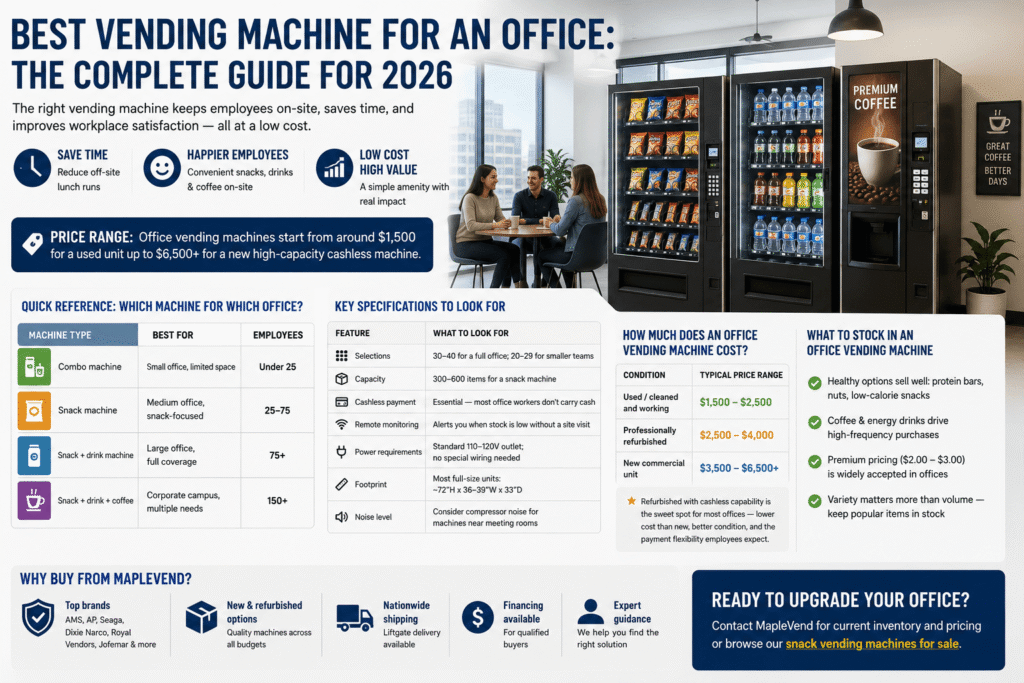
The tradeoff is payback period. At $5,000–$7,000 for a new machine versus $1,500–$2,500 for a comparable used unit, you’re taking on 2–4x more upfront capital for the same machine footprint. In a high-traffic location that generates $500–$800/month net, that difference pays back within a year. In a moderate-traffic office generating $100–$150/month net, the gap takes years to close.
Used Vending Machine: What You Get and What You Risk
A used operator-grade vending machine typically costs $1,200–$3,500, with the most reliable range for a properly inspected unit sitting at $1,500–$2,500. According to Daedalus Distribution’s 2026 vending cost guide, used machines cost 40–60% less upfront than new equivalents — but they carry higher repair risk in the first year and may lack modern payment technology.
What you get with a used machine:
- Significantly lower upfront cost — the primary reason most first-time operators start here
- Faster payback period — lower initial investment means the machine starts generating net profit sooner
- Lower financial risk on an unproven location — if the placement underperforms, a $1,500 loss hurts less than a $6,000 one
What you risk with a used machine:
- Unknown wear history — you don’t know how many cycles the compressor has run, how the coin mechanism has been maintained, or whether the bill validator is near end of life
- Outdated payment technology — older machines may not have cashless capability; retrofitting a card reader costs $200–$500
- Higher energy costs — older refrigerated machines can use 2–3x more electricity than a comparable new unit
- Limited or no warranty — most used machine sales include a 90-day limited parts warranty at best; some include nothing
What About Refurbished Machines?
Refurbished machines sit between new and used — they’re pre-owned units that have been professionally inspected, repaired, and tested before resale. A reputable refurbisher replaces worn components (bill validators, coin mechs, compressor seals), updates payment hardware, and typically includes a limited warranty on the work done.
Refurbished machines typically cost $2,500–$4,500 — less than new, more than basic used — and represent the sweet spot for many operators who want the reliability upside of a new machine without the full new-machine price tag. The key variable is who’s doing the refurbishing: a machine “refurbished” by a seller who cleaned it and changed the price tag is not the same as one that’s been through a genuine technical inspection and parts replacement.
Pros and Cons: New vs Used Vending Machine
| New Vending Machine | Used Vending Machine |
|---|---|
| ✅ Full manufacturer warranty | ✅ Lower purchase price (40–60% less) |
| ✅ Latest cashless payment technology | ✅ Faster return on investment |
| ✅ Energy Star compliant — lower electricity costs | ✅ Lower financial risk on first placement |
| ✅ Zero prior wear history | ✅ Good option for unproven locations |
| ✅ Better appearance — important in offices | ✅ Wide selection of proven commercial models |
| ❌ Higher purchase price | ❌ Unknown wear history |
| ❌ Longer payback period | ❌ May need cashless payment retrofit |
| ❌ Higher upfront capital requirement | ❌ Usually no manufacturer warranty |
| ❌ Older units use more electricity |
5-Year Total Cost of Ownership: New vs Used
Purchase price is only one part of what a vending machine actually costs. Here’s how the numbers compare over a 5-year operating period for a standard refrigerated snack/drink machine:
| Cost Category | New Machine | Used Machine |
|---|---|---|
| Purchase price | $5,000–$7,000 | $1,500–$2,500 |
| Year 1 repairs (estimated) | $0–$100 (warranty covers most) | $200–$800 (higher unknown risk) |
| Years 2–5 repairs (estimated) | $200–$600 | $500–$2,000 |
| Electricity (5 years) | Lower — Energy Star compliant | Higher — older units use more power |
| Cashless retrofit (if needed) | Included | $200–$500 if not already equipped |
| Estimated 5-year total | $5,500–$8,000 | $2,500–$6,000 |
The gap narrows considerably when you factor in repair costs, energy differences, and retrofit costs on a used machine. A well-maintained used unit from a reputable seller with cashless capability already installed can be genuinely economical over 5 years — but a cheap used machine with hidden problems can end up costing more than a new one.
The Cashless Payment Question
This is the single most important technology consideration when comparing new vs used vending machines. According to Cantaloupe’s 2025 Micropayment Trends Report, cashless payments accounted for 71% of all vending transactions in 2024, with the average cashless transaction reaching $2.24 — 37% higher than the $1.78 average for cash transactions.
A used machine without cashless capability placed in an office, hospital, or university — where most buyers don’t carry cash — will consistently underperform a cashless-enabled machine in the same location. The revenue gap is real and compounding: every cashless customer who walks away from a cash-only machine is a lost transaction that doesn’t show up in your data as a loss, just as a sale that never happened.
Bottom line: if you buy a used machine, confirm it either already has a working cashless reader or is MDB-compatible (which allows retrofitting). A machine that can’t be made cashless-capable in 2026 is a machine with a structural revenue ceiling.
New vs Used Vending Machine: Which Is Right for Your Situation?
| Your Situation | Best Choice | Reason |
|---|---|---|
| Budget under $2,500 | Used | Lowest upfront investment |
| Budget over $5,000 | New | Best reliability and warranty |
| First machine, unproven location | Used or refurbished | Lower financial risk if location underperforms |
| High-traffic confirmed location | New | Maximum reliability and uptime |
| Office or corporate environment | New or refurbished | Appearance and cashless capability matter |
| Warehouse or industrial placement | Used | Appearance less important; durability matters more |
| School or healthcare facility | New or refurbished | Better compliance, reliability, and appearance |
| Want best value per dollar | Refurbished | Reliability upside without full new-machine price |
What to Inspect Before Buying a Used Vending Machine
If you decide used is the right choice, four components determine whether the machine is actually a good deal:
- Compressor (refrigerated machines only) — the most expensive component to replace, often $300–$600+. Listen for unusual sounds, check that it reaches and holds temperature, and ask about service history.
- Bill validator and coin mechanism — test both with real currency. A validator that jams or rejects bills consistently is a significant revenue problem that also drives customer frustration.
- Cashless payment capability — confirm whether it has a working card reader, whether it’s MDB-compatible for retrofitting, and what the retrofit cost is if it needs one.
- Parts availability — check that replacement parts for the specific model are still available. A $1,500 machine from a discontinued model line with no available parts is a liability, not a bargain.
Real Machine Examples: New vs Used
To make this concrete, here are specific machines available through MapleVend that illustrate each category:
New machines worth considering:
- AMS 39 snack machine — high capacity, 39 selections, well-regarded for offices and warehouses
- Wittern combo machines — reliable dual-category units for mid-size offices
- Jofemar coffee machines — genuine hot beverage capability for professional environments
Used machines worth considering:
- Dixie Narco 501E — a proven drink machine with wide parts availability and strong resale value
- AP 113 snack machine — durable, widely-serviced, good selection count for a used unit
- AMS 35 — a reliable used snack machine with good parts availability
Where to Buy
For both new and used machines, buying from a reputable supplier who has actually inspected the unit is safer than buying from a private seller who hasn’t. Private listings on eBay, Craigslist, and auction sites can offer lower prices but provide no inspection, no warranty, and no recourse if the machine has hidden problems.
MapleVend carries both new and used commercial vending equipment across snack, drink, coffee, combo, and specialty categories — browse our snack vending machines, drink vending machines, and coffee vending machines to compare options, or see our full used vending machines for sale collection.
Bottom Line
If you’re buying your first vending machine or testing a new location, a quality used or refurbished machine usually offers the best balance of cost and return on investment. The lower upfront cost reduces financial risk, shortens your payback period, and gives you room to learn the business before committing larger capital.
If you’re placing a machine in a proven high-traffic location where uptime, appearance, and modern payment options are critical — an office building, hospital, university, or busy retail environment — investing in a new machine is often the better long-term choice. The warranty protection, cashless capability, and energy efficiency justify the premium when volume is there to support it.
The best decision in the new vs used vending machine debate isn’t simply about price — it’s about matching the machine to your budget, your expected sales volume, and the specific demands of your placement.
Related Guides
Once you’ve decided between new and used, these guides cover the next decisions in the buying process:
- How Much Does It Cost to Stock a Vending Machine? — understand ongoing product costs before you buy
- Do Vending Machines Need Electricity? — power requirements, outlet types, and monthly energy costs
- Can You Put a Vending Machine Anywhere? — permits, zoning, and placement rules explained
Common Mistakes Buyers Make
- Buying a machine without checking parts availability. A discontinued model with no available replacement parts turns every breakdown into a major expense. Always confirm parts are still in production for the specific model before purchasing used.
- Choosing a cash-only machine in 2026. With 71% of vending transactions now cashless, a machine that can’t accept card or mobile payment has a structural revenue ceiling. If the machine isn’t MDB-compatible for a cashless retrofit, pass on it.
- Ignoring electricity and installation requirements. Most machines need a dedicated 15–20 amp circuit. Discovering your location doesn’t have the right outlet after delivery creates delays and extra cost. Confirm electrical requirements before ordering.
- Purchasing from an unverified seller with no warranty. A cheap used machine from a private seller with no inspection history and no warranty is a gamble. The savings can disappear quickly if the compressor or payment system fails in the first 90 days.
- Focusing only on purchase price instead of total ownership cost. A $1,500 used machine that needs a $600 compressor repair, a $400 cashless retrofit, and costs $20/month more in electricity than a new unit may end up costing more over 3 years than a $5,000 new machine with a full warranty.
Frequently Asked Questions
Is it better to buy a new or used vending machine?
It depends on your situation. Used machines are better for a first placement or an unproven location where you want to limit financial risk. New machines are better for high-traffic confirmed locations where reliability and cashless payment capability are critical to maximizing revenue.
How much does a used vending machine cost in 2026?
Operator-grade used machines typically run $1,200–$3,500. Professionally refurbished machines with updated payment hardware cost $2,500–$4,500. Basic used machines from auctions or private sellers can start below $1,000 but typically require significant repairs.
What is the difference between used and refurbished vending machines?
A used machine has been resold as-is with minimal inspection. A refurbished machine has been professionally inspected, repaired, and tested — with worn components replaced and payment hardware updated — and typically includes a limited warranty on the work performed.
Do used vending machines have cashless payment?
Older used machines often don’t — but many can be retrofitted with a cashless card reader if they’re MDB-compatible. A retrofit typically costs $200–$500. Before buying a used machine, confirm whether it has cashless capability or whether it’s MDB-compatible for retrofitting.
How long do vending machines last?
Well-maintained commercial vending machines typically last 10–15 years. The compressor (on refrigerated models) and payment systems are the components most likely to need replacement before the cabinet itself wears out. A used machine that’s 5–8 years old with good service history has significant useful life remaining.
About this guide: This article was researched and written by the MapleVend team based on current 2026 market pricing, operator experience across commercial vending placements, and publicly available industry data. MapleVend is a U.S.-based commercial vending machine marketplace carrying new and used equipment from AMS, Seaga, Dixie Narco, AP, Royal Vendors, Jofemar, and Wittern.
Sources used in this guide:
- VMFS USA — 2026 Vending Machine Price Guide (vmfsusa.com)
- Daedalus Distribution — 2026 Vending Cost Guide (daedalusdistribution.com)
- Cantaloupe — 2025 Micropayment Trends Report (cashless transaction data)
- Energy Star — Vending Machine Efficiency Standards
Ready to choose between a new vs used vending machine for your location? Contact MapleVend to discuss current inventory, condition details, and which option fits your budget and placement — or browse our full vending machine collection to compare options side by side.
