
Snack vs combo vending machine is one of the most practical decisions a new operator faces — and it’s one where the wrong choice quietly costs money through underperformance rather than a single obvious mistake. A snack machine focuses entirely on food, giving you more product depth and variety. A combo machine covers both snacks and drinks in one unit, trading capacity for convenience and floor space efficiency. Neither is universally better — the right choice depends on your location, your available space, and how much foot traffic you expect.
This guide breaks down exactly when each machine type performs better, with real pricing, capacity data, and a clear decision framework. Browse our snack vending machines for sale and commercial vending machines to compare current options.
Key Takeaways
- ✅ Combo machines are the most popular first machine — they cover two categories in one footprint
- ✅ Snack machines offer more product depth and variety for food-focused locations
- ✅ Separate snack + drink machines outperform a single combo at high-traffic locations
- ✅ Combo machines are better for limited space, mixed demand, and first-time operators
- ✅ The right choice depends on foot traffic, available floor space, and audience preference
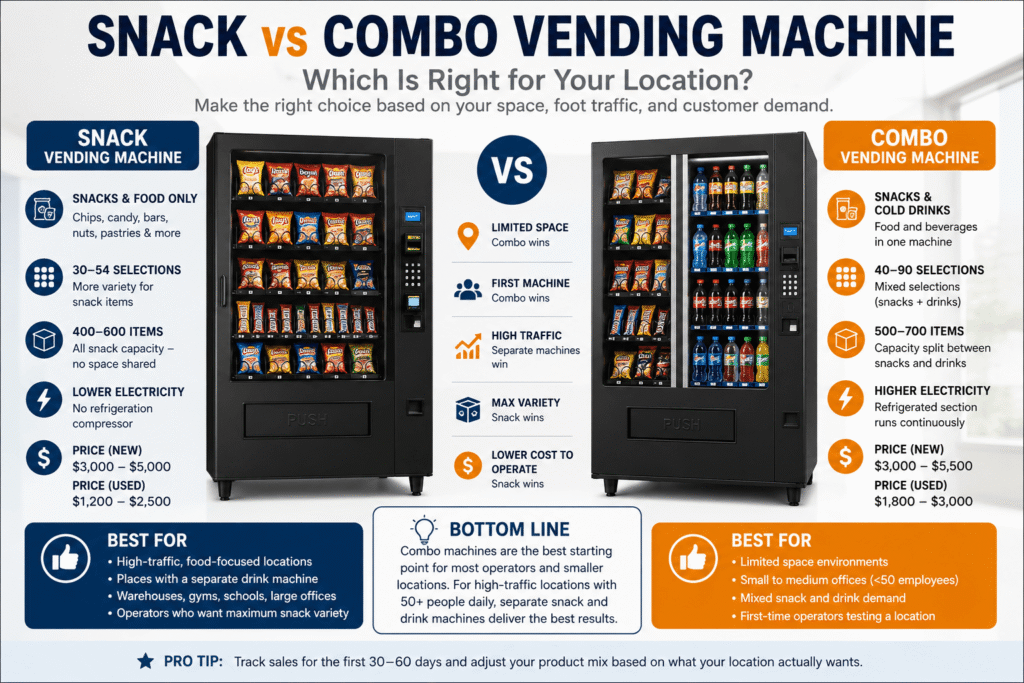
Quick Answer: Snack vs Combo Vending Machine
| Factor | Snack Machine | Combo Machine |
|---|---|---|
| Products offered | Snacks and food only | Snacks and cold drinks |
| Typical selections | 30–54 selections | 40–90 selections (split between snacks and drinks) |
| Capacity | 400–600 items | 500–700 items (mixed) |
| Floor space | One machine footprint | One machine footprint |
| Price (new) | $3,000–$5,000 | $3,000–$5,500 |
| Price (used) | $1,200–$2,500 | $1,800–$3,000 |
| Best for | High-traffic, food-focused locations | Limited space, mixed demand, first machines |
| Electricity | Lower — no refrigeration compressor | Higher — refrigerated drink section |
Which Should You Choose?
| If you… | Choose |
|---|---|
| Have limited floor space | Combo machine |
| Are buying your first machine | Combo machine |
| Have fewer than 30 employees | Combo machine |
| Have 50 or more employees or high foot traffic | Separate snack + drink machines |
| Want maximum snack variety | Snack machine |
| Have mixed snack and drink demand | Combo machine |
| Already have a drink machine in place | Snack machine |
| Want lower electricity costs | Snack machine |
What Is a Snack Vending Machine?
A snack vending machine is designed exclusively for packaged food items — chips, protein bars, candy, nuts, crackers, pastries, and similar non-refrigerated products. Because it doesn’t divide space between food and drinks, a dedicated snack machine can offer more food selections and carry more depth in popular items than a combo unit of the same physical size.
According to Orange County Vending’s April 2026 comparison guide, a snack vending machine puts more of its capacity into food items, which affects almost everything else — product variety, total capacity, and what kind of location the machine fits best. Snack machines work best in locations where hunger is the primary driver and drink demand is already served by a separate machine, water cooler, or cafeteria.
The strongest placements for a standalone snack machine:
- Warehouses and manufacturing facilities where a separate drink machine is already in place
- School and university break areas paired with a beverage machine
- Large offices where separate snack and drink machines run alongside each other
- Gyms and fitness centers where protein bars and snacks are the primary demand
What Is a Combo Vending Machine?
A combo vending machine — also called a dual vending machine or combi unit — dispenses both snacks and cold drinks from a single cabinet with dual temperature zones: a refrigerated section for beverages and an ambient section for packaged food. This makes it the most space-efficient way to offer two product categories in one footprint.
Combo machines typically offer 40–90 selections with a capacity of 500–700 mixed items, and they’re consistently cited as the best first machine for new operators who want to cover both product categories without committing to two separate machines. According to VendSoft’s 2026 vending machine price guide, new combo machines run $3,000–$5,500 and are the most popular single-machine setup for smaller locations.
The strongest placements for a combo machine:
- Small to medium offices with under 50 employees
- Break rooms with limited floor space
- Apartment building common areas
- Small retail or waiting area environments
- Any first placement where the operator wants to test both categories before committing to separate machines
When Separate Snack + Drink Machines Outperform a Combo
For high-traffic locations, separate snack and drink machines consistently outperform a single combo unit — not because the combo is bad, but because each dedicated machine can carry significantly more product depth in its own category. A combo machine dividing its capacity between snacks and drinks gives you roughly half the snack variety of a dedicated snack machine and roughly half the drink variety of a dedicated drink machine.
The practical threshold: once a location has consistent daily foot traffic from 50 or more people, the additional product depth from separate machines typically justifies the cost of a second unit. Below that threshold, a combo unit is usually the more economical and space-efficient choice.
Real Machine Examples
Snack machines from MapleVend’s inventory:
- AMS snack machines — high selection count, durable construction, widely used in offices and warehouses
- AP 112 — 32 selections, reliable workhorse for medium-traffic locations
- AP 113 — proven commercial snack machine with strong parts availability
Combo machines from MapleVend’s inventory:
- Seaga combo machines — popular for small offices and break rooms
- Jofemar combo units — strong performance in mid-size commercial environments
- Wittern combo machines — reliable dual-category units with cashless capability
Pros and Cons
| Snack Machine | Combo Machine |
|---|---|
| ✅ More snack variety and depth | ✅ Covers snacks and drinks in one footprint |
| ✅ Lower electricity — no refrigeration compressor | ✅ Better for limited floor space |
| ✅ Simpler maintenance — no cooling system | ✅ Ideal first machine for new operators |
| ✅ Best for high-traffic food-focused locations | ✅ Reduces guesswork on mixed-demand locations |
| ❌ Doesn’t serve drink demand | ❌ Less snack variety than a dedicated unit |
| ❌ Needs a separate drink machine for full coverage | ❌ Less drink capacity than a dedicated unit |
| ❌ Two machines needed for full snack + drink coverage | ❌ Higher electricity — refrigerated section runs continuously |
Cost Comparison: Snack vs Combo
| Cost Factor | Snack Machine | Combo Machine |
|---|---|---|
| New price | $3,000–$5,000 | $3,000–$5,500 |
| Used price | $1,200–$2,500 | $1,800–$3,000 |
| Monthly electricity | $3–$10 (no compressor) | $15–$45 (refrigerated section) |
| Initial stocking | $150–$300 | $250–$500 |
| Maintenance complexity | Lower — no cooling system | Higher — compressor requires periodic service |
Related Guides
- New vs Used Vending Machine — whether to buy new or used for your first placement
- How Much Does It Cost to Stock a Vending Machine? — product costs, margins, and restocking frequency
- Can You Put a Vending Machine Anywhere? — permits, zoning, and placement rules
- Do Vending Machines Need Electricity? — power requirements by machine type
Bottom Line
Choose a combo vending machine if you’re buying your first machine, have limited floor space, or want to offer snacks and drinks from a single unit without managing two separate machines. It’s the most practical starting point for most new operators and smaller locations.
Choose a dedicated snack vending machine if your location already has beverage options nearby — a water cooler, cafeteria, or separate drink machine — and you want to maximize food variety and depth for a food-focused audience.
For the busiest locations with consistent daily foot traffic from 50 or more people, two dedicated machines almost always outperform one combo machine because each unit can carry more capacity and greater product variety in its own category.
Common Mistakes Buyers Make
- Buying a combo machine for a location with 100+ employees. At that volume, a single combo machine runs out of popular items too quickly. Separate snack and drink machines serve high-traffic locations significantly better.
- Buying a snack-only machine where there are no drink options nearby. If your location has no water cooler, cafeteria, or drink machine within easy reach, thirsty customers who can’t get a drink are less likely to buy a snack either.
- Underestimating electricity requirements. A combo machine’s refrigerated section adds $15–$45/month in electricity costs that a snack machine doesn’t incur. Confirm your location has a dedicated 15–20 amp circuit before ordering.
- Ignoring product mix preferences. A combo machine stocked with the wrong split — too many drink slots, not enough snack variety — underperforms one tuned to what the location’s audience actually wants. Track sales from day one and adjust within the first 30–60 days.
- Choosing a machine based only on purchase price. A cheaper machine with fewer selections and no cashless capability will underperform a better-equipped unit in almost every commercial location.
5-Year Ownership Cost: Snack vs Combo
| Cost Category | Snack Machine | Combo Machine |
|---|---|---|
| Purchase price (new) | $3,000–$5,000 | $3,000–$5,500 |
| Electricity (5 years) | $180–$600 | $900–$2,700 |
| Maintenance (5 years) | Lower — no compressor | Higher — compressor service required |
| Initial stocking | $150–$300 | $250–$500 |
| Estimated 5-year total | $3,500–$6,500 | $4,500–$9,500 |
The combo machine’s higher 5-year cost is driven almost entirely by electricity — the refrigerated drink section runs continuously, adding $15–$45/month that a non-refrigerated snack machine doesn’t incur.
Frequently Asked Questions
What is the difference between a snack vending machine and a combo vending machine?
A snack vending machine dispenses packaged food items only — chips, bars, candy, nuts — and offers more food variety because it doesn’t divide space between snacks and drinks. A combo vending machine dispenses both snacks and cold drinks from one cabinet, using dual temperature zones to keep drinks refrigerated while storing food at ambient temperature.
Which is better — a snack machine or a combo machine?
It depends on your location. A combo machine is better for limited space, mixed demand, and first-time operators. A snack machine is better for high-traffic locations where drink demand is already served separately and you want maximum food variety.
How much does a combo vending machine cost?
New combo machines typically run $3,000–$5,500. Used combo machines cost $1,800–$3,000. Prices vary by brand, selection count, and whether the machine includes cashless payment capability.
Is a combo vending machine good for a small office?
Yes — a combo machine is one of the most practical choices for a small office with fewer than 30–50 employees. It covers both snacks and drinks in one footprint, requires one outlet instead of two, and is simpler to manage on a light restocking schedule.
When should I use separate snack and drink machines instead of a combo?
When foot traffic consistently reaches 50 or more people per day. At that volume, two dedicated machines outperform a single combo because each can carry significantly more variety and capacity in its own category.
Are combo vending machines profitable?
Yes — combo machines can be highly profitable in locations with mixed snack and drink demand and limited floor space. Profitability depends on foot traffic, product pricing, and how well the product mix matches what buyers at that location actually want.
Do combo vending machines use more electricity than snack machines?
Yes — significantly more. A non-refrigerated snack machine uses roughly $3–$10/month in electricity. A combo machine with a refrigerated drink section uses $15–$45/month because the compressor runs continuously. Over 5 years that’s $900–$2,700 more in electricity costs.
Which makes more money — a snack machine or a combo machine?
It depends on the location. In a small office or limited-space environment, a combo machine typically generates more total revenue because it serves both demand categories. In a high-traffic location with 50 or more daily users, separate snack and drink machines generate more revenue because each carries greater product depth and capacity.
Are snack or drink vending machines more profitable?
Drink machines typically generate higher gross revenue per machine at high-traffic locations because beverages have higher purchase frequency than snacks — many users buy a drink every visit but only buy a snack occasionally. However, snack machines have lower operating costs (no refrigeration electricity, no compressor maintenance) and higher net margins on individual products. At locations with 30–60 daily users, a combo machine covering both categories often outperforms either standalone machine.
What is the most profitable vending machine item?
Coffee and hot beverages are the most profitable per transaction at 60–80% gross margin. Energy drinks (Red Bull, Monster) generate 45–60% margin and sell well at gyms, warehouses, and healthcare locations. Premium protein bars and mixed nuts achieve 40–60% margin at health-focused locations. In standard snack machines, name-brand chips generate the highest volume, though at lower margin than specialty items. The highest-earning approach combines high-margin items with daily repeat purchase behavior at a captive location.
How much does a combo vending machine make?
A combo vending machine at an average location (30–50 daily users) generates $150–$350/month gross and $60–$150/month net after product cost, commission, electricity, and maintenance. At a good location (50–100 daily users), $300–$600/month gross and $120–$250/month net is realistic. At a premium location (hospital, large warehouse), $500–$1,000+/month gross is achievable. Combo machines tend to perform best at locations too small to justify two separate machines.
How profitable is a snack vending machine?
A snack vending machine at an average office location generates $100–$250/month gross and $40–$120/month net. At a high-traffic warehouse or school with 100+ daily users, $300–$600/month gross and $120–$250/month net is achievable. Snack machines have lower electricity costs than combo or drink machines and simpler maintenance — making net margins slightly higher per dollar of gross revenue than refrigerated alternatives at comparable locations.
What snacks are in high demand in vending machines?
The consistently highest-demand snack vending items in 2026 are: Lay’s chips, Doritos, Cheez-It crackers, Snickers, Reese’s Peanut Butter Cups, Kit Kat, Nature Valley granola bars, and Planters mixed nuts. In health-focused locations (gyms, healthcare, corporate wellness), KIND bars, RXBARs, and mixed nuts significantly outperform standard candy. Track your specific location’s top sellers by column for the first 60 days — location demographics determine product demand more than general trends.
What is a disadvantage of owning a vending machine?
The main disadvantages are: machines require consistent restocking and maintenance rather than truly passive income; combo machines have higher electricity costs than snack-only units; refrigeration components add repair complexity and cost; revenue depends heavily on location quality; and poor placements generate minimal income regardless of machine type. Operators who treat vending as a managed asset business consistently outperform those who expect it to run itself.
Ready to choose between a snack vs combo vending machine for your location? Contact MapleVend to discuss current inventory and which configuration fits your space and expected foot traffic — or browse our used vending machines for sale to compare options.
