
Jofemar vending machine reviews consistently highlight the same profile: technically sophisticated, engineering-driven machines built for operators who want more than simple mechanical vending. Founded in Spain and now one of the world’s leading vending machine and payment systems manufacturers, Jofemar has built a reputation for advanced dispensing technology, flexible product configuration, and strong coffee vending capability. This review covers what operators actually experience — the strengths, the weaknesses, and which locations Jofemar machines are genuinely well-suited for.
Browse our current Jofemar vending machines for sale to compare available models and pricing.
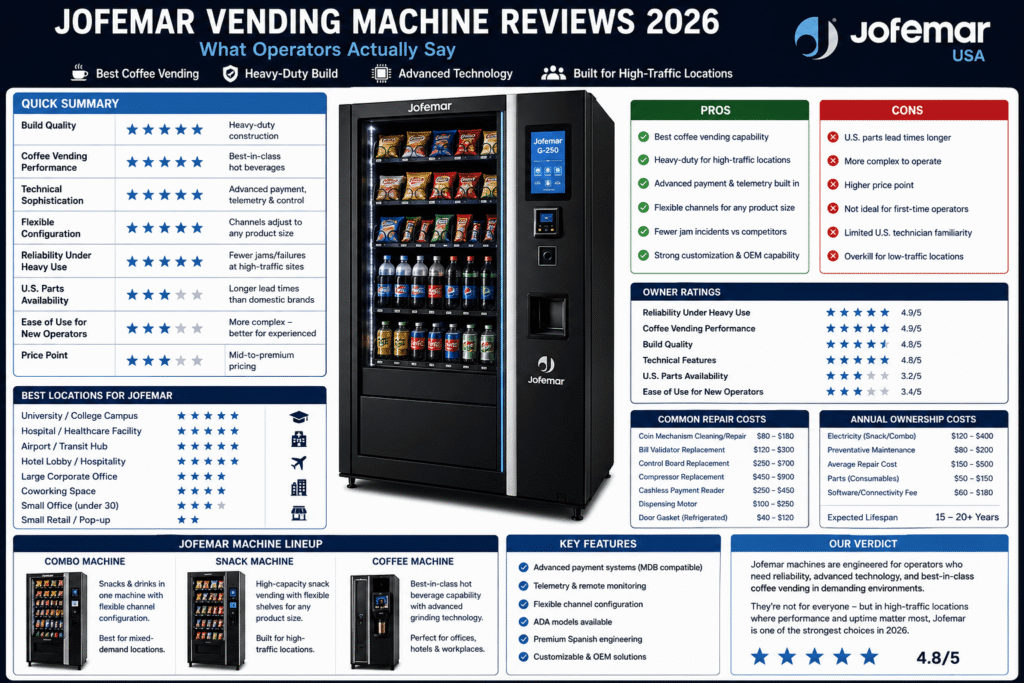
Jofemar Vending Machine Reviews: Quick Summary
| Factor | Rating | Notes |
|---|---|---|
| Build quality | ★★★★★ | Heavy-duty construction — built for high-traffic, demanding environments |
| Coffee vending performance | ★★★★★ | Best-in-class hot beverage capability in the commercial vending market |
| Technical sophistication | ★★★★★ | Advanced payment systems, telemetry, and dispensing control |
| Flexible configuration | ★★★★★ | Channels adjust to any product size — maximizes capacity per tray |
| Reliability under heavy use | ★★★★★ | Fewer jam/failure incidents at high-traffic locations vs competitors |
| U.S. parts availability | ★★★☆☆ | Spanish manufacturer — parts lead times longer than domestic brands |
| Ease of use for new operators | ★★★☆☆ | More complex than Seaga or AMS — better suited to experienced operators |
| Price point | ★★★☆☆ | Mid-to-premium pricing — reflects engineering quality |
Jofemar Vending Machines: Pros and Cons
| Pros | Cons |
|---|---|
| ✅ Best coffee vending capability in commercial vending | ❌ U.S. parts lead times longer than domestic brands |
| ✅ Heavy-duty construction for high-traffic locations | ❌ More complex to operate than Seaga or AMS |
| ✅ Advanced payment systems and telemetry built in | ❌ Higher price point than mid-market alternatives |
| ✅ Flexible channel configuration — adapts to any product size | ❌ Not the best choice for first-time operators |
| ✅ Fewer jam incidents at high-volume locations vs competitors | ❌ Limited U.S. service technician familiarity vs Crane or AP |
| ✅ Strong customization and OEM capability | ❌ Overkill for small offices or low-traffic locations |
Owner Ratings
| Category | Operator Rating | Notes |
|---|---|---|
| Reliability under heavy use | 4.9 / 5 | University operators cite fewer jam incidents vs competitor machines |
| Coffee vending performance | 4.9 / 5 | Advanced grinding technology produces consistently high-quality coffee |
| Build quality | 4.8 / 5 | Heavy-duty Spanish engineering — built to last in demanding environments |
| Technical features | 4.8 / 5 | Payment systems, telemetry, and software logic ahead of most competitors |
| U.S. parts availability | 3.2 / 5 | Spanish manufacturer — parts sourcing takes longer than domestic brands |
| Ease of use for new operators | 3.4 / 5 | Complexity suits experienced operators; steeper learning curve for beginners |
What Operators Like About Jofemar Machines
1. Best Coffee Vending in the Commercial Market
Jofemar’s coffee vending machines are consistently cited as the strongest in the commercial category. According to Jetinno’s 2026 global coffee vending supplier ranking, Jofemar uses advanced grinding technology that produces a fine, consistent coffee powder — resulting in a better-quality cup than most competing machines. The company offers flexible beverage configurations: from compact office models to large-capacity public machines, with the ability to customize the number of beverage options, coffee bean type, and machine layout to match location requirements.
The G-250 ADA floor model received significant operator praise at NAMA shows for its office coffee solution capability. One operator who installed the system noted: “The free-vend invoicing model changed how we do office coffee completely. No more managing supplies, no more waste, and the billing is accurate because the machine tracks everything. Our clients love it.”
2. Heavy-Duty Reliability at High-Traffic Locations
Jofemar machines are specifically engineered for demanding commercial environments. According to operator discussion on Quora’s vending industry forum, “a university switched to Jofemar for high-traffic campus locations and cited fewer jam/failure incidents under heavy daily vend counts” compared to the machines they had previously operated.
A route operator managing hospital placements noted: “We run Jofemar machines in three hospital locations. The uptime is noticeably better than what we had before — in a healthcare environment, a machine that’s down for two days while you wait for parts is a real problem. The reliability justifies the price.”
Another operator on a vending industry forum summarized the tradeoff clearly: “Jofemar isn’t the machine you buy for your first small office location. It’s the machine you put in the university student union or the airport terminal where it’s going to get hammered all day. That’s where the build quality pays for itself.”
3. Advanced Technical Capability
Jofemar stands apart from Seaga and AMS in its technical sophistication. According to Zhongda Smart’s 2026 vending brand comparison, “Jofemar stands out for buyers who think deeply about payment systems, telemetry, software logic, and advanced dispensing control. It has long had a technical identity that appeals to operators and procurement teams who want more than simple mechanical vending.”
For operators running connected routes who want detailed telemetry, advanced payment integration, and software-driven management, Jofemar’s platform delivers capabilities that simpler mechanical machines can’t match.
4. Flexible Channel Configuration
Jofemar machines are designed so all channels adjust to the type of packaging being offered — accommodating non-standard product sizes, fresh items, and specialty products that fixed-coil machines can’t handle. According to Jofemar’s product documentation, this flexible configuration “guarantees the optimisation of all available space” and allows a notable increase in capacity by using the entire surface area of each tray. For operators stocking premium, fresh, or non-standard products, this flexibility is a practical operational advantage.
What Operators Criticize
1. U.S. Parts Lead Times
The most consistent criticism of Jofemar in North American operator reviews is parts availability. As a Spanish manufacturer, Jofemar’s supply chain for the U.S. market involves longer lead times than domestic brands like Seaga (Freeport, IL) or AMS. One Quora contributor noted that Jofemar machines can seem “overly complicated” and noted they’re “not built for the American market” in the same way that domestically manufactured brands are. For route operators who need parts quickly to minimize downtime, this is a real operational consideration.
2. Complexity for New Operators
Jofemar’s technical sophistication is a strength for experienced operators and a challenge for beginners. The advanced payment systems, software configuration, and dispensing controls that make Jofemar machines powerful also make them more complex to set up, service, and troubleshoot than a Seaga combo machine or an AMS snack unit. New operators without prior vending experience typically find Seaga or AMS easier to start with.
3. Premium Pricing
Jofemar machines price at the mid-to-premium tier — reflecting their engineering quality and feature set. For operators who need simple snack or drink vending at a low entry cost, there are more economical options. Jofemar’s pricing makes the most sense at high-traffic locations where the machine’s reliability and technical capability generate enough revenue to justify the premium.
Jofemar Vending Machine Specifications
| Feature | Typical Jofemar |
|---|---|
| MDB compatible | ✅ Yes — supports all major cashless reader systems |
| Cashless payment ready | ✅ Yes — card, mobile wallet, contactless on current models |
| ADA models available | ✅ Yes — G-250 ADA floor model and others |
| Refrigerated models | ✅ Yes — combo and drink configurations available |
| Coffee / hot beverage machines | ✅ Yes — best-in-class hot beverage capability |
| Telemetry / remote monitoring | ✅ Available — advanced IoT and software integration |
| Flexible channel configuration | ✅ Yes — all channels adjust to product packaging size |
| Power requirements | 110–120V standard outlet (most models) |
| Warranty | Model dependent — confirm at time of purchase |
| Country of manufacture | Spain — U.S. distribution through Jofemar USA |
| Expected lifespan | 15–20+ years with routine maintenance |
Jofemar Model Reviews
Jofemar Combo Machine — Best for Mixed-Demand Locations
Jofemar’s combo units combine snacks and drinks with the flexible channel configuration the brand is known for. Strong choice for offices, retail spaces, and public facilities where product variety and user experience matter. Browse the Jofemar combo machine for current options.
Jofemar Snack Machine — Best for High-Traffic Food Locations
Purpose-built for packaged snack vending in demanding environments. The channel flexibility accommodates a wider product range than fixed-coil competitors. Browse the Jofemar snack machine for current availability.
Jofemar Coffee Machine — Best in Class for Hot Beverages
Jofemar’s flagship category. Advanced grinding technology, customizable beverage options, and office coffee solution capability make this the strongest hot beverage vending option in the commercial market. Best for offices, hotels, coworking spaces, and any professional environment where coffee quality matters to the end user.
Used vs New Jofemar Vending Machines
| Factor | Used Jofemar Machine | New Jofemar Machine |
|---|---|---|
| Purchase price | $2,000–$4,500 | $3,700–$8,000+ |
| Warranty | Limited or none | Full manufacturer warranty |
| Parts risk | Higher — confirm parts availability for specific model | Lower — current model with active support |
| Technical complexity | Same — Jofemar machines require operator familiarity regardless of age | Same |
| Best for | Experienced operators who can self-service the machine | High-traffic locations where warranty and current tech matter |
Best Locations for Jofemar Vending Machines
| Location Type | Rating | Why |
|---|---|---|
| University / college campus | ⭐⭐⭐⭐⭐ | High daily vend counts — Jofemar’s reliability under heavy use is a direct advantage |
| Hospital / healthcare facility | ⭐⭐⭐⭐⭐ | 24/7 demand, critical uptime requirement — Jofemar’s build quality suits this well |
| Airport / transit hub | ⭐⭐⭐⭐⭐ | High foot traffic, premium product expectations — coffee capability is a major asset |
| Hotel lobby / hospitality | ⭐⭐⭐⭐⭐ | 24/7 guest access, coffee and snack demand — Jofemar’s premium appearance fits |
| Large corporate office | ⭐⭐⭐⭐ | Strong fit for coffee-focused offices — slightly over-specified for small teams |
| Coworking space | ⭐⭐⭐⭐ | Coffee capability and cashless payment align well with modern coworking audiences |
| Small office (under 30 employees) | ⭐⭐⭐ | Works but engineering premium is overkill — a Seaga combo is more economical here |
| Small retail / pop-up | ⭐⭐ | Low traffic doesn’t justify Jofemar’s cost and complexity |
Not Ideal For
- Pop-up stores and temporary locations — the investment doesn’t make sense for short-term placements
- Small break rooms with under 20 employees — a simpler combo machine is more cost-effective and easier to manage
- Budget startups and first-time operators — the complexity and price point create unnecessary risk for a first machine
- Single-machine operators — Jofemar’s technical features deliver the most value across a multi-machine route where telemetry and remote management reduce labor costs at scale
- Operators without technical comfort — if troubleshooting a complex machine isn’t something you’re comfortable with, simpler alternatives are a better fit
Who Should Buy Jofemar Vending Machines?
- Experienced route operators who want technical sophistication and are comfortable managing complex machines
- High-traffic locations — universities, hospitals, large corporate campuses, transit hubs — where heavy-duty reliability under high daily vend counts is critical
- Coffee-focused placements — offices, hotels, coworking spaces where hot beverage quality drives usage and revenue
- Operators needing flexible product configurations — fresh food, specialty items, non-standard packaging that fixed-coil machines can’t handle
- Connected route operators who want advanced telemetry, payment integration, and software-driven management
Who Should NOT Buy Jofemar Vending Machines?
- First-time operators — Seaga or AMS machines are simpler to start with and have better domestic support
- Small offices or low-traffic locations — the engineering premium is overkill where a $1,500 used combo machine performs adequately
- Operators who need fast U.S. parts sourcing — domestic brands like Seaga and AMS have shorter parts lead times
- Budget-constrained buyers — Jofemar’s pricing reflects its engineering quality; more affordable options exist for basic snack and drink vending
Who Jofemar Competes With
| Brand | Primary Strength | How Jofemar Compares |
|---|---|---|
| Crane | Enterprise — widest U.S. service network | Jofemar matches on build quality; Crane wins on domestic parts support |
| AMS | Snack vending, Sensit® delivery guarantee | Jofemar stronger on coffee and technical features; AMS stronger on snack depth |
| Seaga | Budget combo machines for beginners | Jofemar is significantly more capable and more expensive — different market |
| AP | Heavy-duty snack, high-volume routes | Comparable heavy-duty build; AP has stronger domestic parts advantage |
| Wittern | Premium combo, large offices | Similar premium tier; Wittern is domestic, Jofemar wins on coffee and telemetry |
| Dixie Narco | Cold drink vending | Dixie Narco stronger on dedicated cold beverage; Jofemar stronger on coffee |
| Royal Vendors | Beverage-heavy locations | Royal Vendors more economical for drink-only; Jofemar adds coffee and smart tech |
| Jofemar | Coffee + smart technology, high-traffic reliability | Best choice when technical sophistication and coffee quality are priorities |
Jofemar vs Other Brands
| Brand | Best For | vs Jofemar |
|---|---|---|
| Seaga | Beginners, small offices, combo machines | Simpler, cheaper, better U.S. parts support |
| AMS | Snack routes, healthy vending | Better snack focus; Sensit® delivery; domestic parts |
| AP | Heavy-duty snack vending | Comparable heavy-duty build; domestic parts advantage |
| Dixie Narco | Cold drink vending | Stronger dedicated beverage performance |
| Wittern | Large offices, enterprise | Similar premium tier; domestic manufacturer |
Common Jofemar Vending Machine Repair Costs
| Repair | Typical Cost | Notes |
|---|---|---|
| Coin mechanism cleaning/repair | $80–$180 | Most common routine issue — often preventable with regular cleaning |
| Bill validator replacement | $120–$300 | Transport roller wear is the primary cause — cleaning cards extend life |
| Control board replacement | $250–$700 | Less common but higher cost — confirm parts availability before purchasing used |
| Compressor replacement | $450–$900 | Refrigerated units only — most expensive single repair on older machines |
| Cashless payment reader | $250–$450 | Retrofit or replacement — MDB compatible on current Jofemar models |
| Dispensing motor | $100–$250 | Wear on high-volume machines after several years of heavy use |
| Door gasket (refrigerated) | $40–$120 | Routine replacement — affects cooling efficiency when worn |
Note: Parts sourcing from Spain adds 1–2 weeks to lead times compared to domestic manufacturers — factor this into downtime planning for critical locations.
Jofemar Vending Machine Maintenance Schedule
| Interval | Task | Why It Matters |
|---|---|---|
| Every restock visit | Clean coin acceptor and check bill validator | Prevents the most common cause of customer complaints — rejected payment |
| Weekly | Run validator cleaning card through bill acceptor | Removes dust and debris from transport rollers before buildup causes jams |
| Monthly | Inspect cooling unit and check temperature readings | Catches refrigeration issues before product spoilage or compressor damage |
| Monthly | Check coffee grinder and clean brewing components | Essential on coffee models — coffee residue buildup affects taste and performance |
| Quarterly | Clean condenser coils on refrigerated units | Dirty condensers reduce cooling efficiency and increase compressor wear |
| Quarterly | Test all dispensing channels and check spiral alignment | Identifies worn motors or misaligned coils before they cause stuck product incidents |
| Annually | Inspect and replace door gaskets if worn | Worn gaskets reduce cooling efficiency on refrigerated units |
| Annually | Update payment software and cashless reader firmware | Keeps payment systems compliant and compatible with current card networks |
Annual Ownership Costs
| Cost Category | Typical Annual Cost | Notes |
|---|---|---|
| Electricity — snack/combo | $120–$400 | Refrigerated combo units run higher; snack-only lower |
| Preventative maintenance | $80–$200 | Cleaning, inspection, validator cards — reduces major repair frequency |
| Average repair cost | $150–$500 | Lower on newer machines; higher on used units in first year |
| Parts (consumables) | $50–$150 | Gaskets, cleaning cards, small components |
| Software/connectivity fee | $60–$180 | For telemetry and remote management — varies by system |
| Expected machine lifespan | 15–20+ years | With routine maintenance — cabinet outlasts multiple payment system generations |
How Long Do Jofemar Vending Machines Last?
With routine maintenance, Jofemar machines commonly remain in commercial service for 15–20 years or longer. The heavy-duty Spanish engineering that makes them well-suited to demanding locations also contributes to long cabinet life — most operators report replacing payment technology (validators, cashless readers, control boards) before replacing the machine itself. The compressor on refrigerated units is the component most likely to determine practical end of life, typically after 10–15 years of continuous operation.
For operators buying used Jofemar machines, confirm the control board model and parts availability before purchasing — on machines older than 10 years, some specific control board configurations may have limited parts supply through U.S. channels.
Typical ROI for a Jofemar Coffee Machine
ROI on a Jofemar coffee machine depends heavily on location, pricing, and daily transaction volume — there’s no universal figure that applies across all placements. What follows is an illustrative example based on a busy office environment, not a guarantee of results.
A Jofemar coffee machine in a corporate office with 80–100 employees, priced at $2.00–$2.50 per hot beverage, generating 40–60 coffee transactions per day:
- Daily gross revenue: $80–$150
- Monthly gross revenue: $1,600–$3,000 (based on 20 working days)
- Monthly product/ingredient cost (at ~35% of revenue): $560–$1,050
- Monthly electricity + maintenance budget: $30–$60
- Estimated monthly net: $990–$1,890
At this performance level, a $5,000–$6,000 new Jofemar coffee machine investment could realistically pay back within 4–8 months at a strong location. A lower-traffic location generating 15–20 transactions per day produces proportionally lower returns and a longer payback period.
The key variables that most affect ROI are daily transaction volume (driven primarily by location foot traffic), pricing per cup, and ingredient cost management. Operators who track sales data through Jofemar’s telemetry platform can optimize all three over time.
Our Verdict
Jofemar vending machines are not for everyone — and that’s not a criticism. They’re purpose-built for operators who need heavy-duty reliability, advanced technical capability, and best-in-class coffee vending in demanding commercial environments. A university campus, a hospital, a large hotel, or a high-traffic corporate campus is exactly where a Jofemar machine earns its price premium.
For first-time operators, small offices, or budget-conscious buyers, Seaga and AMS offer simpler, cheaper, and better-supported options for standard snack and drink vending. But for the operator who has outgrown basic machines and needs equipment that can handle real volume with technical sophistication, Jofemar is one of the strongest choices in the 2026 commercial vending market.
Where Jofemar Falls Behind
A balanced review needs to be direct about where Jofemar underperforms relative to alternatives — not just where it excels.
- U.S. parts availability is a genuine operational risk. When a Seaga or AMS machine needs a part, an operator in the U.S. typically gets it within a few days. When a Jofemar machine needs a less common component, the timeline extends. For operators running critical locations where a machine down for 10 days is a real revenue and relationship problem, this is a meaningful consideration — not a reason to avoid Jofemar, but something to plan for by keeping a small stock of common consumables on hand.
- The learning curve is real. Jofemar’s advanced software and configuration options are strengths — but they take time to learn. New operators who haven’t run a route before will find Seaga’s simplicity more forgiving. Jofemar rewards operators who invest time in understanding the platform; it punishes those who don’t.
- Service technician familiarity in the U.S. is limited. Crane, AP, and Seaga machines are what most U.S. vending technicians see daily. Jofemar is less common, which means finding a local technician familiar with the specific machine can take more effort than with domestic brands.
- Not the right machine for simple snack or drink vending. If the placement just needs a reliable snack machine or a cold drink unit, Jofemar’s technical sophistication adds cost and complexity without adding meaningful value. Match the machine to the need.
Related Guides
- AMS vs Seaga Vending Machines — comparison of two popular alternatives
- Best Vending Machine for Small Business — which machine type fits your location
- How to Buy a Used Vending Machine — inspection checklist before purchasing
- Snack vs Combo Vending Machine — choosing the right configuration
Frequently Asked Questions
Are Jofemar vending machines good?
Yes — for the right operator and location. Jofemar machines are consistently well-reviewed for build quality, coffee vending performance, and reliability under heavy use. They’re best suited to experienced operators at high-traffic locations. For first-time operators or small offices, simpler and cheaper alternatives like Seaga are better starting points.
Where are Jofemar vending machines made?
Jofemar machines are manufactured in Spain. The company is one of the world’s leading vending machine and payment systems manufacturers, with a U.S. operation through Jofemar USA. Parts sourcing in the U.S. takes longer than for domestic manufacturers — a consideration for operators who need fast turnaround on repairs.
What is Jofemar best known for?
Jofemar is best known for coffee vending machines, advanced payment systems, telemetry, and flexible product configuration. Their hot beverage capability is considered best-in-class in the commercial vending market, and their technical sophistication appeals to operators who want more than basic mechanical vending.
How much do Jofemar vending machines cost?
Used Jofemar machines typically run $2,000–$4,500. New machines range from $3,700 to $8,000+ depending on model and configuration. Coffee machines and specialty units price toward the higher end of this range.
Are Jofemar vending machines good for beginners?
Not ideally — Jofemar’s technical complexity makes them better suited to experienced operators. First-time buyers are typically better served by a Seaga combo machine or AMS snack machine, which are simpler to operate and maintain and have stronger domestic parts support networks.
What is the most profitable vending machine?
Coffee machines generate the highest gross margin per transaction at 60–80% — and Jofemar’s hot beverage machines are among the most capable coffee vending units in the commercial market. At high-traffic locations (hospitals, corporate offices, universities) where workers buy coffee daily, a well-placed Jofemar coffee machine can generate $300–$800+/month net — significantly above the average snack or combo machine. For total monthly net income across most locations, snack and combo machines at high-traffic commercial placements are the most consistent performers.
What is the most profitable type of vending machine?
Coffee and hot beverage machines have the highest gross margin per transaction at 60–80%. In the Jofemar lineup specifically, the Vision ES Plus coffee machine is considered best-in-class for office and institutional coffee vending at this margin level. For operators who want the highest-margin machine at a confirmed high-traffic location, a Jofemar coffee machine is among the strongest investments in commercial vending. For most first-time operators at standard locations, a snack or combo machine generates more reliable total net income at lower complexity and cost.
What is a disadvantage of owning a Jofemar vending machine?
The main disadvantages are: U.S. parts availability requires ordering through Jofemar USA with lead times of 1–2 weeks or longer — meaning machines can be out of service longer than domestic brands during repairs; technical complexity requires more experienced service technicians; premium pricing ($3,700–$8,000+ new) increases the payback period vs Seaga or AMS; and the Spanish manufacturing origin means fewer local technicians are familiar with the platform compared to Crane, AP, or AMS. Jofemar is the right choice for experienced operators at high-traffic locations where the coffee and product capabilities justify the complexity.
Are AMS vending machines good?
Yes — AMS machines are widely regarded as among the best commercial snack vending machines available. The Sensit® delivery guarantee system eliminates the most common customer complaint in snack vending. AMS machines are particularly strong for healthy vending, school placements, and healthcare locations. Compared to Jofemar, AMS machines have stronger U.S. parts availability and simpler maintenance — making them the better choice for operators who prioritize ease of service over advanced coffee or product configuration capabilities.
What sells the most in a vending machine?
In standard commercial snack machines, name-brand chips, candy bars, and crackers consistently lead by volume. In Jofemar coffee machines, espresso-based drinks and cappuccino lead by transaction count at office and healthcare locations. In Jofemar combo machines, cold drinks (water, cola) and snacks (chips, candy) lead. At premium locations where Jofemar machines are typically deployed, higher-priced items — specialty coffees, premium snacks, healthier options — sell significantly better than at budget vending locations, because the customer base is less price-sensitive.
What is the lifespan of a Jofemar vending machine?
Well-maintained Jofemar machines typically last 15–20+ years in commercial service. Spanish-manufactured Jofemar machines are built to heavy-duty commercial standards — the chassis, refrigeration systems, and dispensing mechanisms are designed for high-volume 24-hour operation. The primary maintenance factor that determines lifespan is parts availability: operators who maintain a small stock of common wear parts (dispensing motors, payment system components) experience significantly fewer extended downtime periods than those who rely entirely on reactive ordering through Jofemar USA.
How much can 10 Jofemar vending machines make?
Ten Jofemar machines at good commercial locations — offices, healthcare facilities, corporate campuses — can generate $2,000–$6,000+/month net depending on machine type and location quality. Coffee machines at premium locations at the high end; combo and snack machines at standard commercial locations at the lower end. The higher per-machine net income potential of Jofemar coffee machines means a 10-machine Jofemar coffee route at strong locations can outperform a 10-machine snack route significantly — but requires the right locations and experienced management to achieve.
What are the most reliable vending machines?
In the U.S. market, AP (Automatic Products) and Wittern snack machines are the most consistently cited for long-term mechanical reliability. Dixie Narco and Royal Vendors lead for cold drink reliability. For coffee vending specifically, Jofemar machines are considered among the most reliable globally — their European commercial build standards are designed for continuous heavy use. The trade-off is that Jofemar’s reliability depends more on having experienced technicians available, while AP, Wittern, and Dixie Narco have broader U.S. service networks that make field repairs faster and less specialized.
Are vending machines a good investment in 2026?
Yes — Jofemar machines in particular represent a strong investment at the right locations. A Jofemar coffee machine at a 100+ person corporate office or hospital generating $400–$600/month net on a $5,000–$7,000 machine cost delivers a 10–15 month payback at premium placements. The higher upfront cost is justified when the location and product type support the revenue potential. For operators without confirmed high-traffic locations, starting with a lower-cost Seaga or AMS machine reduces risk while the route is being established.
Ready to buy a Jofemar vending machine? Browse our Jofemar vending machines for sale to compare current models and pricing — or contact MapleVend to discuss which model fits your location and experience level.
