
The AMS vs Seaga vending machines comparison requires one important clarification upfront: AMS (Automated Merchandising Systems) was acquired by Seaga Manufacturing in 2022. They are now the same company. AMS machines continue to be sold and serviced under the AMS brand name, with the same models and parts networks — but AMS is now a product line within Seaga, not a separate competitor. Understanding this matters before you decide which machines to buy.
This guide covers what AMS and Seaga machines are each known for, how they compare on the factors that matter most to commercial operators, and which specific models to consider for different location types. Browse our AMS vending machines and Seaga vending machines to compare current inventory.
Key Takeaways
- ✅ AMS was acquired by Seaga in 2022 — they are now the same company
- ✅ AMS machines are known for snack vending, healthy options, and the patented Sensit® delivery system
- ✅ Seaga machines are known for affordability, combo units, and strong beginner-friendly options
- ✅ Both brands have strong parts availability and service networks in the U.S.
- ✅ AMS is the stronger choice for snack-focused or healthy vending locations
- ✅ Seaga is the stronger choice for budget-conscious first-time operators
AMS vs Seaga Vending Machines: Quick Comparison
| Factor | AMS Machines | Seaga Machines |
|---|---|---|
| Parent company | Seaga Manufacturing (since 2022 acquisition) | Seaga Manufacturing (founded 1985) |
| Primary strength | Snack vending, healthy food options, fresh food | Combo machines, budget-friendly entry-level options |
| Key technology | Sensit® guaranteed delivery system | Broad product range, multiple form factors |
| Price range (new) | $3,800–$8,500 | $2,500–$6,000 |
| Best for | Offices, schools, healthy vending, high-capacity snack locations | First-time operators, small offices, budget-conscious buyers |
| Parts availability | Strong — active U.S. service network | Strong — same parent company, shared network |
| Cashless payment | Available on current models | Available on current models |
| Used market | $1,500–$3,500 | $1,200–$3,000 |
About AMS Vending Machines
AMS (Automated Merchandising Systems) was founded in 1997 and built a strong reputation in snack and fresh food vending across North American commercial markets. The brand’s most distinctive feature is the patented Sensit® guaranteed delivery system — a sensor that confirms each product has been delivered to the customer before the transaction completes. This reduces refund requests, builds customer trust, and keeps operators from getting complaints about stuck products.
AMS machines are particularly well-regarded for:
- Snack vending with high selection counts — the AMS 39 and AMS 35 models are widely used across offices, schools, and industrial environments for their capacity and reliability
- Healthy and fresh food vending — AMS machines were among the first to be specifically designed for healthier product options, with refrigerated sections capable of handling fresh items alongside packaged goods
- Durability in demanding environments — the machines are built for heavy daily use in offices, schools, and industrial settings
Since the 2022 Seaga acquisition, AMS machines continue to be sold and serviced under the AMS name, with the same model lineup and parts network. Operators who already own AMS machines don’t need to worry about parts availability disappearing — Seaga has maintained and supported the line.
About Seaga Vending Machines
Seaga Manufacturing was founded in 1985 in Illinois and has grown into one of the broadest vending machine product lines in the U.S. market, covering snack machines, beverage machines, combo units, healthy vending, industrial inventory dispensers, and medical dispensers. The brand is particularly well-known for offering accessible price points that make commercial vending achievable for first-time operators and small businesses.
Seaga machines are particularly well-regarded for:
- Combo machines for small locations — Seaga’s combo units are consistently cited as a strong starting point for operators who want to cover both snacks and drinks in one machine without a large upfront investment
- Budget-friendly entry points — Seaga offers some of the most accessible new machine pricing in the commercial vending market, making it the most common recommendation for first-time operators starting with limited capital
- Broad product range — the lineup covers more categories than most manufacturers, from standard snack and drink to specialty configurations
AMS vs Seaga Vending Machines: Which Is Better for Your Location?
| Your Situation | Better Choice | Why |
|---|---|---|
| First machine, limited budget | Seaga | Lower entry price, accessible combo options |
| High-capacity snack vending location | AMS | Higher selection count, Sensit® delivery guarantee |
| Healthy or fresh food vending | AMS | Designed specifically for healthy and fresh food categories |
| Small office under 30 employees | Seaga combo | Cost-effective, covers both snacks and drinks in one unit |
| School or university | AMS | High capacity, USDA Smart Snacks compliant configurations available |
| Warehouse or industrial facility | Either — AMS for snack depth, Seaga for combo | Both perform well in industrial environments |
| Buying used to minimize risk | Either | Both have strong parts availability — inspect condition first |
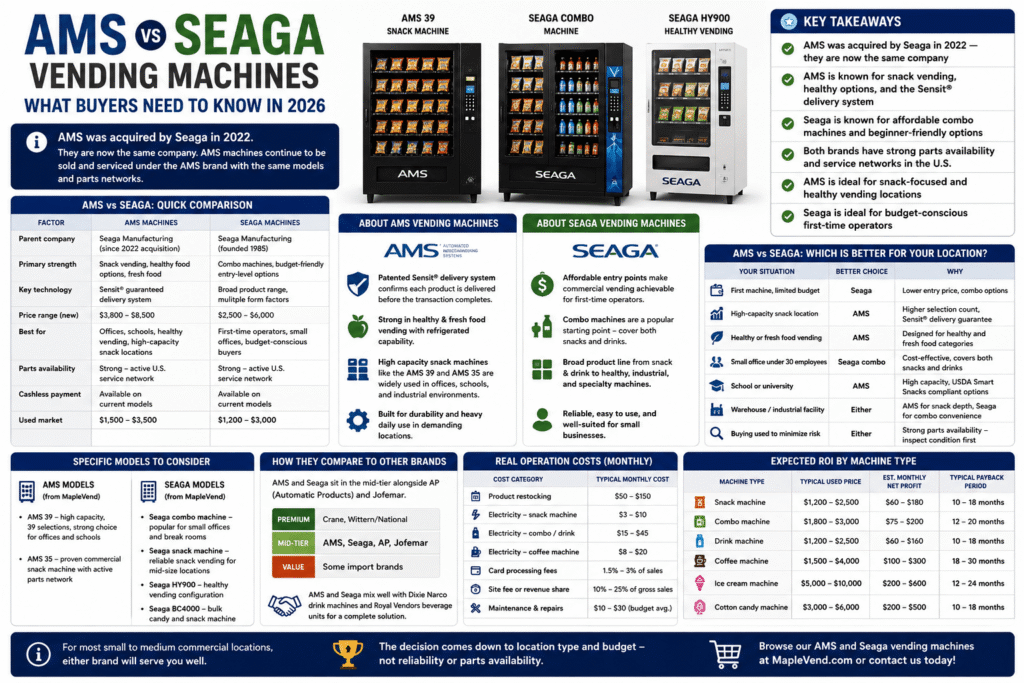
Specific Models to Consider
AMS models available from MapleVend:
- AMS 39 — high capacity, 39 selections, strong choice for offices and schools
- AMS 35 — proven commercial snack machine with active parts network
Seaga models available from MapleVend:
- Seaga combo machine — popular for small offices and break rooms
- Seaga snack machine — reliable snack vending for mid-size commercial locations
- Seaga HY900 — healthy vending configuration
- Seaga BC4000 — bulk candy and snack machine
How They Compare to Other Brands
Within the broader commercial vending market, AMS and Seaga sit in the mid-tier alongside AP (Automatic Products) and Jofemar. According to VendPlacer’s 2026 brand comparison, Crane and Wittern/National dominate the premium tier with the widest nationwide parts and service networks, while AMS and Seaga are strong mid-market choices that offer better value for operators who don’t need the top-tier service infrastructure.
For operators building a route across multiple brands, AMS and Seaga machines mix well with Dixie Narco drink machines and Royal Vendors beverage units — pairing an AMS or Seaga snack machine with a Dixie Narco drink machine is a common and reliable combination for offices and warehouses.
Parts and Service: Does the 2022 Acquisition Matter?
For operators who already own AMS machines, the short answer is: no, not in a negative way. Seaga has maintained the AMS parts network and continues to support existing machines. The acquisition consolidated two brands under one roof, which has generally improved the supply chain for AMS parts rather than disrupting it.
For buyers choosing between new AMS and new Seaga machines today, both draw from the same service infrastructure — meaning parts availability and technical support are comparable across both lines.
Bottom Line
AMS and Seaga are now the same company, which makes the AMS vs Seaga vending machines comparison less a competition and more a product line comparison within a single manufacturer. AMS machines are the stronger choice for snack-focused or healthy vending locations where capacity, delivery reliability, and fresh food capability matter. Seaga machines are the stronger choice for first-time operators and small locations where budget and combo convenience are the primary drivers.
For most small to medium commercial locations, either brand will serve you well. The decision between them comes down to location type and budget — not reliability or parts availability, where both are now on equal footing.
Common Mistakes Buyers Make
- Assuming AMS and Seaga are still separate competitors. Since the 2022 acquisition, buying AMS and buying Seaga means buying from the same manufacturer. The choice between them is a product line decision, not a vendor selection.
- Choosing based on brand name alone. Both brands make multiple machine types at different price points. “I want an AMS machine” is not specific enough — confirm which model, what selection count, and whether it has cashless capability.
- Ignoring the used market. AMS and Seaga both have strong used machine availability at 40–60% less than new. With active parts networks, a well-inspected used AMS or Seaga machine is often the best value in the commercial snack vending category.
Related Guides
- New vs Used Vending Machine — whether to buy new or used
- How to Buy a Used Vending Machine — inspection checklist and red flags
- Best Vending Machine for Small Business — which machine type fits your location
- Snack vs Combo Vending Machine — choosing the right configuration
Frequently Asked Questions
Are AMS and Seaga the same company?
Yes — Seaga Manufacturing acquired AMS (Automated Merchandising Systems) in 2022. AMS continues to operate under its own brand name with the same model lineup, but it is now a product line within Seaga rather than a separate company.
Which is better — AMS or Seaga vending machines?
For snack-focused and healthy vending locations, AMS machines — particularly the AMS 39 and AMS 35 — are the stronger choice due to higher capacity and the Sensit® guaranteed delivery system. For first-time operators and small offices on a tighter budget, Seaga’s combo machines offer a more accessible entry point.
Are AMS vending machines still supported after the Seaga acquisition?
Yes — Seaga has maintained the AMS parts network and technical support since the 2022 acquisition. Operators with existing AMS machines can continue sourcing parts through the same channels.
What is the AMS Sensit® system?
Sensit® is AMS’s patented delivery guarantee system — a sensor that confirms each product has actually been delivered to the customer before the transaction completes. It reduces stuck product incidents and refund requests, which is one of AMS’s key differentiators in the commercial snack vending market.
What is a good AMS vending machine for a small office?
The AMS 35 is a reliable, widely-serviced used machine that works well in small to medium offices. For a first machine at a lower budget, a used Seaga combo machine may be more cost-effective — covering both snacks and drinks in one unit without the higher price of an AMS snack machine plus a separate drink machine.
What is the best vending machine brand?
The best vending machine brand depends on your use case. For snack vending with a delivery guarantee: AMS. For budget-friendly new machines made in the USA: Seaga. For the most durable used snack cabinet: AP (Automatic Products). For enterprise fleet management: Crane. For cold drink vending: Dixie Narco or Royal Vendors. For long-term reliability with the widest U.S. service network: Wittern. There is no single best brand — the right choice depends on machine type, location, budget, and whether you’re buying new or used.
Are AMS vending machines good?
Yes — AMS machines are widely regarded as among the best commercial snack vending machines available. The Sensit® delivery guarantee system is unique to AMS and eliminates the most common customer complaint in snack vending. AMS machines are particularly strong for healthy vending, school placements, and healthcare locations where product reliability and USDA Smart Snacks compliance are priorities. Parts availability is excellent following the Seaga acquisition.
Who makes Seaga vending machines?
Seaga Manufacturing Inc. makes Seaga vending machines. Seaga is a U.S.-based manufacturer headquartered in Freeport, Illinois — one of the few major commercial vending machine brands still manufactured in the United States. Since acquiring AMS (Automated Merchandising Systems) in 2022, Seaga now also manufactures the AMS product line.
Where are AMS vending machines made?
AMS (Automated Merchandising Systems) machines were originally manufactured in Kearneysville, West Virginia. Following Seaga’s acquisition of AMS in 2022, production has been consolidated under Seaga’s U.S. manufacturing operations. Both AMS and Seaga machines are manufactured in the United States — a distinction that matters to buyers who prioritize domestic manufacturing and local parts supply chains.
Where are Seaga vending machines made?
Seaga vending machines are manufactured in Freeport, Illinois, USA. Seaga is one of the only major commercial vending machine brands that manufactures its products entirely in the United States. This gives Seaga machines a domestic parts supply advantage and supports faster repair turnaround times compared to brands that source components internationally.
How much are AMS vending machines?
New AMS snack machines cost $3,800–$5,500 depending on model and configuration. New AMS combo machines cost $4,500–$6,500. Used and refurbished AMS machines cost $1,500–$3,000 for snack units and $2,000–$4,000 for combo units. AMS machines command a slight premium over Seaga in the used market due to the Sensit® delivery system and strong operator demand.
How much does a Seaga vending machine cost?
New Seaga snack machines cost $3,500–$5,000. New Seaga combo machines cost $3,800–$5,500. Used Seaga machines cost $1,200–$2,500 depending on model and condition. Seaga is typically the most affordable new commercial vending machine option in the U.S. market — making it a strong choice for first-time operators who want a new machine with full warranty at a lower entry price than AMS, Crane, or Wittern.
Who is the biggest vending machine manufacturer?
Crane Convenience (formerly Crane Merchandising Systems) is widely considered the largest vending machine manufacturer in the U.S. market by revenue and installed fleet size — Crane also owns the AP and Dixie Narco brands. Globally, Japanese manufacturers including Fuji Electric and Sanden dominate by unit volume. In the U.S. commercial snack and combo machine segment, AMS (now owned by Seaga), Wittern, and Crane are the leading manufacturers.
What are the most reliable vending machines?
The most consistently cited reliable commercial vending machine brands in the U.S. are AP (Automatic Products) for snack machines, Wittern for snack and combo machines, and Dixie Narco for cold drink machines — all known for 15–25 year commercial lifespans with proper maintenance. AMS machines with the Sensit® delivery system are the most reliable for product delivery specifically. Crane National machines are the most reliable for enterprise fleet deployments with IoT management.
Are vending machines still profitable in 2026?
Yes — both AMS and Seaga machines generate strong returns at well-chosen locations. AMS machines tend to outperform at health-focused and institutional locations where the Sensit® delivery system and USDA compliance capabilities command premium product pricing. Seaga combo machines perform well at first placements and small-to-medium offices where the lower machine cost shortens the payback period. Both brands are profitable when placed at locations with sufficient foot traffic and cashless payment enabled.
Ready to choose between AMS and Seaga? Browse our AMS vending machines for sale and Seaga vending machines for sale — or contact MapleVend to discuss which model fits your location and budget.
