
A vending machine route for sale gives you something that buying individual machines never can: an existing business with proven revenue, established locations, and a working operation you can step into from day one. Instead of spending months finding locations, negotiating placement agreements, and waiting for machines to generate data, buying a route means the legwork is already done. But routes are also where many buyers overpay — for inflated revenue numbers, machines on their last legs, and locations that are about to lose their contracts.
This guide covers how to find a vending machine route for sale, how to value it accurately, what due diligence to run before buying, and the red flags that should make you walk away. Browse our used vending machines for sale and commercial vending machines if you’re building or expanding a route rather than buying an existing one.
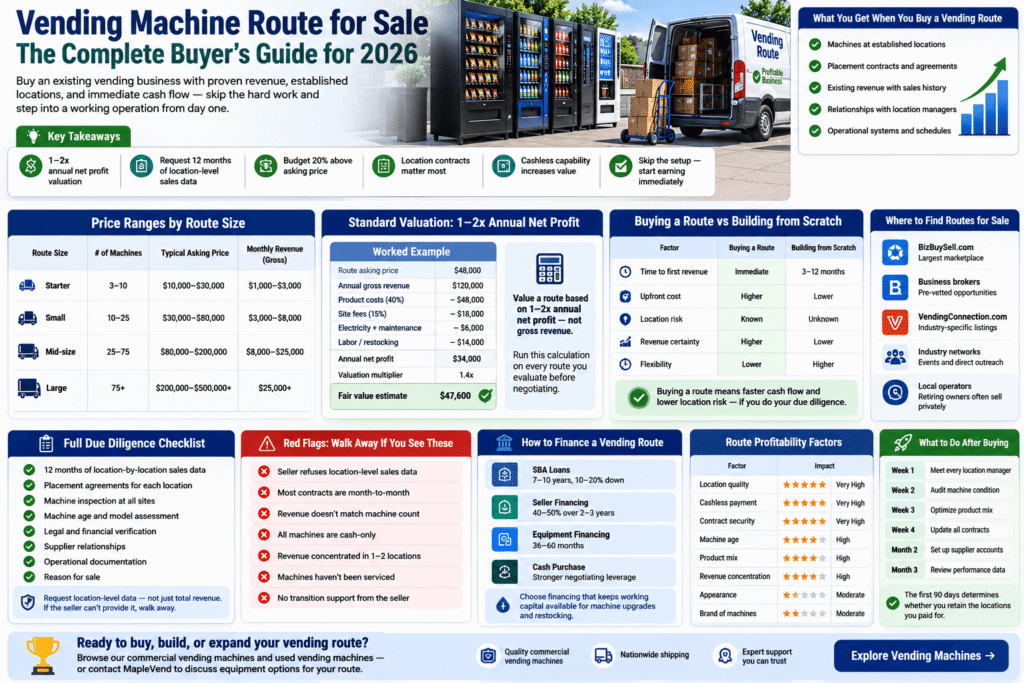
Key Takeaways
- ✅ A vending machine route for sale includes machines, locations, placement contracts, and existing revenue
- ✅ Standard valuation is 1–2x annual net profit — not gross revenue
- ✅ Always request 12 months of location-by-location sales data before agreeing on a price
- ✅ Budget 20% above the asking price for immediate repairs and upgrades
- ✅ Location contract security is the single most important variable in route valuation
- ✅ Machine age and cashless capability significantly affect the route’s real value
What Is a Vending Machine Route for Sale?
A vending machine route is a collection of machines managed by a single operator across multiple locations — offices, schools, warehouses, gyms, hospitals, and similar commercial environments. When a route is for sale, the buyer acquires:
- The machines themselves — physical equipment at each location
- The placement contracts or agreements — the arrangements with each location owner that allow the machines to stay
- The existing revenue — the route’s documented income history
- The established relationships — with location managers, restocking suppliers, and service technicians
- The operational systems — restocking schedules, service routes, pricing structures
According to Start a Vending Machine Business’s April 2026 route buying guide, the key advantage of buying an existing vending machine route for sale is skipping the most time-consuming phase of building a route from scratch: finding locations, negotiating agreements, and waiting months for revenue to develop. A well-documented route with real sales data lets you see exactly what you’re buying before you commit.
Vending Machine Route for Sale: Price Ranges
| Route Size | Number of Machines | Typical Asking Price | Monthly Revenue Range |
|---|---|---|---|
| Starter route | 3–10 machines | $10,000–$30,000 | $1,000–$3,000/month gross |
| Small route | 10–25 machines | $30,000–$80,000 | $3,000–$8,000/month gross |
| Mid-size route | 25–75 machines | $80,000–$200,000 | $8,000–$25,000/month gross |
| Large route | 75+ machines | $200,000–$500,000+ | $25,000+/month gross |
How to Value a Vending Machine Route for Sale
The standard valuation method for a vending machine route for sale is 1–2x annual net profit — not gross revenue. This is the critical distinction most buyers miss. A route grossing $10,000/month may net $2,000–$3,000/month after product costs, site fees, electricity, maintenance, and labor. At 1.5x annual net profit, that route is worth $36,000–$54,000 — not $120,000–$180,000 based on gross revenue.
According to VendSoft’s June 2026 route buying guide, routes price toward the high end of the 1–2x range when location contracts are long-term and secure, machines are modern with cashless capability, and the route has documented growth. Routes price toward the low end when contracts are month-to-month, machines are aging, or the seller can’t verify reported revenue with actual sales data.
The Single Most Important Due Diligence Step
Always request 12 months of location-by-location sales data before agreeing on any price. Not total route revenue — location-by-location. You need to see which specific placements are generating strong sales and which are underperforming, because a route’s value is not evenly distributed. A 20-machine route where 5 locations generate 80% of the revenue is very different from one where revenue is spread consistently across all 20 — and the risk profile is completely different.
If a seller hesitates to provide location-level sales data, walk away. A legitimate operator with a healthy route can produce this data. Reluctance to share it is the clearest signal that the numbers don’t hold up under scrutiny.
Full Due Diligence Checklist
- ☐ 12 months of location-by-location sales data — verified against actual cash collected, not just reported figures
- ☐ Placement agreements for each location — confirm remaining term, renewal terms, and exit provisions. Month-to-month agreements have no security; multi-year contracts are significantly more valuable
- ☐ Machine inspection at each location — confirm working condition, compressor health on refrigerated units, bill validator and coin mechanism function, and cashless payment capability
- ☐ Machine age and model assessment — confirm parts are still available for the specific models included in the route
- ☐ Legal and financial verification — business licenses, sales tax permits, any liens, lawsuits, or back taxes associated with the business
- ☐ Supplier relationships — confirm product supplier accounts can transfer to the new owner or are easily replaceable
- ☐ Operational documentation — restocking schedules, service records, location contact information
- ☐ Reason for sale — retirement, relocation, and health reasons are legitimate; “not enough time” and “moving to better opportunities” can mask route problems
Red Flags: Walk Away If You See These
- 🚩 Seller refuses to provide location-level sales data — the single biggest red flag in any route transaction
- 🚩 Most contracts are month-to-month — you could lose locations immediately after purchase
- 🚩 Revenue figures don’t match machine age and location count — inflated revenue is common in route listings
- 🚩 Machines are all cash-only with no MDB compatibility — significant capital needed for cashless retrofits on top of purchase price
- 🚩 Route is heavily concentrated in one or two locations — losing those accounts destroys the route’s value
- 🚩 Machines haven’t been serviced recently — indicates poor maintenance and likely upcoming repair costs
- 🚩 Seller is unwilling to do a transition period — introducing a new operator to location managers reduces churn; sellers who won’t help with this transition are a concern
Where to Find a Vending Machine Route for Sale
- BizBuySell.com — the largest business-for-sale marketplace in the U.S., with thousands of vending route listings at any time
- Business brokers — vending-specific brokers and general business brokers often have pre-vetted routes not listed publicly
- VendingConnection.com — industry-specific marketplace with route listings and machine sales
- Local vending industry networks — attending industry events and building relationships with existing operators often surfaces routes before they’re publicly listed
- Direct outreach to operators — contacting established local route operators directly about potential interest in selling is a legitimate approach, particularly for acquiring a retiring operator’s route
Budget Planning: The 20% Rule
Add 20% to the asking price when building your acquisition budget — regardless of how new the machines appear or how healthy the seller claims the route is. This buffer covers:
- Immediate machine repairs that surface after purchase
- Cashless payment upgrades on machines without readers ($150–$500 per machine)
- Initial restocking capital for locations you inherit
- Professional and legal fees for the transaction
- Working capital for the first 60–90 days while you learn the route
A $30,000 route should be budgeted at $36,000–$40,000 all-in. Buyers who allocate only the purchase price often find themselves capital-constrained in the first month of operation.
Buying a Route vs Building from Scratch
| Factor | Buying a Route | Building from Scratch |
|---|---|---|
| Time to first revenue | Immediate | 3–12 months |
| Upfront cost | Higher (route premium) | Lower (machine purchase only) |
| Location risk | Known — based on history | Unknown — unproven locations |
| Machine condition | Variable — inspect before buying | Controllable — you choose |
| Revenue certainty | Higher — if data is verified | Lower — builds over time |
| Flexibility | Lower — inherit existing setup | Higher — design from scratch |
Vending Machine Route Valuation: A Worked Example
Here’s how the 1–2x net profit valuation works in practice:
| Item | Amount |
|---|---|
| Route asking price | $48,000 |
| Annual gross revenue | $120,000 |
| Annual product costs (40%) | $48,000 |
| Annual site fees (15%) | $18,000 |
| Annual electricity + maintenance | $6,000 |
| Annual labor / restocking | $14,000 |
| Annual net profit | $34,000 |
| Valuation multiplier | 1.4x net profit |
| Fair value estimate | $47,600 |
In this example, the asking price of $48,000 is closely aligned with fair value at 1.4x net profit — a reasonable deal if location contracts are secure and machines are in good condition. If the seller is asking $65,000 for the same route, the buyer is paying nearly 2x net profit, which is only justified if contracts are long-term and the route shows documented growth. Run this calculation on every route you evaluate before negotiating.
Revenue Concentration Risk
One of the most overlooked factors in route valuation is revenue concentration — how evenly income is distributed across locations. A 20-machine route where 5 locations generate 80% of revenue is fundamentally different from one where revenue is spread across all 20, even if the total numbers look identical.
If one location generates 55% of a route’s income, losing that account after purchase can cut profits in half overnight. Location contracts end. Property managers change. Buildings get sold or repurposed. These are real risks that the route’s historical revenue doesn’t protect you from — what protects you is reviewing each contract’s remaining term before you buy.
When reviewing location-level sales data, specifically flag any location that generates more than 20–25% of total route revenue. Confirm the contract term on that location, the renewal terms, and any history of renewal discussions. If the top location is on a month-to-month arrangement, that risk needs to be reflected in the price you offer.
How to Finance a Vending Machine Route for Sale
Most buyers don’t pay cash for a vending route — here are the main financing options available in 2026:
SBA Loans
The U.S. Small Business Administration’s 7(a) loan program can finance established vending route acquisitions. Routes qualify as small business purchases if they meet SBA size standards. Terms typically run 7–10 years with interest rates at prime + 2–3%. The main requirements are a solid business plan, a down payment of 10–20%, and 2+ years of verifiable financials from the route being purchased. SBA loans take longer to process (45–90 days typically) but offer the lowest long-term monthly payment of any financing option.
Seller Financing
Many vending route sellers, particularly retiring operators, are open to carrying some portion of the purchase price as a seller-financed note. A typical arrangement: buyer pays 50–60% cash at closing, seller carries 40–50% over 2–3 years at 6–10% interest. Seller financing aligns incentives — the seller wants the route to succeed so they get paid — and often includes a transition period where the seller helps introduce the new operator to location managers. Always have a lawyer document seller financing terms in a formal promissory note.
Equipment Financing
The machines within a route can often be financed separately through equipment lenders, using the machines themselves as collateral. This works best when the machines are relatively new and have identifiable resale value. Equipment financing terms typically run 36–60 months at 8–15% interest. The limitation: equipment lenders finance the hardware, not the goodwill or location value, which means you may still need additional capital for the non-equipment portion of the purchase price.
Cash Purchase
Paying cash eliminates monthly financing costs, simplifies the transaction, and gives you stronger negotiating leverage — sellers often accept lower prices from cash buyers who can close quickly. The tradeoff is tying up capital that could otherwise fund machine upgrades, restocking, or working capital buffer. Most experienced route buyers recommend keeping at least 20–25% of the purchase price in reserve even when buying with cash.
Route Profitability Factors
| Factor | Impact on Profitability | Notes |
|---|---|---|
| Location quality and foot traffic | ★★★★★ Very High | The single biggest driver — no other factor compensates for a bad location |
| Cashless payment capability | ★★★★★ Very High | 80%+ of transactions are now cashless — cash-only machines leave revenue on the table |
| Contract security (remaining term) | ★★★★★ Very High | Month-to-month contracts carry real risk of losing locations post-purchase |
| Machine age and condition | ★★★★☆ High | Older machines cost more to maintain and may need cashless retrofits |
| Product mix optimization | ★★★★☆ High | Wrong product mix at a location underperforms its potential significantly |
| Revenue concentration | ★★★★☆ High | Heavy concentration in one location creates outsized risk |
| Machine appearance | ★★☆☆☆ Moderate | Matters more in professional environments; less so in warehouses |
| Brand of machines | ★★☆☆☆ Moderate | Parts availability matters more than brand prestige |
What to Do After Buying a Vending Machine Route
The transition period after buying a vending machine route for sale determines whether you retain the locations you paid for. Key priorities by week:
| Timeline | Action | Why It Matters |
|---|---|---|
| Week 1 | Meet every location manager in person | Establishes your relationship before the previous owner’s goodwill fades |
| Week 2 | Audit every machine’s condition and cashless capability | Identifies upgrade priorities and hidden repair needs |
| Week 3 | Review and optimize product mix at each location | Previous operators often leave underperforming mix running out of inertia |
| Week 4 | Update all placement agreements into your name | Formalizes contracts that may have been informal under previous owner |
| Month 2 | Establish supplier accounts in your name | Ensures product supply doesn’t lapse when previous owner’s accounts close |
| Month 3 | Review performance data and adjust restocking schedules | First 90 days of your own data is more reliable than inherited figures |
Related Guides
- How to Buy a Used Vending Machine — inspection checklist for individual machines
- New vs Used Vending Machine — choosing equipment for your route
- How Much Does It Cost to Stock a Vending Machine? — ongoing operating costs
- Cashless vs Traditional Vending Machines — upgrading route machines for cashless
- Can You Put a Vending Machine Anywhere? — permits and placement rules
Frequently Asked Questions
How much does a vending machine route for sale cost?
Routes are typically priced at 1–2x annual net profit. A starter route of 3–10 machines typically asks $10,000–$30,000. Mid-size routes of 25–75 machines run $80,000–$200,000. Always budget an additional 20% above the asking price for repairs, upgrades, and working capital.
What should I look for when buying a vending machine route?
Request 12 months of location-by-location sales data, review all placement agreements for remaining contract terms, inspect every machine in the route, verify legal and financial records, and confirm parts availability for the specific machine models included.
How do I value a vending machine route?
Standard valuation is 1–2x annual net profit — not gross revenue. Calculate net profit by subtracting product costs, site fees, electricity, maintenance, and labor from gross sales. Routes with secure long-term contracts and modern cashless machines price toward the higher end; routes with month-to-month agreements and aging equipment price toward the lower end.
Where can I find vending machine routes for sale?
BizBuySell.com is the largest public marketplace. Business brokers, VendingConnection.com, and direct outreach to local operators are also effective. Some of the best routes change hands through personal networks before being listed publicly.
Is buying a vending machine route a good investment?
It can be — buying a verified route with real location-level sales data, secure contracts, and modern machines is often faster to profitability than building from scratch. The risks are overpaying for inflated revenue figures, inheriting machines needing significant repairs, and losing key locations after purchase. Thorough due diligence before buying is what separates good route acquisitions from expensive mistakes.
How to find vending machine routes for sale near me?
The most effective methods for finding local vending machine routes for sale: search BizBuySell.com filtered by your state or metro area; search Facebook Marketplace and Craigslist for “vending route” or “vending business for sale” in your city; contact local business brokers who specialize in small business sales; post in local vending operator Facebook groups asking if anyone is exiting; and reach out directly to operators you know in your area. Word of mouth is underrated — many route sales happen privately before ever reaching a public listing.
How do you find a good vending machine route?
A good vending machine route has five characteristics: verified location-level revenue data (not just aggregate totals); signed placement agreements with remaining term at key locations; machines in good working condition with MDB cashless capability; geographically dense placements that minimize drive time between stops; and a seller who is willing to provide a transition period to introduce you to location managers. Routes that check all five boxes justify pricing toward the higher end of the 1–2x net profit valuation range.
How much do vending machine routes cost?
Starter routes (3–10 machines) are priced at $10,000–$30,000. Mid-size routes (15–25 machines) run $40,000–$100,000. Established routes (25–75 machines) run $80,000–$250,000. Routes are typically valued at 1–2x annual net profit — not gross revenue. Always verify claimed revenue with location-level sales data, bank statements, and tax returns before agreeing to any price.
How can I buy a vending machine route?
The route acquisition process: find listings on BizBuySell.com, VendingConnection.com, or through a business broker; request location-level revenue data and verify against bank statements; visit every location in person and inspect all machines; negotiate price based on verified net profit at 1–2x multiplier; arrange financing (SBA Microloan, seller financing, or cash); complete due diligence on placement agreement terms and machine condition; close with a transition agreement that includes seller introductions to location managers. Never buy a route without verified location-level sales data.
Are vending machines a good investment in 2026?
Yes — and buying an existing route is often the fastest path to meaningful vending income. A verified route with $3,000/month net profit purchased at $60,000 (2x annual net) delivers a 24-month payback and $36,000/year in ongoing net income. The key risk is due diligence — routes where claimed revenue isn’t verified by location-level data frequently underperform after acquisition. Verify everything before buying.
Are vending machines still profitable in 2026?
Yes — established routes with cashless payment, secure placement agreements, and data-driven product management consistently generate strong returns in 2026. Routes with modern machines and IoT management generate the highest per-machine net income. Routes with aging cash-only machines and month-to-month placements are the least profitable. When evaluating a route for purchase, prioritize cashless capability and placement contract security above all other factors.
What is a disadvantage of owning a vending machine route?
Owning a route rather than individual machines adds complexity: more machines to maintain, more locations to service, more placement relationships to manage, and more product purchasing and logistics to coordinate. Routes also carry acquisition risk — if revenue was overstated by the seller, or key locations are lost after purchase, the investment underperforms. The transition period immediately after acquisition is the highest-risk phase — having the seller introduce you to location managers and provide 30–60 days of operational overlap is critical to retaining placements.
Looking to upgrade or expand the machines on a route you’re buying? Browse our snack vending machines, drink vending machines, and used vending machines for sale — or contact MapleVend to discuss equipment options for your route.
