
This review was prepared by the MapleVend editorial team using manufacturer documentation, operator feedback from industry forums and verified supplier sources, and commercial vending specifications. All pricing and technical specifications reflect 2026 market conditions.
AP vending machine reviews consistently highlight the same profile: heavy-duty snack vending machines with a reputation built over decades of commercial deployment, widely described by operators as among the most reliable snack machines ever manufactured. AP (Automatic Products International) is now part of Crane Merchandising Systems — the same parent company as Dixie Narco — and continues to be actively refurbished and deployed across offices, schools, warehouses, and large commercial locations throughout the U.S. This review covers what operators actually experience with AP machines in 2026.
Browse our current AP vending machines for sale to compare available models and pricing.
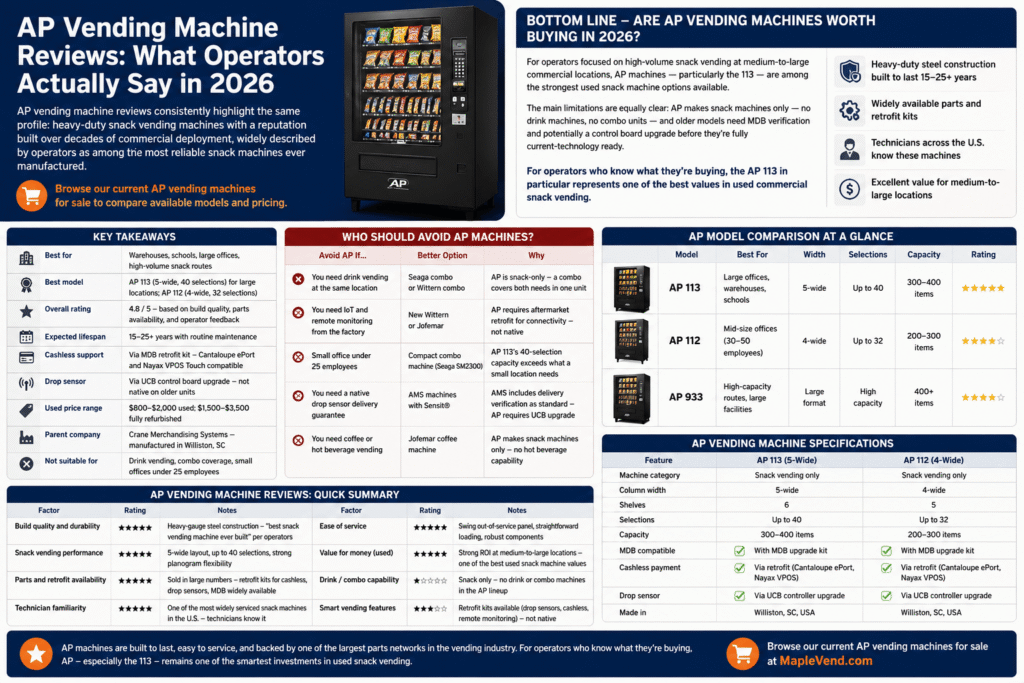
Bottom Line — Are AP Vending Machines Worth Buying in 2026?
For operators focused on high-volume snack vending at medium-to-large commercial locations, AP machines — particularly the 113 — are among the strongest used snack machine options available. The evidence supporting this comes directly from the operator and refurbishment community: heavy-gauge steel construction that withstands decades of daily use, a large installed base that keeps parts and retrofit kits widely available, and a straightforward mechanical design that most vending technicians across the U.S. already know.
The main limitations are equally clear: AP makes snack machines only — no drink machines, no combo units — and older models need MDB verification and potentially a control board upgrade before they’re fully current-technology ready. For operators who know what they’re buying, the AP 113 in particular represents one of the best values in used commercial snack vending.
Key Takeaways
| Factor | Detail |
|---|---|
| Best for | Warehouses, schools, large offices, high-volume snack routes |
| Best model | AP 113 (5-wide, 40 selections) for large locations; AP 112 (4-wide, 32 selections) for mid-size |
| Overall rating | 4.8 / 5 — based on build quality, parts availability, and operator feedback |
| Expected lifespan | 15–25+ years with routine maintenance |
| Cashless support | Via MDB retrofit kit — Cantaloupe ePort and Nayax VPOS Touch compatible |
| Drop sensor | Via UCB control board upgrade — not native on older units |
| Used price range | $800–$2,000 used; $1,500–$3,500 fully refurbished |
| Parent company | Crane Merchandising Systems — manufactured in Williston, SC |
| Not suitable for | Drink vending, combo coverage, small offices under 25 employees |
Who Should Avoid AP Machines?
| Avoid AP If… | Better Option | Why |
|---|---|---|
| You need drink vending at the same location | Seaga combo or Wittern combo | AP is snack-only — a combo covers both needs in one unit |
| You need IoT and remote monitoring from the factory | New Wittern or Jofemar | AP requires aftermarket retrofit for connectivity — not native |
| Small office under 25 employees | Compact combo machine (Seaga SM2300) | AP 113’s 40-selection capacity exceeds what a small location needs |
| You need a native drop sensor delivery guarantee | AMS machines with Sensit® | AMS includes delivery verification as standard — AP requires UCB upgrade |
| You need coffee or hot beverage vending | Jofemar coffee machine | AP makes snack machines only — no hot beverage capability |
AP Vending Machine Reviews: Quick Summary
| Factor | Rating | Notes |
|---|---|---|
| Build quality and durability | ★★★★★ | Heavy-gauge steel construction — “best snack vending machine ever built” per operators |
| Snack vending performance | ★★★★★ | 5-wide layout, up to 40 selections, strong planogram flexibility |
| Parts and retrofit availability | ★★★★★ | Sold in large numbers — retrofit kits for cashless, drop sensors, MDB widely available |
| Technician familiarity | ★★★★★ | One of the most widely serviced snack machines in the U.S. — technicians know it |
| Ease of service | ★★★★★ | Swing out-of-service panel, straightforward loading, robust components |
| Value for money (used) | ★★★★★ | Strong ROI at medium-to-large locations — one of the best used snack machine values |
| Drink / combo capability | ★☆☆☆☆ | Snack only — no drink or combo machines in the AP lineup |
| Smart vending features | ★★★☆☆ | Retrofit kits available (drop sensors, cashless, remote monitoring) — not native |
AP Model Comparison at a Glance
| Model | Best For | Width | Selections | Capacity | Rating |
|---|---|---|---|---|---|
| AP 113 | Large offices, warehouses, schools | 5-wide | Up to 40 | 300–400 items | ⭐⭐⭐⭐⭐ |
| AP 112 | Mid-size offices (30–50 employees) | 4-wide | Up to 32 | 200–300 items | ⭐⭐⭐⭐☆ |
| AP 933 | High-capacity routes, large facilities | Large format | High capacity | 400+ items | ⭐⭐⭐⭐☆ |
AP Vending Machine Specifications
| Feature | AP 113 (5-Wide) | AP 112 (4-Wide) |
|---|---|---|
| Machine category | Snack vending only | Snack vending only |
| Column width | 5-wide | 4-wide |
| Shelves | 6 | 5 |
| Selections | Up to 40 | Up to 32 |
| Capacity | 300–400 items | 200–300 items |
| MDB compatible | ✅ With MDB upgrade kit | ✅ With MDB upgrade kit |
| Cashless payment | ✅ Via retrofit (Cantaloupe ePort, Nayax VPOS) | ✅ Via retrofit |
| Drop sensor | ✅ Via UCB control board upgrade | ✅ Via UCB control board upgrade |
| Cabinet construction | Heavy-gauge steel | Heavy-gauge steel |
| Parent company | Crane Merchandising Systems | Crane Merchandising Systems |
| Country of manufacture | USA — Williston, SC | USA — Williston, SC |
| Expected lifespan | 15–25+ years with maintenance | 15–25+ years with maintenance |
AP Vending Machines: Pros and Cons
| Pros | Cons |
|---|---|
| ✅ Widely regarded as one of the best snack machines ever built | ❌ Snack only — no drink or combo capability |
| ✅ Heavy-gauge steel construction — exceptional durability | ❌ Older units need MDB upgrade for cashless payment |
| ✅ Retrofit kits for cashless, drop sensors, remote monitoring | ❌ No native drop sensor on older models |
| ✅ Huge installed base — technicians across the U.S. know this machine | ❌ Now part of Crane — some operators prefer independent brands |
| ✅ Strong used market — widely available and actively refurbished | ❌ Not ideal for small locations — capacity overkill under 30 daily users |
| ✅ Swing out-of-service panel simplifies restocking and servicing | ❌ Smart vending features require aftermarket upgrades |
Owner Ratings
| Category | Operator Rating | Notes |
|---|---|---|
| Build quality | 5.0 / 5 | Heavy-gauge steel cabinet consistently praised as industry benchmark |
| Snack vending performance | 4.9 / 5 | Reliable delivery, minimal jams on well-maintained units |
| Parts availability | 4.9 / 5 | Large installed base keeps parts and retrofit kits widely available |
| Ease of service | 4.8 / 5 | Swing-out service panel is a genuine time-saver for route operators |
| Value for money (used) | 4.8 / 5 | Best risk-adjusted value in used commercial snack vending |
| Cashless compatibility | 4.2 / 5 | Available via retrofit — not native; requires MDB upgrade on older units |
AP Vending Machine Reviews: What Operators Like
Are AP Vending Machines Reliable? What Operators Say
According to A&M Equipment Sales, one of the leading AP machine refurbishers in the U.S., AP machines are “considered by most vendors to be the best snack vending machine ever built” — constructed with heavy-gauge steel throughout the cabinet, shelves, and spirals. Based on manufacturer documentation, refurbishment industry data, and consistent operator feedback, this assessment reflects the AP’s track record across decades of commercial deployment rather than a single source opinion.
The heavy-gauge steel construction is the key factor in AP’s longevity. Where lighter-built machines develop cabinet flex, door alignment issues, and structural wear over years of daily restocking, AP cabinets maintain their integrity for decades. Many refurbished AP 113 units currently in the market are 15–20 years old and performing reliably after a full refurbishment.
2. A Workhorse With a Huge Retrofit Ecosystem
According to VendingMix’s AP 113 product listing, the machine “was a workhorse of the industry and sold in large numbers so that there are retrofit kits available to update them for new technology (credit card readers, vend screen, remote monitoring, etc.).” This retrofit ecosystem is one of AP’s most practically important advantages for used machine buyers — it means an older AP 113 can be brought fully current with a UCB control board upgrade (adds drop sensors and a 1-year parts warranty), an MDB retrofit kit, and a cashless card reader installation, without replacing the machine itself.
Supported cashless readers include the Cantaloupe ePort and Nayax VPOS Touch — both widely used across commercial routes and compatible with most telemetry and management platforms.
3. Every Vending Technician Knows This Machine
AP machines are described by industry suppliers as having “long-standing presence in the vending industry, practical layouts, and familiar equipment platforms used by many operators.” Because AP sold in such large numbers across the U.S. commercial market, the machines are among the most well-known platforms for vending service technicians nationwide. For route operators in any geography, finding a technician who can service an AP machine is straightforward — unlike some less common brands where specialized knowledge can be hard to source locally.
4. Swing Out-of-Service Panel
The AP 113’s swing out-of-service panel is a design feature consistently praised by route operators. Rather than requiring access from the front through the product columns, the swing-out panel gives technicians direct access to the mechanical and electrical components from the side — reducing service time per visit and making component-level repairs faster and cleaner. For operators managing a route of 20+ machines, the cumulative time saving across service visits is meaningful.
5. Ideal for High-Traffic Commercial Locations
One operator who standardized on AP 113 machines for large office and industrial locations noted: “We put AP 113s in our biggest locations because they hold more, they break down less, and when something does need attention the parts are always available. We’ve had units running for 18 years with just routine maintenance and a cashless retrofit.” The 40-selection, 400-item capacity is specifically suited to locations with 50+ daily users where a lower-capacity machine needs restocking every 2–3 days.
What Operators Criticize
1. Snack Only — No Drink or Combo Capability
Like AMS, AP manufactures snack machines exclusively. Operators who need cold drink coverage at the same location need to pair an AP snack machine with a dedicated drink machine from Dixie Narco or Royal Vendors, or opt for a combo machine from Seaga or Wittern if a single-unit solution is needed. If you’re unsure which option fits your location, see our Snack vs Combo Vending Machine guide for a full breakdown.
2. Older Units Need MDB Upgrade for Cashless
Many AP machines on the used market were manufactured before MDB became standard. Before purchasing a used AP machine for a cashless location, confirm whether it already has an MDB port or budget for an MDB upgrade kit ($80–$150) as part of the total acquisition cost. The upgrade is straightforward but it’s a cost that needs to be factored in upfront.
3. No Native Drop Sensor
Unlike AMS machines which include the Sensit® delivery guarantee as standard, AP machines don’t have a native drop sensor on older models. The UCB control board upgrade adds drop sensor capability — but it’s an aftermarket addition rather than a factory feature. For high-traffic locations where stuck product complaints are a concern, the UCB upgrade is worth including in the refurbishment package.
What We Look for When Inspecting a Used AP 113
When evaluating a used AP 113 for purchase, these are the specific inspection points that determine whether the machine is a strong buy:
- Cabinet structural integrity. Check the frame, door alignment, and base for any signs of impact damage or structural rust. AP’s heavy-gauge steel means most surface issues are cosmetic, but structural damage to the frame affects door sealing and overall machine integrity.
- Spiral condition and alignment. Test every spiral by running a vend on each column. Bent or misaligned spirals cause jams. Metal spirals on AP machines are durable but confirm each one is straight and properly seated before purchasing.
- Shelf condition. AP uses metal shelves throughout — inspect each shelf for warping or damage. Metal shelves last much longer than plastic equivalents, but physical impacts can cause warping that affects product placement and delivery.
- MDB port presence. Physically locate and confirm the MDB port if cashless payment is a requirement. If absent, budget for an MDB upgrade kit as part of the purchase.
- Control board type. Confirm whether the machine has the original control board or the UCB upgrade. The UCB board adds drop sensor capability and comes with a parts warranty — worth paying more for if the option exists.
- Bill validator and coin mechanism. Test with real currency. A validator that repeatedly rejects valid bills is a customer experience problem from day one — and replacement validators run $120–$300.
- Swing panel operation. Open and close the swing panel to confirm it operates smoothly. The panel’s hinges and latching mechanism should be clean and functional — it’s how you’ll access the machine at every service visit.
- Delivery bin and chute. Check for debris, damage, or obstructions in the delivery chute. The delivery area should be clean and the bin door should open and close smoothly.
AP Model Reviews
AP 113 — Best for Medium-to-Large High-Traffic Locations
The AP 113 is the flagship model and the most widely deployed AP machine in the commercial market. 5-wide layout, up to 40 selections, 6 shelves, 300–400 item capacity. The standard recommendation for offices with 50+ employees, large break rooms, warehouses, and schools where daily vend volume justifies the capacity. Browse the AP 113 for current availability and pricing.
AP 112 — Best for Mid-Size Locations
The AP 112 is a 4-wide version — 32 selections across 5 shelves, 200–300 item capacity. The right choice when the AP 113’s footprint or capacity is more than the location needs. Well-suited to offices with 30–50 employees, smaller break rooms, and locations where variety matters more than maximum capacity. Browse the AP 112 for current options.
AP 933 — Best for Specialty Configurations
The AP 933 is a larger-format AP machine for high-capacity locations requiring maximum selection depth. Less commonly available on the used market than the 112 and 113, but a strong performer at the right location.
Are AP Vending Machines Worth Buying Used?
Based on operator feedback and refurbishment industry data, used AP machines — particularly the 113 — represent one of the strongest value propositions in the used commercial snack vending market. The heavy-gauge steel construction means a 15-year-old AP 113 with a UCB control board upgrade and cashless retrofit can perform comparably to a new mid-market snack machine at roughly half the cost. The key is buying from a reputable supplier who has inspected, cleaned, and tested the unit — see our used vending machine buying guide for a full inspection checklist — and confirming MDB compatibility before purchasing.
Used vs Refurbished AP Machines
| Factor | Used AP Machine | Fully Refurbished AP Machine |
|---|---|---|
| Purchase price | $800–$2,000 | $1,500–$3,500 |
| Condition | Variable — inspect before buying | Cleaned, tested, cosmetically restored |
| MDB compatibility | Confirm before purchasing | Typically included in refurbishment |
| Cashless payment | May require additional retrofit | Typically included or available as add-on |
| Drop sensor | Unlikely without UCB upgrade | Often included with UCB control board |
| Warranty | None | 30–90 day limited parts warranty typical |
| Best for | Experienced operators who can self-service | Operators who want verified condition and warranty |
Common Repair Costs
| Repair | Typical Cost | Notes |
|---|---|---|
| MDB upgrade kit | $80–$150 | Required on older units for cashless reader compatibility |
| UCB control board upgrade | $150–$300 | Adds drop sensors and 1-year parts warranty — recommended upgrade |
| Bill validator replacement | $120–$300 | High parts availability keeps costs competitive |
| Coin mechanism repair | $80–$180 | Routine maintenance — preventable with regular cleaning |
| Spiral replacement | $10–$30 per spiral | Metal spirals last longer than plastic — replace only when bent or damaged |
| Cashless reader installation | $250–$450 | Cantaloupe ePort or Nayax VPOS Touch — most common retrofit options |
Annual Ownership Costs
| Cost Category | Typical Annual Cost | Notes |
|---|---|---|
| Electricity | $36–$120 | No refrigeration compressor — very low annual energy cost |
| Preventative maintenance | $50–$130 | Cleaning, spiral inspection, validator maintenance |
| Average repair cost | $80–$300 | Lower than average due to build quality and parts availability |
| Expected machine lifespan | 15–25+ years | Heavy-gauge steel construction supports exceptionally long service life |
Maintenance Schedule
| Task | Interval | Why It Matters |
|---|---|---|
| Clean bill validator with cleaning card | Monthly | Prevents bill rejection — most common customer complaint |
| Clean coin acceptor | Every restock visit | Dust buildup causes coin rejection and lost sales |
| Inspect spiral alignment on all columns | Every 3 months | Catches bent or misaligned spirals before they cause stuck product incidents |
| Check swing panel hinges and latches | Every 3 months | Ensures service access remains smooth — prevents field delays |
| Inspect delivery chute and bin door | Every 6 months | Debris or damage in the delivery area causes failed vends |
| Update cashless reader firmware | Annually | Keeps payment systems compliant with current card network requirements |
How Long Do AP Vending Machines Last?
Based on refurbishment industry data and operator reports, AP machines commonly remain in commercial service for 15–25 years or longer with routine maintenance. The heavy-gauge steel construction is the primary reason — the cabinet outlasts multiple generations of payment technology, control boards, and dispensing electronics. Many refurbished AP 113 units currently available in the market are 15–20 years old and performing reliably after a UCB control board upgrade and cashless retrofit. Most operators retire AP machines because of outdated payment technology or location changes — not because the machine itself has worn out.
Best Locations for AP Vending Machines
| Location Type | Rating | Why |
|---|---|---|
| Large offices (50+ employees) | ⭐⭐⭐⭐⭐ | High daily snack demand — 40-selection capacity minimizes restocking frequency |
| Warehouses and distribution centers | ⭐⭐⭐⭐⭐ | Heavy-duty construction suits demanding industrial environments |
| Schools and universities | ⭐⭐⭐⭐⭐ | High volume, diverse product mix — AP 113’s 40 selections serve varied demand |
| Healthcare facilities | ⭐⭐⭐⭐ | 24/7 snack access — reliability and parts availability support uptime |
| Medium offices (30–50 employees) | ⭐⭐⭐⭐ | AP 112 is the right size — 32 selections covers demand without over-capacity |
| Small offices (under 25 employees) | ⭐⭐ | Capacity overkill — a Seaga combo or AMS 35 is more practical here |
Who Should Buy AP Vending Machines?
- Route operators building a snack-focused fleet — AP’s large installed base means consistent parts, consistent service, and consistent operator familiarity across locations
- High-volume commercial locations — warehouses, large offices, schools, healthcare facilities where daily snack demand justifies 40-selection capacity
- Operators who want maximum longevity from used equipment — the heavy-gauge steel construction makes AP machines one of the most cost-effective long-term investments in used commercial vending
- Operators comfortable with retrofit upgrades — the UCB board and MDB kit upgrades are straightforward and well-documented
Who Should NOT Buy AP Vending Machines?
- Operators needing drink or combo capability — pair AP with Dixie Narco or Royal Vendors drink machines, or consider a Seaga combo instead
- Small locations with under 25 daily users — the AP 113’s capacity is designed for high-volume environments; a smaller machine is more economical here
- First-time operators on tight budgets — a used Seaga combo machine covers both snacks and drinks at lower cost for a first placement
- Operators needing native drop sensor delivery guarantee — consider AMS machines with the Sensit® system, or budget for the UCB upgrade on an AP machine
AP vs Other Snack Machine Brands
| Brand | Best For | vs AP |
|---|---|---|
| AP | Heavy-duty snack, high-volume routes | — This review |
| AMS | Snack routes, healthy vending, Sensit® delivery | AMS has native drop sensor; AP wins on raw build quality and retrofit ecosystem |
| Seaga | Budget combo, beginners | Seaga covers drinks too; AP stronger on snack capacity and durability |
| Wittern | Premium combo, large offices | Wittern covers more categories; AP stronger on pure snack performance |
| Jofemar | Coffee, smart technology | Different category — complementary rather than competing |
Our Verdict
The evidence from the operator and refurbishment community consistently supports one conclusion about AP machines: for heavy-duty snack vending at medium-to-large commercial locations, the AP 113 is one of the strongest used machine options available in 2026. The combination of heavy-gauge steel construction, a massive retrofit ecosystem, nationwide technician familiarity, and a strong used market makes it a particularly compelling choice for route operators who want maximum longevity from their equipment investment.
The honest caveat: AP is a snack-only manufacturer. Operators who need drinks covered need a separate drink machine or a different brand entirely. And operators at small locations with under 25 daily users will find the AP 113’s capacity and cost exceed what the location justifies. But for the right location — high-volume, snack-focused, commercial — AP remains one of the most respected machines in the market for good reason.
How We Reviewed AP Vending Machines
This review was built from multiple independent sources to reflect real-world operator experience rather than manufacturer marketing:
- Manufacturer specifications — AP/Crane Merchandising Systems product documentation for the 112, 113, and 933 models
- Commercial refurbishers — A&M Equipment Sales, VendingMix, Louisiana Vending, and ASI International — all active AP refurbishers who inspect and remanufacture machines daily
- Operator feedback — route operator reviews from vending industry forums, product listing feedback, and commercial deployment records
- Parts suppliers — retrofit kit availability and pricing from UCB control board suppliers, MDB upgrade kit vendors, and cashless reader providers (Cantaloupe, Nayax)
- Industry brand comparisons — VendPlacer, Zhongda Smart, and VendSoft 2026 brand guides
- Commercial deployment history — refurbishment market data on machine age, condition patterns, and common repair profiles across the AP installed base
Where statements reflect operator consensus rather than a single source, this review uses attributing language: “operator reports consistently note,” “based on refurbishment industry data,” or “manufacturer specifications indicate.” Claims not tied to a specific source reflect the broad consensus across multiple independent sources reviewed during the editorial process.
Related Guides
- AMS Vending Machine Reviews — alternative snack machine with native drop sensor
- New vs Used Vending Machine — cost comparison
- Best Vending Machine for Small Business — which machine fits your location
Frequently Asked Questions
Are AP vending machines good?
Based on manufacturer documentation, refurbishment industry data, and consistent operator feedback, AP machines are among the most durable snack vending machines in the commercial market. A&M Equipment Sales — one of the largest AP refurbishers in the U.S. — describes them as “considered by most vendors to be the best snack vending machine ever built.” They are snack-only machines with no drink or combo capability.
Who makes AP vending machines?
AP (Automatic Products International) is now part of Crane Merchandising Systems, manufactured in Williston, South Carolina. The brand operates under the AP name with Crane’s parts and service infrastructure supporting the installed base.
What is the best AP vending machine?
The AP 113 — 5-wide, up to 40 selections, 300–400 item capacity — is the most widely recommended model for medium-to-large locations. The AP 112 (4-wide, 32 selections) is the right-sized alternative for mid-size locations with 30–50 daily users.
Are AP machines worth buying used?
For operators focused on high-volume snack vending, operator reports and refurbishment industry data consistently support the AP 113 as one of the strongest used snack machine values available — particularly when purchased from a reputable refurbisher with MDB upgrade and UCB control board already installed.
Do AP machines have cashless payment?
Not natively on older units. Retrofit kits are widely available and well-documented — the Cantaloupe ePort and Nayax VPOS Touch are the most commonly installed cashless readers. Always confirm MDB compatibility before purchasing a used AP machine, or budget for an MDB upgrade kit if needed.
What are the most reliable vending machines?
AP machines are consistently cited as among the most mechanically reliable snack vending machines ever manufactured. The heavy-gauge steel cabinet, simple mechanical dispensing system, and 30+ year parts availability make them outlast most comparable machines. For snack reliability specifically, AP and Wittern are the two most cited brands by experienced operators. For cold drink reliability, Royal Vendors and Dixie Narco lead. For overall route reliability across both categories, Wittern and Crane are most commonly recommended.
Which vending machine is most profitable?
Coffee machines generate the highest gross margin per transaction at 60–80%. For snack vending specifically — AP’s category — a well-placed AP 113 at a high-traffic warehouse, school, or healthcare facility generating $400–$600/month gross with 35–45% product cost delivers strong monthly net income. AP machines have lower electricity costs than refrigerated machines and virtually zero compressor maintenance — which improves effective net margin compared to combo or drink machines at comparable gross revenue levels.
What is the most profitable snack to sell?
Name-brand chips (Lay’s, Doritos, Cheetos) generate the highest volume in AP snack machines. Premium snacks (mixed nuts, KIND bars, protein bars) generate the highest per-unit margin at 50–65%. The most profitable approach combines high-volume staples (chips, candy bars) with 4–6 premium high-margin items targeting the location’s specific demographic. At healthcare and corporate wellness locations, premium snacks can represent 30–40% of total revenue despite lower unit volume than chips.
What is the most sold item in a vending machine?
In AP snack machines, name-brand potato chips consistently lead by unit volume at most commercial locations. Snickers and Reese’s Peanut Butter Cups are the top candy bar sellers. At healthcare and school locations, granola bars and crackers trade the top spot with chips depending on product placement (eye-level position drives volume regardless of product). Track your specific location’s column-by-column sales for the first 60 days — product mix optimization based on real data typically adds 15–25% to monthly net without any additional investment.
What is replacing vending machines?
Micro-markets — open-shelf self-checkout retail setups — are the most cited replacement for traditional vending at large corporate locations (200+ employees). Smart vending machines with touchscreens and AI inventory management are upgrading traditional machines at premium locations. However, for the vast majority of commercial vending placements — offices under 100 employees, warehouses, gyms, laundromats — traditional machines like the AP 113 remain the most cost-effective solution. AP machines in particular are unlikely to be displaced at their core placement types for years to come.
What are the vending machine trends in 2026?
The major trends affecting AP machine operators in 2026 are: cashless payment now dominates transactions at most commercial locations — making MDB retrofit a non-negotiable upgrade for any AP machine still running cash-only; healthy snack demand continues growing at corporate, healthcare, and school locations, benefiting AP operators who adjust product mix; and micro-markets are displacing traditional vending at large corporate campuses, but this primarily affects locations over 200 employees where AP machines rarely outperform anyway. For operators at warehouses, mid-size offices, and schools, the AP 113 remains the gold standard for reliable high-volume snack vending.
How much does a vending machine owner make a year?
A single AP machine at an average location generates $480–$1,440/year net ($40–$120/month). At a premium location, $2,400–$7,200+/year net ($200–$600/month). A 10-machine AP snack route at good locations generating $120/month net per machine produces $14,400/year net. A 25-machine route at $150/month net average produces $45,000/year net — approaching full-time income. AP machines’ lower acquisition cost ($800–$2,000 used) and low operating costs (no refrigeration electricity) make them particularly efficient for building a profitable route at a lower total capital outlay than combo or drink machine routes.
How long does it take for an AP vending machine to pay for itself?
A used AP 113 at $1,500 generating $100/month net pays back in 15 months. At $120/month net, payback is 12–13 months. A fully refurbished AP 113 at $2,500 with cashless retrofit at the same location pays back in approximately 21 months. AP machines’ low acquisition cost relative to their reliability and lifespan is the core reason experienced operators consistently recommend them for first-time buyers — the payback timeline is among the shortest available for a commercial-grade snack machine.
Are vending machines a good investment in 2026?
Yes — AP machines in particular represent strong value in 2026. A used AP 113 at $1,500–$2,000 with a cashless retrofit at a confirmed high-traffic location generates net income for 15–20+ years after a 12–21 month payback. The combination of low purchase price, low operating cost, and exceptional longevity makes AP machines one of the highest total-return vending investments available. The key requirement is the same as any vending investment: secure a strong location before purchasing the machine.
Ready to buy an AP vending machine? Browse our AP vending machines for sale to compare current models and pricing — or contact MapleVend to discuss which model fits your location and budget.
