
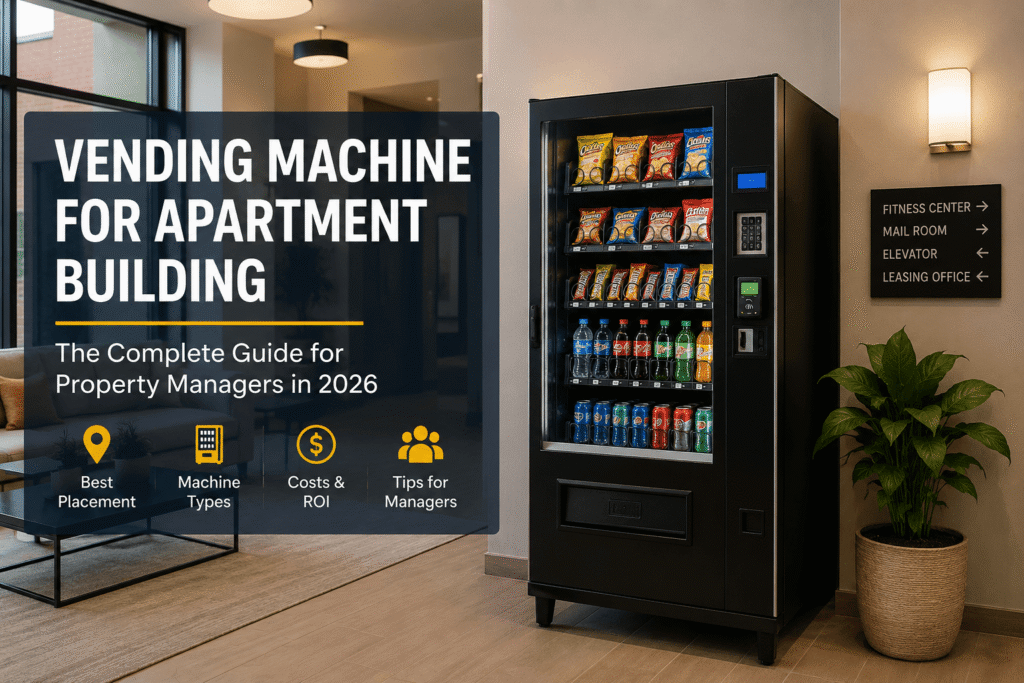
A vending machine for an apartment building solves two problems at once: residents want snacks and drinks at midnight without driving to a gas station, and property managers want an amenity that doesn’t need babysitting. The newer cashless, remotely-monitored machines mean you’re not the one restocking it every other day. If you already know what you’re after, browse our complete collection of vending machines for sale.
We also carry snack, drink, and combo vending machines built specifically with residential properties and multifamily communities in mind.
Why a Vending Machine for Apartment Building Common Areas Makes Sense
A vending machine in a gas station gets used by people who happen to be there anyway. A vending machine in an apartment lobby gets used by the same fifty or two hundred people, every single day, because they live there. That difference shows up in the sales numbers.
There’s also a real financial case for property managers. Vending and micro market machines in the U.S. grew about 7% in a recent year, to roughly 2.2 million units, according to Vending Market Watch’s industry report. People aren’t walking away from convenience retail. The National Apartment Association has long pointed to resident amenities as a meaningful piece of tenant satisfaction and retention strategy in multifamily housing — vending fits squarely into that bucket, even if it’s a smaller line item than a pool or a fitness center. On the tenant side specifically, plenty of vending operators and property-amenity blogs make the case that small conveniences like this factor into renewal decisions — take that with a grain of salt since most of those sources have something to sell, but it lines up with common sense: residents notice friction in daily routines, and removing a little of it rarely hurts.
The other part is just staffing math. Nobody on your team has to be awake at 2 a.m. for a resident to get a drink. Modern machines track their own inventory, so you’re not sending someone to peek inside every few days either. Learn more about our smart vending machines if remote monitoring and cashless payment are priorities for your building.
Where to Put It
Placement matters more than almost anything else here. In order of how well they usually perform:
- Lobby or mailroom — everyone walks past it, residents and guests both
- Laundry room — people are stuck there for half an hour with nothing to do; snacks and even detergent or dryer sheets sell well
- Fitness center — protein bars and sports drinks make sense to someone mid-workout in a way they don’t anywhere else
- Community room or co-working space — worth considering if your building markets shared workspace as an amenity
If you’ve got more than one common area, don’t put the same machine in both. Snacks in the lobby, drinks by the gym tends to outperform two identical setups.
Which Machine Type Actually Makes Sense
Snack machines are the safe default for a lobby or laundry room — chips and candy don’t need refrigeration, so installation is simpler, and pretty much everyone eats them. AMS and AP both make compact snack machines that work well if your lobby is on the small side.
Drink machines do better near a gym or pool, where someone wants something cold right now, not in five minutes. Dixie Narco and Royal Vendors both have reliable beverage units across a few different capacities.
If your common area is tight on square footage, a combo machine (snacks and drinks in one box) usually beats running two separate machines — it covers both categories in the same footprint a standard snack machine would take up. Seaga makes a few combo models built specifically for smaller spaces like this.
One thing I’d actually prioritize regardless of type: cashless capability. Residents expect to tap a card or phone at this point, and it has a side benefit — there’s no cash box for someone to pry open.
Here’s a quick comparison of how the main types stack up:
| Machine Type | Best For | Space Needed |
|---|---|---|
| Snack | Lobby, mailroom | Small |
| Drink | Gym, pool area | Medium |
| Combo | Most buildings | Small |
| Smart / cashless | Luxury properties | Medium |
Best Products to Stock in an Apartment Building Vending Machine
What sells in an apartment complex vending machine looks a little different from what sells in an office break room, mostly because residents are shopping at all hours and for a wider range of reasons.
For snack machines, the reliable performers are chips, candy bars, granola bars, and pastries — nothing surprising there, but variety matters more than novelty. A few healthier options (protein bars, trail mix, nuts) tend to move steadily too, especially in buildings with a younger or fitness-oriented resident base.
For drink machines, cold water and sports drinks sell consistently near a gym, while soda and energy drinks do better in a lobby or near a community room. If your building has any kind of pet-friendly policy, a small selection of bottled water is genuinely appreciated by people walking dogs at odd hours.
Laundry rooms are the one spot worth stocking outside the usual snack-and-drink mix. Single-use detergent pods, dryer sheets, and stain-remover pens solve a real problem — someone who forgot detergent doesn’t want to make a special trip, they want it right there.
If you’re not sure where to start, a standard assortment of 8–10 snack SKUs and 6–8 drink SKUs covers most apartment buildings well, and you can always adjust based on what’s actually selling once the machine’s been in for a month.
How Much Money Can an Apartment Building Vending Machine Make?
This is the question everyone actually wants answered, and the honest version is: it depends heavily on resident count and placement, more than on the machine itself.
A vending machine for apartments in a building with under 50 units, tucked in a low-traffic spot, might bring in modest monthly revenue — enough to be a nice perk, not enough to budget around. A well-placed machine in a 150+ unit building, sitting in the lobby or laundry room where people pass by daily, can produce meaningfully more, since usage scales pretty directly with how many residents walk by it.
A few things move the number more than people expect:
- Placement beats machine quality. A great machine in a dead-end hallway will underperform a basic one in the lobby.
- Cashless adoption matters. Buildings that skip cashless tend to leave real money on the table, since a chunk of residents simply won’t bother with cash.
- Product mix has to match the building. A 25-and-under resident base buys differently than a 55+ community, and stocking the wrong mix quietly caps revenue without it being obvious why.
If you’re running the machine yourself, you keep all of that revenue minus restocking costs. If you’re working with an operator on commission, expect a share — often somewhere in the 10–20% range, though it varies — in exchange for not touching it yourself.
None of this will replace rent as a revenue line. But across vending machines for apartment complexes generally, it’s a low-effort amenity that tends to pay for itself within the first year and keep generating modest income after that.
New or Used?
For a single building, a used and properly refurbished machine is usually the smarter starting point. Cheaper, faster payback, and most decent sellers still back it with a parts warranty.
New machines make more sense once you’re equipping several properties at once and want everything to match — same branding, same payment tech, same warranty timeline across the board.
Neither is “correct.” It’s a tradeoff between upfront cost and warranty length, and that tradeoff looks different depending on how many buildings you’re dealing with. Most sellers list both conditions side by side, so it’s easy enough to compare once you know which type you want.
What This Actually Costs
Exact pricing depends on brand, capacity, and condition. But the pattern holds across most sellers:
- Used snack or drink machines cost the least upfront, in exchange for a shorter remaining warranty or a less polished look
- New machines cost more but come with a full warranty and current payment tech already built in
- Combo machines run a bit higher than single-purpose machines, since there’s simply more inside them
Pricing for a vending machine for apartment building common areas really comes down to the specific model, so it’s worth requesting a quote once you’ve decided on placement and type rather than trying to estimate from a category page.
Run It Yourself, or Hand It to an Operator?
Buy the machine and stock it yourself, and you keep every dollar — but you’re also the one restocking and doing light maintenance. For one building, that math usually works out better over time.
Or bring in a vending operator who places and stocks the machine for a cut of sales. You’ll see less revenue per sale, but you also stop thinking about it. That trade starts to look better once you’re managing several buildings and nobody on staff has time to restock all of them.
I’d lean toward self-operating for one property and outsourcing past three or four, but plenty of managers go the other way and it works fine either way.
Before You Buy
Walk the space first and check three things:
- Is there an outlet nearby? Most machines run fine on a standard outlet, though it’s worth double-checking for larger refrigerated units.
- Is there room to service it? Restocking means pulling the machine away from the wall sometimes, so leave space on at least one side.
- Does your jurisdiction require a permit? Rare for an indoor common-area machine, but a quick call to your local building department settles it.
Mistakes Worth Avoiding
A few patterns show up often enough in apartment vending that they’re worth flagging before you commit to anything.
Buying based on the cheapest sticker price. A used machine that’s a few hundred dollars cheaper but missing a working compressor or a reliable bill validator isn’t actually cheaper — you’ll eat the repair cost within the first year, plus the downtime while it’s broken and residents are annoyed. Ask specifically what’s been refurbished versus what’s original to the unit.
Ignoring the door swing and clearance. Plenty of lobbies and laundry rooms have just enough wall space for the machine itself but not enough room to actually open it for restocking. Measure the full door swing, not just the machine’s footprint, before you order anything.
Skipping cashless to save a little upfront. It’s tempting, especially on a used machine, but cash-only units tend to see lower usage among younger residents — a lot of people simply don’t carry cash anymore, and the few dollars saved on the unit usually isn’t worth the lost sales over a year or two.
Picking the machine before walking the space. It’s easy to fall for a specific model online and then discover it’s two inches too deep for where you wanted to put it. Measure first, shop second.
Forgetting about noise. Refrigerated drink machines have a compressor that cycles on and off, and it’s audible. That’s a non-issue in a lobby, but worth thinking about if you’re placing one near a community room people use for quiet work or calls.
Frequently Asked Questions
Are vending machines profitable in apartment buildings?
Generally, yes. Residents are right there, every day, which tends to produce steadier sales than a machine sitting in a random retail spot.
What is the best vending machine for an apartment building?
Most people land on combo machines, mostly because square footage in a lobby is always tighter than anyone wants it to be, and one combo unit beats finding room for two.
Where should a vending machine be placed in an apartment building?
Lobby, mailroom, laundry room, fitness center, or community room — basically wherever residents already spend time waiting around.
How much does an apartment building vending machine cost?
It depends on the brand, whether it’s new or used, and what type you pick. Both new and used machines are available across a range of budgets.
Do apartment building vending machines need internet?
No — a basic machine works fine offline. Internet just gets you remote stock monitoring and cashless payment, which is genuinely convenient but not a requirement.
Should apartment buildings offer vending machines?
For most properties, yes. It’s a low-cost amenity that makes daily life slightly easier for residents, and it can bring in a little extra revenue for the owner along the way — not a huge one, but a real one.
MapleVend carries new and used machines from AMS, Seaga, Dixie Narco, AP, Royal Vendors, Jofemar, and Wittern, including compact and combo models that fit apartment common areas well. Browse what’s in stock to see current pricing and availability by brand.
Not sure which vending machine for apartment building common areas is right for your property? Contact MapleVend and we’ll help you choose a vending solution that fits your building, budget, and residents’ needs.
