
A vending machine for school environments is one of the most regulated placements in the vending industry — and one of the most consistently misunderstood. Whether you’re looking for a snack vending machine for a high school cafeteria, a beverage-only machine for an elementary school, or a full commercial unit for a college campus, the rules governing school vending machines vary significantly by institution type and grade level. Getting a machine into a school isn’t simply a matter of finding wall space and plugging it in — federal nutrition standards, district approval processes, and wellness policies create specific requirements that don’t exist in offices, warehouses, or retail settings.
This guide covers everything you need to know: the compliance requirements, the best machine types for educational environments, placement strategies, and realistic revenue expectations. Browse our commercial vending machines for sale or contact us to discuss which configuration fits your school’s specific needs.
Can You Put a Vending Machine in a School?
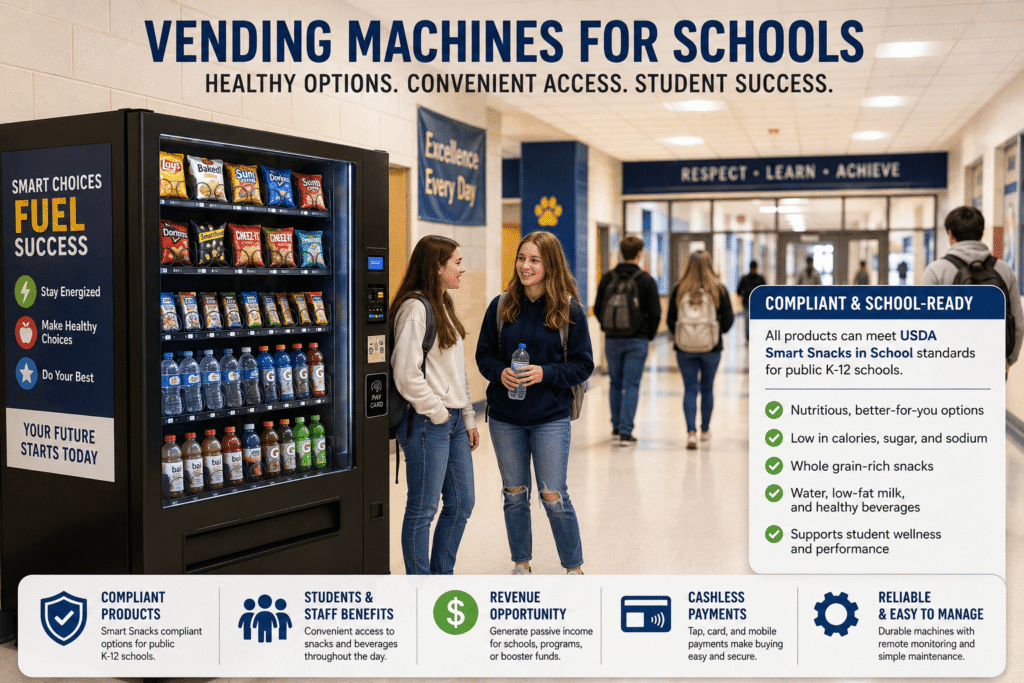
Yes — but with conditions that vary significantly depending on the school type, grade level, and whether it’s a public or private institution. According to USDA Food and Nutrition Service guidelines, any food or beverage sold in a public school during the school day must meet Smart Snacks in School nutrition standards — a set of federal requirements covering calorie limits, fat content, sodium, sugar, and whole grain requirements for all competitive foods sold on campus.
In practice, this means:
- Public K-12 schools must comply with USDA Smart Snacks standards for any vending sales during school hours. Products that don’t meet these standards cannot be sold from the machine during the school day, though some districts allow different rules before and after school hours.
- Private and charter schools may have more flexibility since they’re not bound by the same federal nutrition program requirements, though most still enforce internal wellness policies.
- College and university campuses are not subject to Smart Snacks requirements and can sell standard snack and beverage products without restriction.
The compliance question is separate from the approval question. Even when a school can legally have a vending machine, placement typically requires approval from the district’s food services department or business office — not just a building principal. Starting that conversation early is the single most important step in a successful school vending placement.
Best Vending Machine for School Use
The right machine for a school depends heavily on the grade level, available space, and whether the placement is for students, staff, or both. A few configurations perform consistently well in educational environments:
Snack machines with Smart Snacks-compliant product options. A standard 30–40 selection snack machine stocked with compliant products is the most common school vending setup. AMS vending machines and Seaga machines both offer the selection depth needed to stock a full range of approved snack items without running out of variety.
Beverage machines for water and low-calorie drinks. Plain water, low-fat milk, and beverages meeting Smart Snacks calorie and sugar thresholds are always safe from a compliance standpoint and consistently strong sellers in student environments. Dixie Narco and Royal Vendors beverage machines are reliable options for schools looking to offer drinks without the compliance complexity of mixed snack/beverage units.
Combo machines for staff lounges and smaller spaces. A combo machine covering both snacks and drinks is often the practical choice for teacher and staff areas, where Smart Snacks requirements may be more relaxed or non-applicable. Staff-only placements allow a broader product mix and typically generate strong, consistent revenue from adults who buy frequently throughout the day.
Machine Recommendations by School Type
| School Type | Recommended Machine | Why |
|---|---|---|
| Elementary school | Beverage only | Strictest nutrition rules; water and low-fat milk are safest |
| Middle school | Smart Snacks snack machine | Higher student volume; compliant snack selection works well |
| High school | Snack + beverage (separate or combo) | Larger campus, more buying occasions per day |
| College / university | Standard commercial snack or combo | No Smart Snacks restriction; full product range available |
| Staff lounge (any level) | Combo machine | Adults buying daily; compliance often more flexible |
Vending Machine Specifications for Schools
| Feature | Typical Specification |
|---|---|
| Capacity | 250–600 snacks depending on model |
| Selections | 20–40 product slots |
| Payment options | Cash, card, mobile wallet — cashless standard on current models |
| Power requirements | 110–120V standard outlet |
| ADA compliant | Available on most current models |
| Refrigeration | Optional — required for fresh food or dairy items |
| Remote monitoring | Available on most current cashless-enabled units |
| Dimensions | Typically 72″ tall x 36–39″ wide x 33″ deep |
USDA Smart Snacks: What It Means for School Vending
Smart Snacks in School is the federal standard that governs what can be sold in public school vending machines during school hours. According to the USDA, the National School Lunch Program serves approximately 30 million children across public schools in the United States — meaning Smart Snacks compliance affects the vast majority of K-12 vending placements nationwide. The key requirements for snack items are:
- 200 calories or fewer per item
- 200mg sodium or fewer per item (with exceptions for some entrees)
- 35% or fewer calories from total fat (with exceptions for nuts, seeds, and cheese)
- Less than 10% calories from saturated fat
- Zero grams of trans fat
- 35% or fewer of weight from total sugars
- Whole grains must be the primary grain ingredient for grain-based items
For beverages, water, plain low-fat milk, and plain or carbonated water are always compliant. Other beverages must meet specific calorie and sugar thresholds that vary by grade level — elementary schools have stricter limits than high schools.
The practical implication: your product mix will be more limited than in a commercial vending placement, but there’s still a meaningful range of compliant products available across snacks, protein bars, nuts, whole grain items, and beverages. Many operators find that compliance-focused stocking actually drives more consistent per-visit spending, since students who rely on the machine for snacks purchase regularly rather than occasionally.
Placement Strategy: Where to Put a Vending Machine in a School
Placement approval and physical placement are two different decisions. Once you have district approval, the most effective locations within a school building are:
- Near the cafeteria — students are already thinking about food, and a machine near the cafeteria captures purchases from students who want something beyond what’s on the lunch menu
- Main hallways near high-traffic intersections — visibility is everything for impulse purchases; a machine students pass multiple times per day outperforms one tucked in a corner
- Near gymnasiums or athletic areas — sports drinks, water, and protein bars sell strongly in these locations, and compliance is often easier since many athletic programs run outside school hours
- Teacher/staff lounges — often the most reliable revenue source in a school, since staff buy frequently and aren’t subject to the same student-facing compliance requirements in some districts
Revenue Expectations for School Vending
School vending revenue is more seasonal and schedule-dependent than most other placements. Machines earn nothing during summer break, spring break, and holiday periods — which is a meaningful reduction in annual revenue compared to a 12-month location like a warehouse or hospital. Most school vending contracts account for this with adjusted site fee structures.
During the school year, a well-placed machine in a school with 500+ students can realistically generate $400–$900 in monthly gross revenue depending on student count, product mix, and pricing. Staff-only placements run lower but are more consistent. The key revenue driver is frequency — students who buy from the machine 2–3 times per week generate meaningfully more annual revenue per capita than occasional buyers.
How Much Does a School Vending Machine Cost?
Pricing varies by condition, brand, and configuration. As a general reference:
| Condition | Typical Price Range |
|---|---|
| Used / cleaned and working | $1,500–$3,000 |
| Professionally refurbished | $2,500–$4,000 |
| New commercial unit | $4,000–$7,000+ |
What affects price most is selection count, brand, and whether the machine includes a built-in cashless reader. A 40-selection new unit with cashless capability costs more than a 20-selection used machine with coin and bill only — but the cashless unit will typically generate 20–35% more revenue in a student environment where most buyers don’t carry cash.
New vs. Used Vending Machines for Schools
Schools and districts evaluating vending equipment often gravitate toward newer machines for two specific reasons: appearance and cashless payment capability. A visually worn or outdated machine in a school hallway gets used less than a clean, modern unit — the aesthetic matters more in an environment where students make impulse decisions based partly on how inviting the machine looks.
That said, a properly refurbished machine in good cosmetic condition at a lower price point is still a sound choice, particularly for a first placement or a staff-only location where appearance is less of a driver. Browse used vending machines for sale to compare available options by condition and brand.
Who Should Consider School Vending?
- School administrators looking to generate passive revenue for school programs without adding staff
- PTA and booster organizations exploring fundraising through vending revenue splits
- Vending route operators looking to add multiple school locations to a seasonal route
- District food services departments evaluating compliant vending as a cafeteria supplement
- College and university administrators seeking 24/7 student food access without cafeteria hours
Why Buy From MapleVend?
- Commercial-grade snack and beverage machines from AMS, Seaga, Dixie Narco, Royal Vendors, and more
- New and refurbished options across all budgets
- Nationwide freight shipping with liftgate delivery
- Financing available for qualified buyers
- Guidance on matching machine type and product capacity to your school’s specific needs
- Honest condition reporting on every used unit we sell
Frequently Asked Questions
Can schools have vending machines?
Yes. Vending machines are common in middle schools, high schools, and college campuses. Public K-12 schools must comply with USDA Smart Snacks in School nutrition standards for any products sold during school hours. Private schools and colleges have more flexibility.
What can be sold in a school vending machine?
In public K-12 schools during school hours, products must meet USDA Smart Snacks standards — generally 200 calories or fewer, limited sodium, fat, and sugar content, and whole grains as the primary ingredient for grain-based items. Water and low-fat milk are always compliant. Many snack bars, nuts, and low-calorie beverages qualify.
How much does a school vending machine make?
Revenue varies by student count, grade level, and product mix, but a well-placed machine in a school with 500+ students can generate $400–$900 per month during the school year. Staff-only placements run lower but more consistently. Summer and holiday breaks produce no revenue.
Who approves a vending machine in a school?
In most public school districts, approval runs through the district’s food services department or business office rather than an individual school principal. Starting the conversation with district administration — not building staff — is the right first step.
Do school vending machines need to be cashless?
Not legally, but cashless capability significantly improves sales. Students increasingly pay by card or mobile wallet rather than carrying cash, and machines without cashless readers consistently underperform comparable cashless-enabled units in student environments.
Looking for a vending machine for school use? Contact MapleVend to discuss the right machine for your grade level, space, and compliance requirements — or browse our snack vending machines for sale to compare options.
