
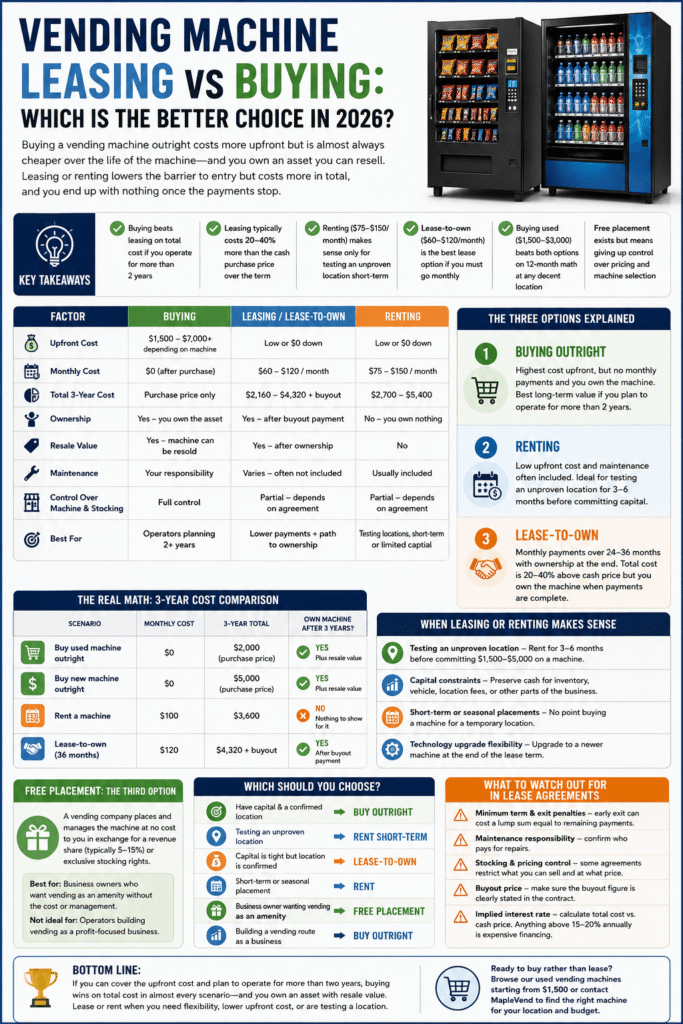
Vending machine leasing vs buying is a financial decision more than anything else — and the math is less close than most first-time operators expect. Buying a machine outright costs more on day one but is almost always cheaper over the life of the machine, and you own an asset you can resell. Leasing or renting lowers the barrier to entry but costs more in total, and you end up with nothing once the payments stop.
That said, there are genuine situations where leasing makes sense. This guide covers the real numbers behind both options, the contract traps to avoid, and a clear decision framework for 2026. Browse our vending machine shop and commercial vending machines to compare current buying options.
Key Takeaways
- ✅ Buying beats leasing on total cost if you operate for more than 2 years
- ✅ Leasing typically costs 20–40% more than the cash purchase price over the lease term
- ✅ Renting ($75–$150/month) makes sense only for testing an unproven location short-term
- ✅ Lease-to-own ($60–$120/month) is the best lease option if you must go monthly
- ✅ Buying used ($1,500–$3,000) beats both options on 12-month math at any decent location
- ✅ Free placement exists but means giving up control over pricing and machine selection
Quick Comparison: Leasing vs Buying a Vending Machine
| Factor | Buying | Leasing / Renting |
|---|---|---|
| Upfront cost | $1,500–$7,000+ depending on machine | Low or $0 down |
| Monthly cost | None (after purchase) | $60–$150/month |
| Total 3-year cost | Purchase price only | $2,160–$5,400 + no ownership |
| Ownership | Yes — you own the asset | No (rental) / Eventually (lease-to-own) |
| Resale value | Yes — machine can be resold | None on rental; possible on lease-to-own |
| Maintenance responsibility | Yours | Usually included in rental; varies on lease |
| Control over machine/stocking | Full | Partial — depends on agreement |
| Best for | Operators planning 2+ years of operation | Testing locations, limited capital, short-term needs |
The Three Options Explained
Option 1 — Buying Outright
Buying a vending machine outright is the most straightforward path and the most economical over any period longer than about 18–24 months. You pay once, you own the machine, and every dollar of revenue after product costs and operating expenses goes directly to you — no monthly payments eating into margin.
According to VendSoft’s June 2026 vending machine cost guide, the practical rule is: if you plan to operate for more than two years and can cover the upfront cost, buying wins on total cost. A used snack or combo machine runs $1,500–$3,000; a new commercial unit runs $3,500–$5,500.
The downside: more capital at risk upfront, and you’re responsible for all maintenance and repairs.
Option 2 — Renting
Renting a vending machine means paying a monthly fee — typically $75–$150/month for a snack/drink combo — to a supplier who retains ownership of the machine. Maintenance and repairs are usually included in the rental fee, which is one of its genuine advantages.
The problem with renting is the math: rent for two years at $100/month and you’ve spent $2,400 — the price of a good used machine — with nothing to show for it. Rent for three years and you’ve spent $3,600 with still no asset and no end in sight.
According to VendBuddy’s 2026 rent vs buy analysis, the one case renting genuinely beats buying is testing an unproven location for 3–6 months before committing capital. If you’re not sure a location will generate enough volume to justify a purchase, renting for a quarter while you validate the location can save you from buying a machine for a bad spot.
Option 3 — Lease-to-Own
Lease-to-own sits between renting and buying — you make monthly payments over 24–36 months and own the machine at the end. Monthly payments typically run $60–$120 for a standard machine, with the total cost landing 20–40% above the outright cash price.
As a real example from the 2026 market: Micromart’s lease-to-own program runs $230/month over 36 months with a $1,000 buyout — a total outlay of $9,280 for a machine that might cost $5,500 new. That premium buys you lower monthly payments and preserved capital, but it’s a meaningful cost over the term.
Lease-to-own is the best lease option if you genuinely need to go monthly — you get a path to ownership and lower payments than renting, even if the total cost is higher than buying outright.
The Real Math: 3-Year Cost Comparison
| Scenario | Monthly Cost | 3-Year Total | Own Machine After 3 Years? |
|---|---|---|---|
| Buy used machine outright | $0 | $2,000 (purchase price) | ✅ Yes — plus resale value |
| Buy new machine outright | $0 | $5,000 (purchase price) | ✅ Yes — plus resale value |
| Rent a machine | $100 | $3,600 | ❌ No — nothing to show for it |
| Lease-to-own (36 months) | $120 | $4,320 + buyout | ✅ Yes — after buyout payment |
The used machine purchase wins on 3-year total cost in every scenario — at $2,000 purchase price vs $3,600 in rental fees, you save $1,600 and end up owning an asset with resale value. Even a $5,000 new machine purchase beats renting over 3 years if the machine generates consistent revenue.
When Leasing Actually Makes Sense
Despite the math favoring buying, there are specific situations where leasing or renting is the genuinely better choice:
- Testing an unproven location. Renting for 3–6 months before committing $3,000–$5,000 on a machine for a location you’re not sure about is sensible risk management. If the location underperforms, you return the machine and cut your losses — you haven’t sunk capital into a placement that doesn’t work.
- Capital constraints. If your available capital is needed for other parts of the business (stocking, vehicle, location fees), leasing preserves that capital while still getting a machine in place generating revenue. The premium over time may be worth it for cash flow reasons.
- Short-term or seasonal placements. A 3-month event venue or a seasonal location doesn’t justify buying a machine you’ll need to store or relocate afterward. Renting for the season and returning the machine makes more sense.
- Technology upgrade flexibility. Some lease agreements allow upgrading to a newer machine at the end of the term, which can be valuable if you want access to newer cashless or smart vending technology without the cost of replacing owned equipment.
Free Placement: The Third Option Nobody Mentions
A third option exists beyond buying and leasing: free placement, where a vending service company places and manages the machine at no cost to the location owner in exchange for a revenue share or exclusive stocking rights.
Free placement is genuinely free in the sense that you don’t pay for the machine — but it comes with tradeoffs. The supplier controls what goes in the machine, the pricing, and how often it’s serviced. You typically receive a commission of 5–15% of gross sales rather than keeping full revenue. For a business that simply wants vending available as an amenity and doesn’t want to manage it, this can be a reasonable arrangement. For an operator who wants to run vending as a business, it’s not relevant — you need to own or control the machine.
Which Should You Choose?
| Your Situation | Best Choice | Why |
|---|---|---|
| Have capital and a confirmed location | Buy outright | Best total cost over 2+ years |
| Testing an unproven location | Rent for 3–6 months first | Limits capital risk on unknown location |
| Capital is tight but location is confirmed | Lease-to-own | Lower monthly payments; path to ownership |
| Short-term or seasonal placement | Rent | No point buying for a temporary location |
| Business owner wanting vending as an amenity | Free placement | No cost or management responsibility |
| Building a vending route as a business | Buy outright | Full revenue control and asset ownership |
What to Watch Out For in Lease Agreements
If you do go the leasing route, these contract terms are worth reading carefully before signing:
- Minimum term and early exit penalties. Most leases lock you in for 24–36 months. Exiting early often triggers a lump-sum penalty equal to the remaining payments.
- Maintenance and repair responsibility. Rental agreements typically include maintenance; lease-to-own agreements often don’t. Confirm who pays for repairs before signing.
- Stocking and pricing control. Some agreements — particularly free placement — restrict what products you can stock and at what prices. Confirm you have the control you need.
- Buyout price on lease-to-own. Make sure the buyout figure is clearly stated in the contract and isn’t subject to change at the lessor’s discretion.
- Implied interest rate. Calculate the total cost of the lease vs the cash purchase price to understand the effective interest rate you’re paying. Anything above 15–20% annually is expensive financing.
Bottom Line
The vending machine leasing vs buying decision comes down to time horizon and available capital. If you can cover the upfront cost and plan to operate for more than two years, buying wins on total cost in almost every scenario — and you end up owning an asset with resale value.
If you’re testing a new location, working with limited capital, or running a short-term placement, renting or lease-to-own gives you a lower barrier to entry at a higher total cost. Just go in knowing the math: rent for two years at $100/month and you’ve spent the price of a decent used machine with nothing to show for it.
Common Mistakes Operators Make
- Renting long-term without running the math. Two years of rent at $100/month equals $2,400 — enough to buy a good used machine outright. Always compare total cost before committing to a rental term.
- Signing a lease without reading the exit terms. Early exit penalties can be substantial. If there’s any chance the location won’t work out, make sure you understand what it costs to leave the agreement.
- Assuming free placement is free. Free placement reduces your revenue to a commission and removes your control over the machine. For a business running vending as a revenue stream, these tradeoffs usually aren’t worth it.
- Leasing when buying used would cost less. A used machine at $1,500–$2,000 often costs less over 12 months than a lease that totals the same amount with nothing to show for it at the end.
Related Guides
- New vs Used Vending Machine — choosing the right machine for your budget
- How Much Does It Cost to Stock a Vending Machine? — ongoing operating costs explained
- Can You Put a Vending Machine Anywhere? — permits and placement rules
- Cashless vs Traditional Vending Machines — payment system comparison
Frequently Asked Questions
Is it better to lease or buy a vending machine?
Buying is better for operators planning to run the machine for more than two years and who can cover the upfront cost. Leasing is better for testing unproven locations, managing limited capital, or short-term placements where buying doesn’t make financial sense.
How much does it cost to lease a vending machine?
Rental runs $75–$150/month with no path to ownership. Lease-to-own runs $60–$120/month over 24–36 months with a buyout at the end. Total cost on a lease typically runs 20–40% above the outright cash purchase price.
Can you get a vending machine for free?
Yes — through free placement programs where a vending company installs and manages the machine at no cost to you in exchange for a revenue share or exclusive stocking rights. The tradeoff is reduced control over pricing, product selection, and service frequency.
What is lease-to-own for a vending machine?
Lease-to-own means making monthly payments over a fixed term (typically 24–36 months) with ownership transferring to you at the end, sometimes with a small buyout payment. Total cost is higher than buying outright but lower than renting indefinitely, and you end up owning the machine.
How long does it take for a vending machine to pay for itself?
It depends on location, product mix, and pricing — but a well-placed machine generating $300–$500/month gross revenue can pay back a $2,000 used machine purchase in 6–12 months. A $5,000 new machine at the same revenue takes 12–18 months. Buying used at a good location is the fastest path to payback.
Is renting a vending machine worth it?
Renting is worth it in specific situations: testing an unproven location before committing to a purchase, short-term placements (events, seasonal locations), or when capital is extremely limited. For any placement you plan to keep for more than 12 months, buying — used or new — is almost always the better financial decision. Monthly rental fees of $75–$150 add up quickly and you build no equity.
Is it smart to buy a vending machine with a lease?
Lease-to-own can be smart if you lack the upfront capital for an outright purchase but have a strong confirmed placement. You build equity with each payment and own the machine at the end of the term. The trade-off is paying 20–40% more in total cost compared to buying outright. If you can afford to buy outright, buying is the stronger financial choice.
Do vending machine owners make good money?
Yes — at scale, vending machine operators make meaningful income. A single well-placed machine generates $75–$150/month net. A 10-machine route at good locations generates $800–$2,000/month net. A 30-machine full-time route generates $3,000–$8,000+/month net. The income scales with route size, location quality, and how actively the operator manages product mix and pricing.
How much do vending machines pay for rent?
Vending operators typically pay location owners a commission of 10–20% of gross sales rather than a fixed rent. At a machine generating $400/month gross, that’s $40–$80/month to the location owner. Some premium locations (hospitals, airports, large corporate campuses) negotiate higher commissions of 20–30%. A small number of high-competition locations charge a flat monthly fee — typically $50–$200/month — instead of a percentage.
What makes the most money in a vending machine?
Coffee and hot beverages generate the highest gross margin — 60–80% per transaction. Energy drinks and premium snacks (protein bars, mixed nuts) generate 45–60% margins and are increasingly in demand at gyms, offices, and healthcare facilities. Standard chips and candy generate 30–50% margins at high volume. The highest-earning products combine strong margin with high purchase frequency — daily repeat buyers at captive locations are the foundation of profitable vending.
Are vending machines still profitable in 2026?
Yes — the fundamentals of vending profitability are unchanged. Cashless payment adoption has increased transaction volume at most locations. Smart inventory management reduces stockouts and waste. Rising product prices have expanded gross margins at locations where operators have pricing power. The operators who report declining profitability typically have cash-only machines at low-traffic locations. Well-managed routes with cashless payment and data-driven product selection consistently generate strong returns.
What is the lifespan of a vending machine?
Commercial vending machines from established brands typically last 15–25 years with proper maintenance. Whether you buy or lease, machine lifespan matters significantly to the financial calculation. A leased machine at $100/month over 36 months costs $3,600 total — often more than the machine’s purchase price. A bought machine generating net income for 15–20 years after a 12–24 month payback delivers far higher total return. Lifespan is one of the strongest arguments for buying over leasing for any long-term placement.
What is replacing vending machines?
Micro-markets — open-shelf self-checkout setups — are replacing traditional vending at large corporate locations (200+ employees). Smart vending with touchscreens and IoT management is upgrading traditional machines at premium locations. For most commercial placements — offices under 100 employees, warehouses, gyms, laundromats — traditional machines remain the most cost-effective solution. The leasing vs buying decision remains relevant across all these categories; buying almost always wins on total cost for placements lasting more than 2 years.
What are the trends for vending machines in 2026?
The major 2026 trends affecting the leasing vs buying decision are: cashless payment is now essential at most locations — making MDB compatibility a non-negotiable requirement whether leasing or buying; healthy snack demand continues growing, benefiting operators who own machines and can adjust product mix freely (leased machines often restrict product selection); and smart machine features (IoT, touchscreen) are increasingly valued by premium location managers — which affects whether leasing a smart machine vs buying a traditional one is worth the cost difference at your specific location.
How much can I make a month owning a vending machine?
Owning (vs leasing) a vending machine typically generates $20–$50/month more net income than leasing or renting the same machine at the same location — because lease/rental payments eliminate a significant portion of what would otherwise be net profit. A machine generating $150/month net if owned generates $50–$75/month net if leased at $75–$100/month. Over 36 months, that difference adds up to $1,800–$2,700 in additional income from owning — which typically covers the purchase price of a used machine entirely.
How much does a vending machine owner make a year?
A single owned machine at an average location generates $900–$1,800/year net ($75–$150/month). At a good location, $1,800–$3,600/year net. At a premium location, $3,600–$9,600+/year net. A 10-machine owned route at average locations generates $9,000–$18,000/year net. The same 10 machines leased at $100/month each reduce annual net by $12,000 in lease payments — the difference between meaningful income and breaking even. Ownership vs leasing at scale is the difference between a profitable business and a marginal one.
What type of vending machine makes the most money?
Coffee machines generate the highest gross margin per transaction at 60–80%. For owned machines at most commercial locations, snack and combo machines at high-traffic offices, warehouses, and healthcare facilities generate the most reliable total monthly net income. From a leasing vs buying perspective, coffee machines typically justify ownership most strongly — the high margin per transaction means the additional monthly cost of a lease payment erodes profitability more than on a lower-margin snack machine. Own your highest-margin machines; lease only when testing unproven locations.
What is the most profitable snack to sell?
Name-brand chips (Lay’s, Doritos) generate the highest volume. Premium snacks (mixed nuts, KIND bars, protein bars) generate the highest per-unit margin at 50–65%. One advantage of owning vs leasing is product selection freedom — leased machines often come with stocking restrictions or exclusive supplier agreements that prevent operators from carrying the highest-margin items. Owning your machine gives full control over product mix, which is directly tied to monthly net profit.
Ready to buy rather than lease? Browse our used vending machines for sale starting from $1,500, or contact MapleVend to discuss financing options and which machine fits your location and budget.
