
This guide was prepared by the MapleVend editorial team using 2026 market pricing data, manufacturer specifications, and commercial operator cost benchmarks.
How much is a snack vending machine in 2026? A new commercial snack vending machine costs $3,000–$5,000. A used or refurbished snack machine from a reputable supplier costs $1,200–$2,500. The price depends on three things: whether the machine is new or used, its capacity and selection count, and what payment technology it carries. This guide breaks down every price tier, what you get at each level, and the ongoing costs most buyers forget to budget for.
Quick Answer
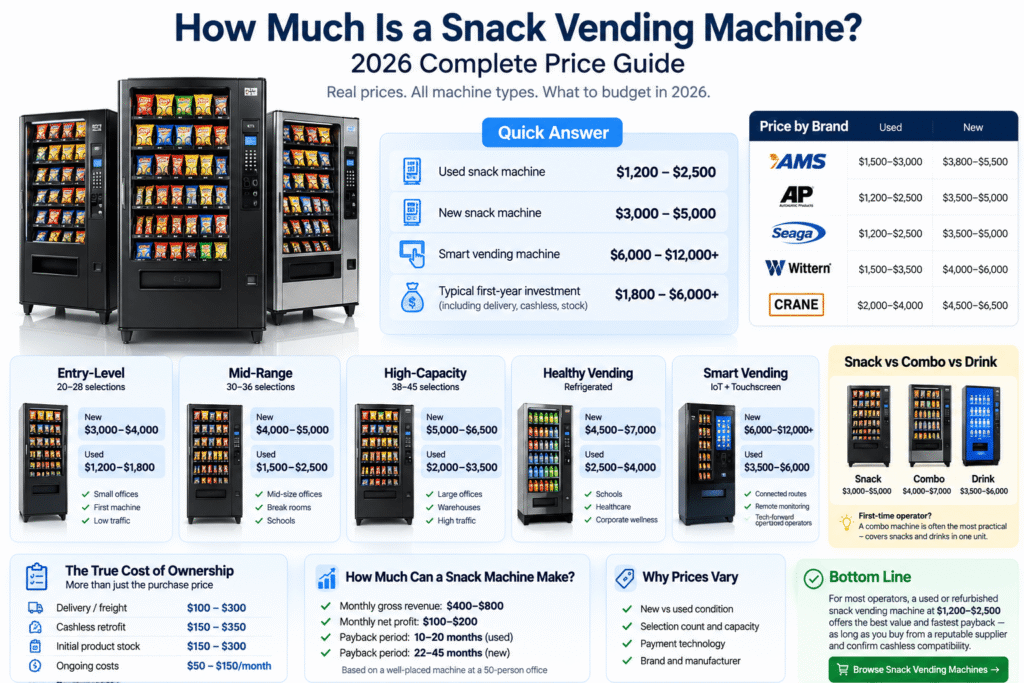
- Used snack vending machine: $1,200–$2,500
- New snack vending machine: $3,000–$5,000
- Smart vending machine: $6,000–$12,000+
- Typical first-year investment: $1,800–$6,000+ including delivery, cashless retrofit, initial stocking, and a repair buffer
Browse our current used vending machines for sale and new snack machines to compare available models and pricing.
Snack Vending Machine Average Prices at a Glance
| Machine Type | Average Cost | Best For |
|---|---|---|
| Used / refurbished snack machine | $1,200–$2,500 | First-time operators, unproven locations |
| New snack machine | $3,000–$5,000 | Proven high-traffic locations, warranty needed |
| New healthy vending machine (refrigerated) | $4,500–$7,000 | Schools, healthcare, corporate wellness |
| Smart snack machine (IoT, touchscreen) | $6,000–$12,000+ | Connected routes, remote monitoring needed |
Bottom Line: How Much Should You Budget?
| Buyer Type | Machine Type | Budget Range |
|---|---|---|
| First-time operator, tight budget | Used snack machine | $1,200–$2,500 |
| First-time operator, wants warranty | New entry-level snack machine | $3,000–$4,000 |
| Experienced operator, mid-size location | New mid-range snack machine | $4,000–$5,000 |
| High-traffic location, high capacity | New high-capacity snack machine | $5,000–$6,500 |
| Tech-forward operator, remote monitoring | Smart snack machine with IoT | $6,000–$12,000+ |
Key Takeaways
- ✅ New commercial snack machines cost $3,000–$5,000 from established manufacturers
- ✅ Used and refurbished snack machines cost $1,200–$2,500 — best value for first-time operators
- ✅ Smart machines with touchscreens and IoT connectivity run $6,000–$12,000+
- ✅ Budget an additional 20% above purchase price for delivery, cashless retrofit, and initial stock
- ✅ Ongoing costs run $50–$150/month per machine for restocking, electricity, and maintenance
- ✅ A well-placed snack machine at a 50-person office generates $100–$200/month net profit
Snack Vending Machine Prices by Category
| Machine Category | New Price | Used / Refurbished Price | Best For |
|---|---|---|---|
| Entry-level snack machine (20–28 selections) | $3,000–$4,000 | $1,200–$1,800 | Small offices, first machine, low-traffic locations |
| Mid-range snack machine (30–36 selections) | $4,000–$5,000 | $1,500–$2,500 | Mid-size offices, break rooms, schools |
| High-capacity snack machine (38–45 selections) | $5,000–$6,500 | $2,000–$3,500 | Large offices, warehouses, high-traffic locations |
| Healthy vending machine (refrigerated) | $4,500–$7,000 | $2,500–$4,000 | Schools, healthcare, corporate wellness programs |
| Smart snack machine (IoT, touchscreen) | $6,000–$12,000+ | $3,500–$6,000 | High-traffic connected routes, remote monitoring |
Snack Vending Machine Price by Brand
| Brand | Used / Refurbished | New | Known For |
|---|---|---|---|
| AMS | $1,500–$3,000 | $3,800–$5,500 | Sensit® delivery guarantee, healthy vending |
| AP (Automatic Products) | $1,200–$2,500 | $3,500–$5,000 | Heavy-gauge steel, most durable snack machine |
| Seaga | $1,200–$2,500 | $3,500–$5,000 | Most affordable new machine, easy to repair |
| Wittern / National Vendors | $1,500–$3,500 | $4,000–$6,000 | Top-tier reliability, widest U.S. service network |
| Crane National | $2,000–$4,000 | $4,500–$6,500 | Premium tier, enterprise-grade reliability |
What Affects the Price of a Snack Vending Machine?
1. New vs Used
The single biggest price variable is whether you buy new or used. According to VendSoft’s June 2026 vending machine cost guide, new snack machines run $3,000–$5,000, while used or refurbished units cost $1,200–$2,500 — roughly 40–60% less. For first-time operators placing a machine at an unproven location, the used market often represents the better risk-adjusted choice: lower capital at risk if the location underperforms, with comparable performance if the machine is properly inspected before purchase.
For guidance on evaluating used machines before buying, see our How to Buy a Used Vending Machine guide — it covers the specific inspection points that determine whether a used machine is a good buy or a liability.
2. Selection Count and Capacity
Snack machines are primarily priced by their selection count — how many different products they can carry simultaneously. A 20-selection machine costs less than a 40-selection machine from the same manufacturer. The tradeoff is restocking frequency: a low-capacity machine at a busy location needs restocking every 2–3 days, while a high-capacity machine at the same location might run a full week between visits. For route operators, the restocking labor savings from a higher-capacity machine often justify the higher purchase price at busy locations.
3. Payment Technology
A snack machine with only cash payment capability costs less than the same machine with a cashless card reader installed. According to Digital Media Vending’s 2026 price guide, refurbished snack machines from reputable dealers range from $1,500–$2,500, while new machines from Seaga, AMS, and Crane National run $4,000–$5,500. The gap between cash-only and cashless-equipped machines at similar capacity levels is typically $200–$500. Given that over 80% of vending transactions in the U.S. are now cashless according to PayRange’s May 2026 operator analysis, a machine without card payment capability has a structural revenue disadvantage — the retrofit cost ($150–$350) is almost always worth paying upfront.
4. Brand and Manufacturer
Established commercial brands — Seaga, AMS, AP, Wittern, Crane — price higher than off-brand or imported machines because they carry active parts networks, known service histories, and technician familiarity across the U.S. A $2,000 off-brand machine with no parts availability is significantly riskier than a $2,500 refurbished AMS or Seaga unit with an active domestic parts supply chain. When evaluating price, always factor in parts availability and service network quality — not just the sticker price.
Real Snack Vending Machine Price Examples
| Model | Selections | Condition | Typical Price |
|---|---|---|---|
| AP 112 | 32 | Used / refurbished | $1,200–$2,000 |
| AP 113 | 40 | Used / refurbished | $1,500–$2,500 |
| AMS 35 | 35 | Used / refurbished | $1,500–$2,500 |
| AMS 39 | 39 | Used / refurbished | $1,800–$3,000 |
| Seaga snack machine | Various | New | $3,500–$5,000 |
| Crane National snack machine | Various | New | $4,500–$6,500 |
| Smart snack machine | Various | New | $6,000–$12,000+ |
The True Cost of a Snack Vending Machine
The purchase price is only part of the total cost. According to VendSoft’s 2026 cost analysis, operators who plan only for the machine sticker price often get caught off guard by ongoing costs that erode their margins. A complete first-year budget for a snack machine looks like this:
| Cost Item | One-Time | Monthly / Annual |
|---|---|---|
| Machine purchase | $1,200–$5,000 | — |
| Delivery / freight | $100–$300 | — |
| Cashless reader retrofit (if needed) | $150–$350 | — |
| Initial product stock | $150–$300 | — |
| Electricity | — | $3–$10/month |
| Product restocking | — | $50–$150/month |
| Card processing fees | — | 1.5–3% of cashless sales |
| Maintenance and repairs | — | $10–$30/month (budget average) |
| Site fee / revenue share | — | 0–25% of gross sales |
How Much Does a Snack Machine Make?
Understanding the cost of a snack machine is most useful when paired with realistic revenue expectations. A well-placed snack machine at a 50-person office typically generates:
- Daily gross revenue: $20–$40
- Monthly gross revenue: $400–$800
- Monthly product cost (at ~40% of revenue): $160–$320
- Monthly electricity + maintenance: $15–$40
- Estimated monthly net profit: $100–$200
At this performance level, a $2,000 used snack machine pays back in 10–20 months. A $4,500 new machine at the same location takes 22–45 months to pay back — which is why used machines are typically the better choice for first placements at unproven locations. For a full breakdown of revenue potential, see our guide on how much it costs to stock a vending machine.
New vs Used Snack Vending Machine: Which Should You Buy?
| Factor | New Machine | Used / Refurbished Machine |
|---|---|---|
| Price | $3,000–$6,500 | $1,200–$3,000 |
| Warranty | Full manufacturer warranty | Limited or none (varies by supplier) |
| Payment technology | Current cashless standard | May need retrofit — confirm before buying |
| Risk level | Lower — known condition | Higher — varies by inspection and supplier |
| Payback period | Longer — higher upfront cost | Shorter — lower upfront cost |
| Best for | Proven high-traffic locations, operators wanting warranty | First machines, unproven locations, budget-conscious operators |
For a full comparison of the two options, see our New vs Used Vending Machine guide.
Snack vs Combo vs Drink Vending Machine: Price Comparison
If you’re deciding between a snack machine and other types, here’s how the prices compare across all three categories in 2026:
| Machine Type | New Price | Used Price | Best For |
|---|---|---|---|
| Snack vending machine | $3,000–$5,000 | $1,200–$2,500 | Locations with existing drink options, high snack demand |
| Combo vending machine | $4,000–$7,000 | $1,800–$3,500 | First machine, small offices, limited space — covers both snacks and drinks |
| Drink vending machine | $3,500–$6,000 | $1,200–$3,000 | Gyms, warehouses, locations where cold drink demand is primary |
For most first-time operators choosing between a snack machine and a combo unit, the combo machine is the more practical starting point — it covers both product categories in one footprint, one outlet, and one placement agreement. See our full Snack vs Combo Vending Machine comparison for a detailed breakdown.
Common Mistakes When Budgeting for a Snack Machine
- Budgeting only for the purchase price. Delivery, cashless retrofit, initial stock, and a repair buffer typically add $500–$1,000 to the true first-year cost. Plan for the all-in number, not just the sticker price.
- Buying the cheapest machine available. A $900 off-brand machine with no parts availability network is not a bargain — it’s a liability the moment something breaks. Established brands with active service networks cost more for a reason.
- Ignoring site fees. Some location owners charge a revenue share of 10–25% of gross sales. A machine generating $600/month gross at a location charging 20% revenue share nets $120 less per month before product costs — factor this in before agreeing to a placement.
- Skipping the cashless upgrade. A cash-only snack machine leaves significant revenue on the table in 2026. The $150–$350 cashless retrofit cost pays back within weeks at most commercial locations.
How We Estimated These Costs
Prices in this guide are based on 2026 manufacturer MSRP data, refurbished vending supplier listings (including A&M Equipment Sales, VendingMix, and MapleVend’s own commercial inventory), and commercial vending dealer pricing observed across the U.S. market during the first half of 2026.
Used machine prices reflect machines in working condition from reputable commercial refurbishers and may vary by region, payment system included, cosmetic condition, and model year. Private seller prices (Craigslist, Facebook Marketplace) can be lower but carry significantly higher risk — the ranges above reflect pricing from commercial suppliers with inspection and testing processes in place.
Ongoing cost estimates (electricity, restocking, maintenance) are based on VendSoft’s June 2026 operator cost benchmarks and MapleVend’s commercial deployment experience across snack machine placements at offices, warehouses, and schools.
Related Guides
- Vending Machine Leasing vs Buying — financing options
- Best Vending Machine for Small Business — which machine fits your location
Frequently Asked Questions
How much is a snack vending machine?
A new commercial snack vending machine costs $3,000–$5,000 from established manufacturers like Seaga, AMS, and Crane. A used or refurbished snack machine from a reputable supplier costs $1,200–$2,500. Smart machines with touchscreens and IoT connectivity run $6,000–$12,000+.
How much does a used snack vending machine cost?
Used snack machines from reputable commercial suppliers typically run $1,200–$2,500 depending on brand, model, capacity, and whether cashless payment has been retrofitted. Refurbished units with updated payment hardware and a limited warranty typically run $1,500–$2,500.
Is a snack vending machine a good investment?
A well-placed snack machine at a 50+ person office or high-traffic commercial location typically generates $100–$200/month net profit and pays back a used machine purchase within 10–20 months. Location quality is the primary variable — a machine in a poor location underperforms regardless of price paid.
What is the cheapest snack vending machine?
The most affordable commercial-grade snack machines are used AP 112 and AMS 35 units from reputable suppliers, typically available for $1,200–$1,800. Be cautious of machines priced below $1,000 — at that price point, hidden problems are common and total true cost often exceeds a cleaner used unit at $1,500.
What brands make the best snack vending machines?
Based on operator reviews and commercial deployment history, AMS, AP, Seaga, and Wittern are consistently cited as the strongest snack vending machine brands in the U.S. market. AMS offers the Sensit® delivery guarantee; AP is known for heavy-gauge steel construction; Seaga for accessible pricing; Wittern for long-term reliability and service network.
How profitable is a snack vending machine?
A snack vending machine at an average commercial location generates $100–$250/month gross and $40–$120/month net after product cost, commission, electricity, and maintenance. At a high-traffic location with 100+ daily users — a warehouse, school, or healthcare facility — $300–$600/month gross and $120–$250/month net is achievable. Snack machines have a profitability advantage over refrigerated machines: zero compressor cost, lower electricity ($3–$10/month), and simpler maintenance — all of which improve effective net margin at comparable gross revenue levels.
What type of vending machine is the most profitable?
Coffee machines generate the highest gross margin per transaction at 60–80%. For snack vending specifically, machines with a high selection count (40+ selections) at captive high-traffic locations generate the most reliable monthly net income. Snack machines have lower operating costs than combo or drink machines — no refrigeration electricity, no compressor maintenance — which makes their effective net margin higher per dollar of gross revenue than refrigerated alternatives at comparable locations.
What sells the most in a snack vending machine?
Name-brand chips (Lay’s, Doritos, Cheetos) consistently lead by unit volume at most commercial locations. Candy bars (Snickers, Reese’s Peanut Butter Cups, Kit Kat) are the top-selling candy items. Crackers (Cheez-It, Goldfish) and granola bars (Nature Valley) perform well at office and healthcare locations. At health-focused corporate offices and gyms, mixed nuts, KIND bars, and protein bars increasingly outsell standard candy. Track your specific location’s column-by-column sales for the first 60 days and adjust the planogram based on actual data rather than assumptions.
What is the lifespan of a snack vending machine?
Commercial snack vending machines from established brands (AP, AMS, Wittern, Seaga, Crane) typically last 15–25 years with proper maintenance. Snack machines outlast refrigerated machines in most cases because there is no compressor to fail and no refrigeration system to maintain. A used snack machine that is 8–10 years old from a reputable brand has 10–15+ years of commercial life remaining — which is a key reason used snack machines deliver among the highest total return on investment of any vending machine category.
What is replacing vending machines?
Micro-markets — open-shelf self-checkout setups — are replacing traditional snack vending at large corporate locations with 200+ employees. Smart snack machines with touchscreens and IoT inventory management are upgrading traditional machines at premium locations. For the vast majority of snack vending placements — offices under 100 employees, warehouses, schools, gyms, laundromats — traditional snack machines remain the most cost-effective solution. The snack machine market at core commercial placements is not shrinking.
How long does it take a snack vending machine to pay itself off?
A used snack machine at $1,500 generating $100/month net pays back in 15 months. At $120/month net, payback is 12–13 months. A new snack machine at $4,000 at the same location takes approximately 33 months. At a premium high-traffic location generating $200/month net, a $4,000 new machine pays back in 20 months. Snack machines’ lower electricity and maintenance costs give them a shorter effective payback period than comparable combo or drink machines at the same gross revenue level.
Are vending machines a good investment in 2026?
Yes — snack vending machines in particular offer strong investment characteristics. Low electricity cost ($3–$10/month), no compressor maintenance, 15–25 year lifespan, and consistent demand at commercial locations combine to make a used snack machine one of the highest total-return vending investments available. A $1,500 used machine generating $100/month net produces $1,200/year after a 15-month payback — and continues generating income for 10–15+ more years with routine maintenance.
Can I legally put a snack vending machine on my property?
Yes — on your own private property. However, residential zoning codes in most cities prohibit commercial vending from residential properties, so placing a machine at your home for public access is typically not permitted. For commercial placements on other people’s property, you need a signed placement agreement with the property owner. The most legally straightforward placements are private commercial locations — offices, warehouses, gyms — where you negotiate directly with the property manager and sign a standard placement agreement.
What is a disadvantage of owning a snack vending machine?
The main disadvantages are: snack machines are single-category — they cannot vend cold drinks, which means operators need a separate drink machine to serve both categories at the same location; snack machines at low-traffic locations generate minimal revenue regardless of machine quality; and restocking requires purchasing, transporting, and organizing inventory on a weekly or biweekly basis. Operators who place snack machines at confirmed high-traffic locations and pair them with a drink machine where demand warrants it minimize these disadvantages effectively.
Ready to buy a snack vending machine? Browse our snack vending machines for sale across new and used options — or contact MapleVend to discuss which model fits your location and budget.
