
How much is a drink vending machine in 2026? A new cold drink vending machine costs $4,000–$6,000. A used or refurbished drink machine from a reputable supplier costs $1,500–$3,000. Drink machines cost more than snack machines because of refrigeration — the compressor, insulation, and cooling system add both upfront cost and ongoing electricity expense. This guide breaks down every price tier, what you get at each level, and the total cost of ownership most buyers overlook.
Browse our current used vending machines for sale and new drink machines to compare available models and pricing.
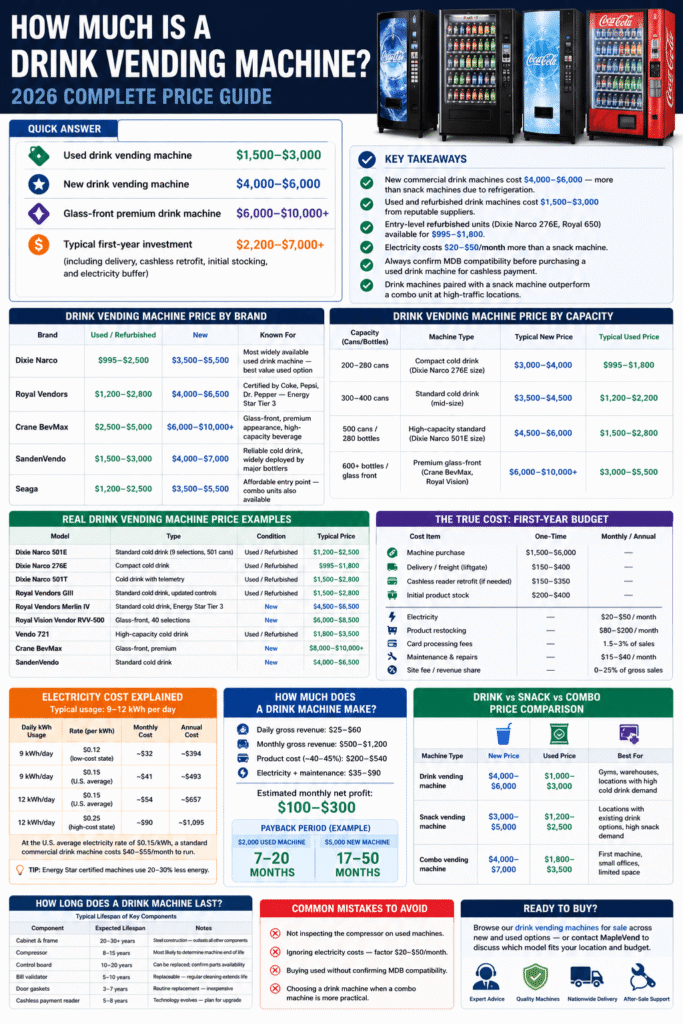
Quick Answer
- Used drink vending machine: $1,500–$3,000
- New drink vending machine: $4,000–$6,000
- Glass-front premium drink machine: $6,000–$10,000+
- Typical first-year investment: $2,200–$7,000+ including delivery, cashless retrofit, initial stocking, and electricity buffer
Drink Vending Machine Average Prices at a Glance
| Machine Type | New Price | Used / Refurbished Price | Best For |
|---|---|---|---|
| Standard cold drink machine | $4,000–$6,000 | $1,500–$3,000 | Offices, warehouses, gyms — most common commercial placement |
| Glass-front beverage machine | $6,000–$10,000+ | $3,000–$5,000 | Retail, hotel lobbies, premium office environments |
| Outdoor-rated drink machine | $5,000–$8,000 | $2,500–$4,000 | Transit hubs, outdoor venues, gas stations |
| Entry-level refurbished drink machine | — | $995–$1,800 | First machine, unproven locations, tight budget |
Key Takeaways
- ✅ New commercial drink machines cost $4,000–$6,000 — more than snack machines due to refrigeration
- ✅ Used and refurbished drink machines cost $1,500–$3,000 from reputable suppliers
- ✅ Entry-level refurbished units (Dixie Narco 276E, Royal 650) available for $995–$1,800
- ✅ Electricity costs $20–$50/month more than a snack machine — factor into ROI calculations
- ✅ Always confirm MDB compatibility before purchasing a used drink machine for cashless payment
- ✅ Drink machines paired with a snack machine outperform a combo unit at high-traffic locations
Drink Vending Machine Price by Brand
| Brand | Used / Refurbished | New | Known For |
|---|---|---|---|
| Dixie Narco | $995–$2,500 | $3,500–$5,500 | Most widely available used drink machine — best value used option |
| Royal Vendors | $1,200–$2,800 | $4,000–$6,500 | Certified by Coke, Pepsi, Dr. Pepper — Energy Star Tier 3 |
| Crane BevMax | $2,500–$5,000 | $6,000–$10,000+ | Glass-front, premium appearance, high-capacity beverage |
| SandenVendo | $1,500–$3,000 | $4,000–$7,000 | Reliable cold drink, widely deployed by major bottlers |
| Seaga | $1,200–$2,500 | $3,500–$5,500 | Affordable entry point — combo units also available |
Drink Vending Machine Price by Capacity
| Capacity | Machine Type | Typical New Price | Typical Used Price |
|---|---|---|---|
| 200–280 cans | Compact cold drink (Dixie Narco 276E size) | $3,000–$4,000 | $995–$1,800 |
| 300–400 cans | Standard cold drink (mid-size) | $3,500–$4,500 | $1,200–$2,200 |
| 500 cans / 280 bottles | High-capacity standard (Dixie Narco 501E size) | $4,500–$6,000 | $1,500–$2,800 |
| 600+ bottles / glass front | Premium glass-front (Crane BevMax, Royal Vision) | $6,000–$10,000+ | $3,000–$5,500 |
Why Drink Machines Cost More Than Snack Machines
According to VendSoft’s June 2026 vending machine cost guide, drink machines cost more than snack machines because of refrigeration — the compressor, insulation panels, door seals, and electronic cooling controls add significant hardware cost that a snack machine simply doesn’t carry. A basic snack machine uses a standard outlet and draws minimal power; a cold drink machine runs its compressor continuously to maintain 35–40°F internal temperature around the clock.
The practical implications for buyers:
- Higher purchase price: $1,000–$2,000 more than a comparable snack machine at the same capacity
- Higher electricity cost: $20–$50/month vs $3–$10/month for a snack machine
- Higher repair risk on used machines: the compressor is the most expensive single component — always inspect before buying used
- Higher revenue potential: cold drinks generate strong impulse purchases in gyms, warehouses, and outdoor locations where temperature matters
What Affects the Price of a Drink Vending Machine?
1. New vs Used
According to Digital Media Vending’s 2026 pricing guide, refurbished beverage machines from reputable dealers run $995–$2,195, with entry-level models like the Dixie Narco 276E and Royal 650 available for $1,200–$1,800 refurbished. New machines from major manufacturers run $4,000–$6,000, while glass-front machines like the Crane BevMax push above $8,000–$10,000. For first-time operators at unproven locations, a properly inspected used Dixie Narco or Royal Vendors machine typically represents the better risk-adjusted investment. For guidance on what to check before buying used, see our used vending machine inspection guide.
2. Glass Front vs Standard Cabinet
Glass-front drink machines — where customers can see the product selection through a transparent front — cost significantly more than standard cabinet machines but generate higher sales at premium locations. The visual merchandising effect is real: customers buy what they can see. At hotel lobbies, premium coworking spaces, and modern retail environments, a glass-front machine can justify the $3,000–$5,000 premium through higher per-unit revenue. At a warehouse break room, a standard cabinet machine performs comparably at a much lower price point.
3. Capacity and Package Flexibility
Drink machines are priced partly by how many selections they carry and how flexibly they handle different package sizes — 12oz cans, 16oz cans, 20oz bottles, 1-liter bottles. Machines that require shims or kits to switch between formats cost less upfront but require more operator effort to reconfigure. Machines with flexible or universal channel systems (like Royal Vendors’ lineup) cost more but save labor at locations where the product mix changes frequently.
4. Brand and Certification
Drink machines from brands certified by Coca-Cola, Pepsi, or Dr. Pepper — Royal Vendors and a small number of other manufacturers — price at a premium over uncertified equivalents. For operators running branded beverage programs through bottler relationships, these certifications matter directly to contract eligibility. For operators buying for a standard office or warehouse location without a bottler relationship, certification adds cost without adding practical value.
Real Drink Vending Machine Price Examples
| Model | Type | Condition | Typical Price |
|---|---|---|---|
| Dixie Narco 501E | Standard cold drink (9 selections, 501 cans) | Used / refurbished | $1,200–$2,500 |
| Dixie Narco 276E | Compact cold drink | Used / refurbished | $995–$1,800 |
| Dixie Narco 501T | Cold drink with telemetry | Used / refurbished | $1,500–$2,800 |
| Royal Vendors GIII | Standard cold drink, updated controls | Used / refurbished | $1,500–$2,800 |
| Royal Vendors Merlin IV | Standard cold drink, Energy Star Tier 3 | New | $4,500–$6,500 |
| Royal Vision Vendor RVV-500 | Glass-front, 40 selections | New | $6,000–$8,500 |
| Vendo 721 | High-capacity cold drink | Used / refurbished | $1,800–$3,500 |
| Crane BevMax | Glass-front, premium | New | $8,000–$10,000+ |
| SandenVendo | Standard cold drink | New | $4,000–$6,500 |
The True Cost of a Drink Vending Machine
The purchase price is only part of the total cost. A complete first-year budget for a cold drink machine:
| Cost Item | One-Time | Monthly / Annual |
|---|---|---|
| Machine purchase | $1,500–$6,000 | — |
| Delivery / freight (liftgate) | $150–$400 | — |
| Cashless reader retrofit (if needed) | $150–$350 | — |
| Initial product stock | $200–$400 | — |
| Electricity | — | $20–$50/month |
| Product restocking | — | $80–$200/month |
| Card processing fees | — | 1.5–3% of cashless sales |
| Maintenance and repairs | — | $15–$40/month (budget average) |
| Site fee / revenue share | — | 0–25% of gross sales |
How Much Does a Drink Vending Machine Cost to Run? Electricity Explained
Cold drink machines run their compressors continuously — unlike snack machines which draw minimal power. A typical commercial drink machine consumes 9–12 kWh per day. Here’s what that means in real dollars at common U.S. electricity rates:
| Daily kWh Usage | Rate (per kWh) | Monthly Cost | Annual Cost |
|---|---|---|---|
| 9 kWh/day | $0.12 (low-cost state) | ~$32 | ~$394 |
| 9 kWh/day | $0.15 (U.S. average) | ~$41 | ~$493 |
| 12 kWh/day | $0.15 (U.S. average) | ~$54 | ~$657 |
| 12 kWh/day | $0.25 (high-cost state e.g. CA, NY) | ~$90 | ~$1,095 |
At the U.S. average electricity rate of $0.15/kWh, a standard commercial drink machine costs $40–$55/month to run. Energy Star certified machines — like the Royal Vendors Merlin IV — use less power and can reduce these costs by 20–30% compared to older non-certified units. For operators in high-cost electricity states like California or New York, energy efficiency is a more meaningful purchase consideration than it is in lower-cost markets.
Practical rule: If your location’s monthly net revenue after product costs is under $80, electricity alone may make a cold drink machine marginally profitable. The math works best at locations generating $150+/month net before electricity and maintenance.
How Much Does a Drink Machine Make?
A well-placed cold drink machine at a 50-person warehouse or gym typically generates:
- Daily gross revenue: $25–$60
- Monthly gross revenue: $500–$1,200
- Monthly product cost (at ~40–45% of revenue): $200–$540
- Monthly electricity + maintenance: $35–$90
- Estimated monthly net profit: $100–$300
At this performance level, a $2,000 used drink machine pays back in 7–20 months depending on location volume. A $5,000 new machine at the same location takes 17–50 months — which reinforces why used machines are typically the better choice for first placements. For a full breakdown of ongoing stocking costs, see our guide on how much it costs to stock a vending machine.
Drink vs Snack vs Combo Vending Machine: Price Comparison
| Machine Type | New Price | Used Price | Best For |
|---|---|---|---|
| Drink vending machine | $4,000–$6,000 | $1,500–$3,000 | Gyms, warehouses, locations with high cold drink demand |
| Snack vending machine | $3,000–$5,000 | $1,200–$2,500 | Locations with existing drink options, high snack demand |
| Combo vending machine | $4,000–$7,000 | $1,800–$3,500 | First machine, small offices, limited space |
For most first-time operators choosing between a dedicated drink machine and a combo unit, the combo machine is more practical — it covers both snacks and drinks in one footprint at a lower combined cost than buying separate machines. A dedicated drink machine makes the most sense as a second unit at a location that has already proven drink demand beyond what a combo machine can cover.
New vs Used Drink Vending Machine: Which Should You Buy?
| Factor | New Machine | Used / Refurbished Machine |
|---|---|---|
| Price | $4,000–$6,000+ | $1,500–$3,000 |
| Compressor condition | New — no wear history | Variable — always inspect before buying |
| Warranty | Full manufacturer warranty | Limited or none (varies by supplier) |
| Cashless payment | Current standard included | May need retrofit — confirm MDB compatibility |
| Energy efficiency | Current Energy Star ratings | Varies by machine age and model |
| Best for | High-traffic proven locations, warranty needed | First machines, unproven locations, budget operators |
For a full comparison of the two options, see our New vs Used Vending Machine guide.
How Long Does a Drink Vending Machine Last?
A commercial cold drink vending machine typically lasts 10–20 years with routine maintenance. The main components and their expected lifespans:
| Component | Expected Lifespan | Notes |
|---|---|---|
| Cabinet and frame | 20–30+ years | Steel construction — outlasts all other components |
| Compressor | 8–15 years | The component most likely to determine machine end of life — inspect on used machines |
| Control board | 10–20 years | Can be replaced; confirm parts availability on older models |
| Bill validator | 5–10 years | Replaceable — regular cleaning extends life significantly |
| Door gaskets | 3–7 years | Routine replacement — inexpensive and easy to source |
| Cashless payment reader | 5–8 years | Technology evolves — plan for periodic upgrade regardless of physical condition |
Refurbished machines from established brands (Dixie Narco, Royal Vendors, SandenVendo) can continue operating reliably for many years when properly maintained. Most operators retire drink machines because of outdated payment technology or compressor wear — not because the cabinet itself has failed. Energy Star certified machines tend to last longer at the compressor level because they run more efficiently and generate less heat stress on the cooling system over time.
Common Mistakes When Buying a Drink Vending Machine
- Not inspecting the compressor on used machines. The compressor is the most expensive single component in a drink machine — replacement runs $350–$800. Always power the machine on and listen for clean, consistent compressor operation before buying used.
- Ignoring electricity costs. A cold drink machine running continuously costs $20–$50/month in electricity — $240–$600/year. At a low-traffic location where net profit is only $80/month, electricity alone takes a significant bite. Factor it in before placing.
- Buying a used unit without confirming MDB compatibility. Older drink machines may lack the MDB port needed for cashless retrofits. Always confirm before purchasing — a machine without MDB capability can’t be cost-effectively upgraded for cashless payment.
- Choosing a drink machine when a combo machine is more practical. At a first location or small office, a combo machine covers both snacks and drinks in one unit. A dedicated drink machine only makes sense when drink volume at a proven location outpaces what a combo can handle.
How We Estimated These Costs
Prices in this guide are based on 2026 manufacturer MSRP data, refurbished vending supplier listings (including A&M Equipment Sales, VendingMix, and MapleVend’s commercial inventory), and industry pricing data from VendSoft, Digital Media Vending, and LatestCost’s June 2026 U.S. drink machine price analysis. Used machine prices reflect machines in working condition from commercial refurbishers and may vary by region, cashless payment capability, compressor condition, and cosmetic condition.
Related Guides
- Dixie Narco Vending Machine Reviews — the top used drink machine option
- Royal Vendors Vending Machine Reviews — certified by Coke, Pepsi, and Dr. Pepper
- Cashless vs Traditional Vending Machines — upgrading older drink machines
- Best Vending Machine for Small Business — which machine type fits your location
- Vending Machine Leasing vs Buying — financing options for drink machines
Frequently Asked Questions
How much is a drink vending machine?
A new cold drink vending machine costs $4,000–$6,000 from established manufacturers like Dixie Narco, Royal Vendors, and SandenVendo. Used and refurbished drink machines cost $1,500–$3,000. Entry-level refurbished units (Dixie Narco 276E, Royal 650) are available for $995–$1,800. Glass-front premium machines run $6,000–$10,000+.
Why do drink vending machines cost more than snack machines?
Drink machines cost more because of refrigeration — the compressor, insulation panels, door seals, and electronic cooling controls add significant hardware cost. They also cost more to run: $20–$50/month in electricity vs $3–$10/month for a snack machine.
What is the cheapest drink vending machine?
The most affordable commercial-grade drink machines are used Dixie Narco 276E and Royal 650 units from reputable refurbishers, typically available for $995–$1,800. Be cautious of machines priced below $800 from private sellers — compressor condition is difficult to assess without a proper inspection.
Is a drink vending machine worth it?
A well-placed cold drink machine at a gym, warehouse, or high-traffic commercial location typically generates $100–$300/month net profit and pays back a used machine in 7–20 months. The key variables are location foot traffic, drink demand, and electricity cost — factor all three before committing to a placement.
Do I need a separate drink machine or a combo machine?
For a first placement or small office, a combo machine covers both snacks and drinks more cost-effectively than buying two separate machines. A dedicated drink machine makes the most sense as a second unit at a proven high-traffic location where cold drink volume has outgrown what a combo machine can handle.
Are drink vending machines profitable?
Yes — cold drink machines at good locations generate strong monthly revenue because beverage purchase frequency is higher than snack purchase frequency at most commercial locations. A drink machine at a warehouse, gym, or outdoor location with 100+ daily users can generate $300–$600+/month gross. After product cost (35–45%), location commission (10–20%), and electricity ($20–$50/month), net income at a strong location runs $100–$250+/month. The higher electricity cost vs snack machines is offset by higher gross revenue at active commercial placements.
What sells the most in a drink vending machine?
Bottled water is consistently the highest-volume single item in most commercial drink machines. Coca-Cola, Pepsi, and diet cola follow. Energy drinks (Red Bull, Monster) lead at gyms, warehouses, and industrial locations. Sports drinks (Gatorade, Powerade) perform well at outdoor, athletic, and manual labor locations. At corporate offices, sparkling water and premium beverages increasingly compete with traditional cola for top-volume status. Cashless payment is essential for drink machines — the majority of beverage purchases are now contactless.
What is the lifespan of a drink vending machine?
Commercial cold drink machines from established brands (Dixie Narco, Royal Vendors, Crane BevMax) typically last 15–20 years with proper maintenance. The compressor is the component most likely to need replacement before the cabinet wears out — typically at 10–15 years on heavily used machines. Operators who service the condenser coil quarterly and maintain proper temperature settings significantly extend compressor life. A used drink machine 5–8 years old from a reputable brand has 8–12+ years of commercial life remaining with routine maintenance.
What is replacing vending machines?
Micro-markets are replacing traditional vending at large corporate locations with 200+ employees. Smart drink machines with touchscreens and IoT management are upgrading traditional machines at premium placements. For the vast majority of drink vending locations — gyms, warehouses, outdoor industrial, schools — traditional cold drink machines remain the most cost-effective solution. The beverage vending segment at core commercial placements continues to perform strongly despite these trends.
How long does it take a drink vending machine to pay itself off?
A used drink machine at $1,800 generating $120/month net pays back in 15 months. A new drink machine at $5,000 at the same location pays back in approximately 42 months. At a premium high-traffic location (warehouse, gym, outdoor industrial) generating $200/month net, a $5,000 new machine pays back in 25 months. Drink machines have a longer payback period than snack machines at comparable revenue levels due to higher machine cost and electricity overhead — which is why starting with a used machine is particularly recommended for first-time drink machine buyers.
Are vending machines a good investment in 2026?
Yes — cold drink machines at the right locations deliver strong ROI. Royal Vendors and Dixie Narco machines certified by Coca-Cola and Pepsi bottlers consistently generate above-average revenue at confirmed high-traffic locations. The investment case is strongest at warehouses, gyms, outdoor industrial locations, and schools where cold drink demand is year-round, consistent, and not easily replaced by nearby retail alternatives. Always secure the location before purchasing the machine.
What is a disadvantage of owning a drink vending machine?
The main disadvantages are: higher electricity cost ($20–$50/month) vs snack machines ($3–$10/month); compressor maintenance adds repair complexity and occasional significant cost; drink-only machines cannot serve snack demand at the same location; higher purchase price than snack machines increases payback period; and compressor failure can put the machine out of service for days while awaiting repair. Operators who run preventative maintenance schedules and stock common wear parts reduce these disadvantages significantly.
Can I legally put a drink vending machine on my property?
Yes — on your own commercial or private property with appropriate permits. Residential zoning codes in most cities prohibit commercial vending from residential addresses. For commercial placements on other people’s property, you need a signed placement agreement with the property owner. Cold drink machines at outdoor public locations may also require municipal permits and ADA compliance (controls accessible from wheelchair height). Always confirm local permit requirements before placing any machine.
Ready to buy a drink vending machine? Browse our drink vending machines for sale across new and used options — or contact MapleVend to discuss which model fits your location and budget.
