
This guide was prepared by the MapleVend editorial team using manufacturer documentation, operator feedback, industry lifespan studies, and commercial vending deployment records.
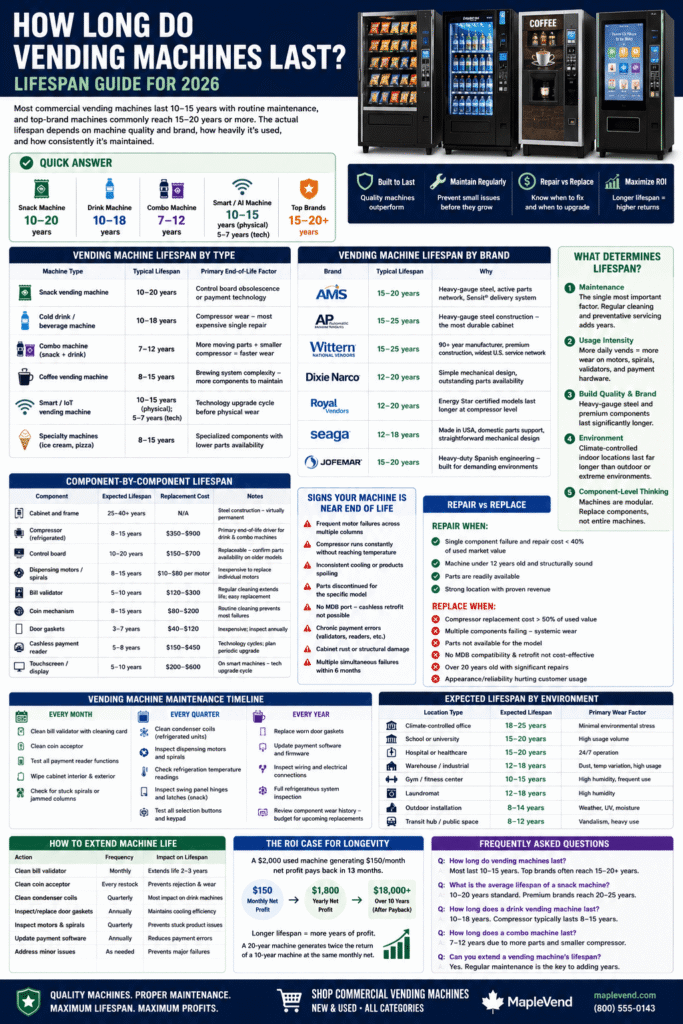
How long do vending machines last? Most commercial vending machines last 10 15 years with routine maintenance, and top-brand machines from established manufacturers like AMS, Dixie Narco, Crane, Royal Vendors, and Wittern commonly reach 15 20 years or more. The actual lifespan depends on three things: machine quality and brand, how heavily it’s used, and how consistently it’s maintained. This guide covers what determines vending machine lifespan, how different machine types compare, and the signs that tell you it’s time to repair vs. replace.
Browse our commercial vending machines for sale new and used options across all categories.
Quick Answer
- Standard snack machine: 10 20 years with proper maintenance
- Standard cold drink machine: 10 18 years (compressor is the limiting factor)
- Combo machine: 7 12 years (more moving parts, smaller compressor)
- Smart / AI vending machine: Physical machine lasts 10 15 years; technology components need upgrading every 5 7 years
- Top-brand machines (AMS, Dixie Narco, Crane, Wittern): 15 20+ years with normal upkeep
Vending Machine Lifespan by Type
| Machine Type | Typical Lifespan | Primary End-of-Life Factor |
|---|---|---|
| Snack vending machine | 10 20 years | Control board obsolescence or payment technology |
| Cold drink / beverage machine | 10 18 years | Compressor wear most expensive single repair |
| Combo machine (snack + drink) | 7 12 years | More moving parts + smaller compressor = faster wear |
| Coffee vending machine | 8 15 years | Brewing system complexity more components to maintain |
| Smart / IoT vending machine | 10 15 years (physical); 5 7 years (tech) | Technology upgrade cycle before physical wear |
| Specialty machines (ice cream, pizza) | 8 15 years | Specialized components with lower parts availability |
Vending Machine Lifespan by Brand
According to a New York-based route operator cited by MotoSnax Vending who has placed and serviced machines across the Tri-State Area: “With the right brand and proper upkeep, a vending machine can last 8 to 20 years depending on the model, usage, and environment.” The same operator notes: “In my entire time running vending machines, I have never replaced a machine because it ‘died.’ The only issues I’ve run into were small and affordable fixes.”
| Brand | Typical Lifespan | Why |
|---|---|---|
| AMS | 15 20 years | Heavy-gauge steel, active parts network, Sensit(R) delivery system |
| AP (Automatic Products) | 15 25 years | Heavy-gauge steel construction the most durable cabinet in commercial vending |
| Wittern / National Vendors | 15 25 years | 90+ year manufacturer, premium construction, widest U.S. service network |
| Dixie Narco | 12 20 years | Simple mechanical design, outstanding parts availability |
| Royal Vendors | 12 20 years | Energy Star certified models last longer at compressor level |
| Seaga | 12 18 years | Made in USA, domestic parts support, straightforward mechanical design |
| Jofemar | 15 20 years | Heavy-duty Spanish engineering built for demanding commercial environments |
What Determines How Long a Vending Machine Lasts?
1. Maintenance The Single Most Important Factor
According to Vending Exchange’s 2026 lifespan guide, “regular maintenance is perhaps the single most important factor in extending a vending machine’s life.” A machine that receives consistent cleaning, inspection, and preventative servicing will outlast a neglected machine of identical quality by years. The relationship is direct: operators who clean validators monthly, inspect compressors quarterly, and replace worn gaskets on schedule consistently report longer machine life and lower repair costs than operators who service reactively.
See our vending machine maintenance guide for a full preventative schedule.
2. Usage Intensity and Traffic Volume
A machine in a quiet office break room with 20 daily users experiences far less mechanical stress than the same machine in a high-traffic warehouse with 200 daily vends. According to CoolerVend’s February 2026 lifespan analysis, “machines placed in quiet offices or breakrooms often push past [10 15 years] without much drama. Machines in gyms, warehouses, or high-traffic facilities usually show their age sooner.” High usage wears motors, spirals, validators, and payment hardware faster though it also generates more revenue to fund maintenance and eventual replacement.
3. Build Quality and Brand
Heavy-gauge steel construction is the most durable cabinet material in commercial vending and the primary reason AP and Wittern machines regularly achieve 20+ year lifespans while lighter-built machines of the same era wear out in 10 12 years. The quality of the compressor (on refrigerated machines), control board components, and dispensing motors also varies significantly between manufacturers and price tiers. Premium machines cost more because the components that determine longevity are higher quality.
4. Environment and Placement Conditions
Machines placed in climate-controlled indoor environments office break rooms, hospital lobbies, school hallways experience less environmental stress than machines deployed outdoors or in locations with extreme temperature variation. Humidity, dust, and temperature cycling accelerate wear on seals, electronics, and cooling systems. Outdoor-rated machines are specifically engineered for these conditions; standard indoor machines placed outdoors have shorter effective lifespans.
5. Component-Level Repair vs Whole Machine Replacement
One of the most important insights from experienced operators is that vending machines are modular individual components fail, not machines. A compressor replacement extends a machine’s life by 8 12 years. A control board upgrade adds years of operational life. A cashless reader retrofit keeps a machine current with payment technology without replacing the cabinet. The right mental model is not “how long will this machine last?” but “which components will need replacing over time, and at what cost?”
Component-by-Component Lifespan
| Component | Expected Lifespan | Replacement Cost | Notes |
|---|---|---|---|
| Cabinet and frame | 25 40+ years | N/A rarely replaced | Steel construction virtually permanent with minimal maintenance |
| Compressor (refrigerated) | 8 15 years | $350 $900 | Primary end-of-life driver for drink and combo machines |
| Control board | 10 20 years | $150 $700 | Replaceable confirm parts availability on older models |
| Dispensing motors / spirals | 8 15 years | $10 $80 per motor | Individual motor replacement is inexpensive monitor high-traffic columns |
| Bill validator | 5 10 years | $120 $300 | Regular cleaning extends life replacement is straightforward |
| Coin mechanism | 8 15 years | $80 $200 | Routine cleaning prevents most failures |
| Door gaskets | 3 7 years | $40 $120 | Inexpensive annual inspection recommended |
| Cashless payment reader | 5 8 years | $150 $450 | Technology cycles plan periodic upgrade regardless of condition |
| Touchscreen / display | 5 10 years | $200 $600 | Relevant on smart machines technology upgrade cycle drives replacement |
How Long Do Smart Vending Machines Last?
Smart vending machines IoT-connected units with cashless payment, touchscreens, and remote monitoring have a dual lifespan. The physical machine (cabinet, motors, dispensing mechanisms) is built to the same standards as traditional commercial machines and typically lasts 10 15 years. The technology layer software, connectivity hardware, touchscreen interfaces, AI components has a shorter useful cycle of 5 7 years before it becomes outdated relative to consumer payment expectations and management platform capabilities.
As noted by DFY Vending’s April 2026 analysis, smart machines are “going to last no question about it. But there’s one important caveat: the technology will need upgrading every 5 7 years. Think of it like a smartphone. The physical machine might be fine, but the software and tech components will need refreshing to stay current.” Operators should budget for technology refresh cycles rather than expecting their smart machine investment to remain current indefinitely on original hardware.
Browse our smart vending machines for sale for current connected machine options.
Signs Your Vending Machine Is Near End of Life
These are the warning signs that indicate a machine is approaching the point where repair costs exceed replacement value:
- Frequent motor failures. If dispensing motors are failing across multiple columns not just one it indicates systemic wear rather than a single component issue.
- Compressor running constantly without reaching temperature. A compressor that runs continuously but can’t hold 35 40 degreesF is losing efficiency. Replacement cost ($350 $900) may exceed the machine’s used market value on older units.
- Inconsistent cooling on refrigerated units. Products spoiling or not staying cold despite a functioning compressor indicates refrigerant loss, condenser failure, or evaporator issues multiple component problems simultaneously.
- Parts discontinued for the specific model. When a control board or proprietary component is no longer manufactured or stocked, every future failure becomes a potential machine replacement.
- No MDB port cashless retrofit not possible. A machine that cannot be cost-effectively upgraded for cashless payment has a structural revenue ceiling that worsens every year as cash usage declines.
- Chronic payment errors. Repeated bill rejections, coin jams, or cashless reader failures that recur after replacement indicate control board or power supply issues rather than component wear.
- Cabinet rust or structural damage. Surface rust is cosmetic. Structural rust at the frame, base, or door hinges affects machine integrity and is typically not worth repairing on a machine with other issues.
- Multiple simultaneous failures. One component failing is normal. Two or three failing within the same 6-month period indicates the machine is entering systemic wear budget for replacement rather than continuing to repair.
Signs It’s Time to Repair vs Replace
Repair when these apply:
- A single component has failed (compressor, validator, control board) and replacement cost is under 40% of the machine’s used market value
- The machine is under 12 years old and the cabinet is structurally sound
- Parts are readily available for the specific model
- The machine has a strong location with proven revenue downtime has real cost
Replace when these apply:
- Compressor replacement cost exceeds 50% of the machine’s current used market value
- Multiple components are failing simultaneously indicates systemic wear
- Parts are no longer available for the specific model
- The machine lacks MDB compatibility and cashless retrofit is not cost-effective
- The machine is over 20 years old and has required significant repairs in the past 2 years
- The machine’s appearance or reliability is visibly affecting customer usage at the location
Vending Machine Maintenance Timeline
| Every Month | Every Quarter | Every Year |
|---|---|---|
| Clean bill validator with cleaning card | Clean condenser coils (refrigerated units) | Replace worn door gaskets |
| Clean coin acceptor | Inspect dispensing motors and spirals | Update payment software and firmware |
| Test all payment reader functions | Check refrigeration temperature readings | Inspect wiring and electrical connections |
| Wipe cabinet interior and exterior | Inspect swing panel hinges and latches (snack) | Full refrigeration system inspection |
| Check for stuck spirals or jammed columns | Test all selection buttons and keypad | Review component wear history budget for upcoming replacements |
How to Extend the Life of Your Vending Machine
| Action | Frequency | Impact on Lifespan |
|---|---|---|
| Clean bill validator with cleaning card | Monthly | Extends validator life 2 3 years |
| Clean coin acceptor | Every restock | Prevents rejection issues and accelerated wear |
| Clean condenser coils (refrigerated) | Quarterly | Reduces compressor stress most impactful maintenance action on drink machines |
| Inspect and replace door gaskets | Annually | Maintains cooling efficiency and reduces compressor workload |
| Inspect dispensing motors and spirals | Quarterly | Catches worn motors before they cause stuck product incidents |
| Update payment software and firmware | Annually | Keeps machine compliant and reduces payment rejection issues |
| Address minor issues immediately | As needed | Prevents small problems from becoming major failures |
Expected Vending Machine Lifespan by Environment
Location type is one of the most underappreciated factors in vending machine longevity. The same machine from the same manufacturer will last significantly longer in a climate-controlled office than in an outdoor transit installation.
| Location Type | Expected Lifespan | Primary Wear Factor |
|---|---|---|
| Climate-controlled office | 18 25 years | Minimal environmental stress wear is primarily usage-driven |
| School or university | 15 20 years | High usage volume motors, validators, and payment hardware wear faster |
| Hospital or healthcare | 15 20 years | 24/7 operation consistent but manageable wear with proper maintenance |
| Warehouse or industrial facility | 12 18 years | Dust, temperature variation, and high usage accelerate component wear |
| Gym or fitness center | 10 15 years | High humidity, frequent use, and physical wear on cabinet exterior |
| Laundromat | 12 18 years | High humidity from dryers door seals and electrical components at higher risk |
| Outdoor installation | 8 14 years | Temperature cycling, UV exposure, moisture, and vandalism requires outdoor-rated machine |
| Transit hub or public space | 8 12 years | Highest physical abuse risk vandalism, heavy use, outdoor exposure |
The ROI Case for Longevity
Understanding vending machine lifespan matters most in the context of return on investment. A $2,000 used AP 113 snack machine that generates $150/month net profit pays back in 13 months and then generates 8 12 years of net profit before the machine needs meaningful capital investment. At $150/month net over 10 years, that’s $18,000 in cumulative net profit from a $2,000 investment. The machine’s lifespan is the multiplier on the initial investment.
This is why premium brands with longer lifespans can justify higher purchase prices a machine that lasts 20 years generates twice the cumulative return of a machine that lasts 10 years at the same monthly net, before accounting for replacement cost. For a full breakdown of vending machine economics, see our guide on vending machine leasing vs buying.
Related Guides
- New vs Used Vending Machine how age affects purchase decisions
- How to Buy a Used Vending Machine inspection checklist before purchasing
- AMS Vending Machine Reviews one of the longest-lasting snack machine brands
- AP Vending Machine Reviews heavy-gauge steel, 15 25 year lifespan
- Wittern Vending Machine Reviews 90+ year manufacturer, premium longevity
Frequently Asked Questions
How long do vending machines last?
Most commercial vending machines last 10 15 years with routine maintenance. Top-brand machines from established manufacturers like AMS, AP, Wittern, Dixie Narco, and Royal Vendors commonly reach 15 20 years or more. The primary variables are maintenance consistency, usage intensity, and machine build quality.
What is the average lifespan of a snack vending machine?
A standard commercial snack machine typically lasts 10 20 years. Heavy-gauge steel machines from AP and Wittern regularly achieve 20 25 years. The main end-of-life driver is control board obsolescence or cashless payment technology becoming outdated not the cabinet wearing out mechanically.
How long does a drink vending machine last?
A cold drink machine typically lasts 10 18 years. The compressor is the component most likely to determine practical end of life it typically lasts 8 15 years and costs $350 $900 to replace. Replacing the compressor on a machine that is otherwise sound extends its useful life by another 8 12 years.
How long does a combo vending machine last?
Combo machines typically last 7 12 years shorter than dedicated snack or drink machines because they have more moving parts and use a smaller compressor that runs under more continuous load. High-traffic locations accelerate wear more on combo machines than on dedicated units.
Can you extend a vending machine’s lifespan?
Yes maintenance is the single most important factor in lifespan. Regular cleaning of the bill validator, condenser coils, and coin acceptor; prompt replacement of worn gaskets; and addressing minor issues before they become major failures can add years to a machine’s operational life. IoT monitoring systems can also detect component failures before they cause breakdowns, reducing wear from emergency repairs.
How often do you refill a vending machine?
Most machines at standard commercial locations need restocking weekly or biweekly. High-traffic locations (100+ daily users) may need 2 3 restock visits per week. Low-traffic locations may only need monthly restocking. Restock frequency directly affects how much time the business takes operators who cluster machines geographically reduce drive time per visit and restock more efficiently. Use sales data by column to determine actual restock frequency rather than visiting on a fixed schedule regardless of inventory level.
How much does it cost to refill a vending machine?
Initial stocking of a standard snack machine costs $150 $400. Ongoing restock cost per visit runs $60 $200 depending on what sold since the last visit. Product cost should run 35 45% of gross revenue at a well-managed machine. Operators who buy in bulk from Costco, Sam’s Club, or Restaurant Depot reduce per-unit cost by 20 35% vs retail pricing which directly improves monthly net income without any other changes to the operation.
What type of vending machine is the most profitable?
Coffee machines generate the highest gross margin per transaction at 60 80% and coffee machines from established brands like Jofemar last 15 20+ years, making them strong long-term investments at high-traffic corporate and healthcare locations. For total monthly net income across most commercial locations, snack machines have the longest lifespan combined with the lowest operating cost no compressor, no refrigeration electricity which makes them the highest total-return machine type when lifespan and operating cost are factored alongside gross revenue.
What is the average monthly profit for a vending machine?
A single vending machine generates $40 $120/month net at average locations and $150 $600+/month net at premium placements. Profitability is strongly correlated with machine longevity a machine that lasts 20 years at $100/month net generates $24,000 in total net income from a $2,000 investment. A machine that breaks down at 8 years generates $9,600. This is why buying a known brand with an established service network and long lifespan is worth paying a premium over a cheap unknown-brand machine that may not reach 5 years of commercial service.
What are the downsides of vending machines?
The main downsides related to machine lifespan are: older machines require more frequent maintenance and repairs; refrigerated machines have compressor failure risk that can take the machine offline for days; parts for discontinued brands become unavailable, forcing premature replacement; and machines at the end of their useful life generate unreliable income due to increasing downtime. Buying from established brands with active U.S. parts networks (AP, AMS, Wittern, Crane, Dixie Narco, Royal Vendors) is the most effective way to minimize all of these downsides.
Can you actually make money owning vending machines?
Yes and machine lifespan is one of the key reasons vending generates strong total returns. A $2,000 used machine generating $100/month net pays back in 20 months and then generates $1,200/year for the remaining 10 18 years of its useful life. Total net income over a 15-year lifespan at $100/month net is $18,000 from a $2,000 investment. The math improves significantly at good locations generating $150 $200/month net which is why location quality and machine longevity together determine whether vending is genuinely worth it.
Is a vending machine business worth it in 2026?
Yes for operators who buy long-lasting machines from established brands, place them at confirmed high-traffic locations, and manage them actively. The combination of low startup cost, recurring revenue, and 15 25 year machine lifespan makes vending one of the more capital-efficient small business investments available. The operators who find it not worth it are typically those who bought cheap machines of unknown brands that required costly repairs, or placed machines at low-traffic locations where monthly revenue never justified the investment.
What is replacing vending machines?
Micro-markets are replacing traditional vending at large corporate locations with 200+ employees. Smart vending machines with touchscreens and IoT are replacing older traditional machines at premium locations. However, for the core commercial placement types where long-lasting traditional machines excel warehouses, mid-size offices, schools, gyms, healthcare facilities traditional machines remain the most cost-effective solution. The 15 25 year lifespan of a well-maintained AP or Wittern machine means it will likely outlast several cycles of “replacement technology” trends before needing to be retired.
Looking for long-lasting commercial vending equipment? Browse our commercial vending machines for sale from established manufacturers or contact MapleVend to discuss which brand and model offers the best long-term value for your location.
