
This guide was prepared by the MapleVend editorial team using 2026 market data, supplier research, and commercial operator buying experience.
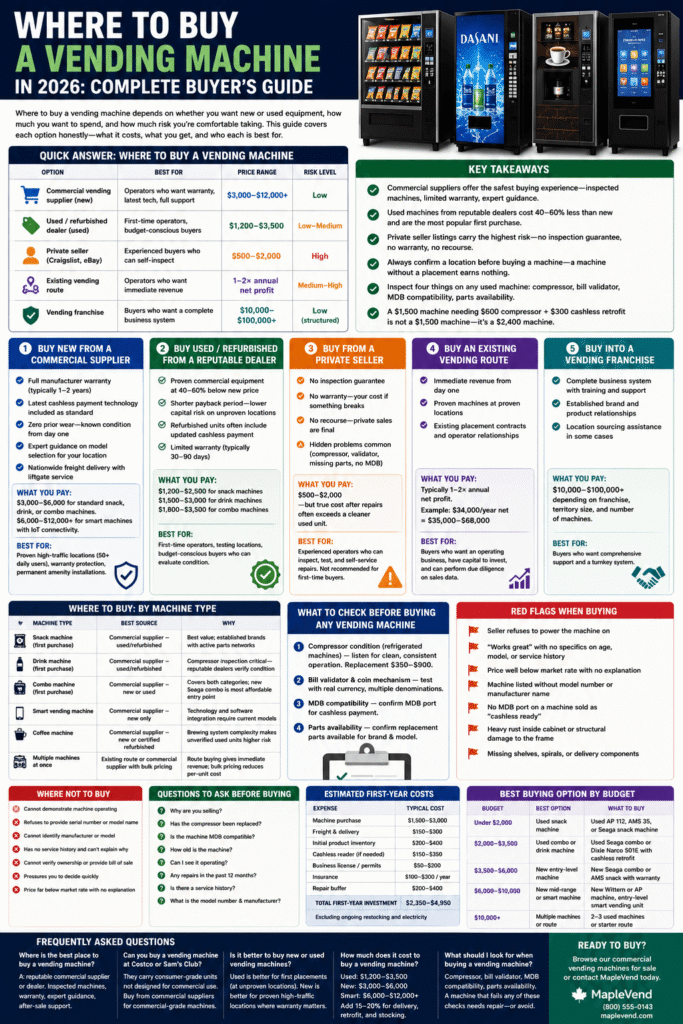
Where to buy a vending machine depends on whether you want new or used equipment, how much you want to spend, and how much risk you’re comfortable taking. There are four main options: buy new from a commercial supplier or manufacturer, buy used or refurbished from a reputable dealer, buy an existing vending route, or buy into a vending franchise. This guide covers each option honestly what it costs, what you get, and who each is best for.
Browse our new and used commercial vending machines across all categories and brands.
Quick Answer: Where to Buy a Vending Machine
| Option | Best For | Price Range | Risk Level |
|---|---|---|---|
| Commercial vending supplier (new) | Operators who want warranty, latest tech, full support | $3,000 $12,000+ | Low |
| Used/refurbished dealer (used) | First-time operators, budget-conscious buyers | $1,200 $3,500 | Low Medium |
| Private seller (Craigslist, eBay) | Experienced buyers who can self-inspect | $500 $2,000 | High |
| Existing vending route | Operators who want immediate revenue | 1 2x annual net profit | Medium High |
| Vending franchise | Buyers who want a complete business system | $10,000 $100,000+ | Low (structured) |
Key Takeaways
- Commercial suppliers offer the safest buying experience inspected machines, limited warranty, expert guidance
- Used machines from reputable dealers cost 40 60% less than new and are the most popular first purchase
- Private seller listings (Craigslist, eBay, Facebook Marketplace) carry the highest risk no inspection guarantee, no warranty, no recourse
- Always confirm a location before buying a machine a machine without a placement earns nothing
- Inspect four things on any used machine: compressor, bill validator, MDB compatibility, parts availability
- A $1,500 machine needing $600 compressor + $300 cashless retrofit is not a $1,500 machine it’s a $2,400 machine
Option 1: Buy New from a Commercial Vending Supplier
Buying new from a reputable commercial vending supplier is the lowest-risk option and the right choice for operators placing machines at proven high-traffic locations where reliability, warranty coverage, and the latest payment technology are priorities.
What you get:
- Full manufacturer warranty (typically 1 2 years)
- Latest cashless payment technology included as standard
- Zero prior wear known condition from day one
- Expert guidance on model selection for your specific location
- Nationwide freight delivery with liftgate service
What you pay: $3,000 $6,000 for standard snack, drink, or combo machines. $6,000 $12,000+ for smart machines with IoT connectivity and touchscreens.
Best for: Operators placing machines at proven locations with 50+ daily users, operators who want warranty protection, businesses adding vending as a permanent amenity rather than a test.
MapleVend carries new and used commercial vending equipment from AMS, Seaga, Dixie Narco, AP, Royal Vendors, Jofemar, and Wittern. Browse our snack vending machines, drink vending machines, and smart vending machines to compare current options.
Option 2: Buy Used or Refurbished from a Reputable Dealer
According to VendSoft’s June 2026 buying guide, used or refurbished machines cost $1,200 $3,000 roughly half the price of new making used machines the most popular first purchase for new operators. Refurbished units from a reputable reseller typically include a limited warranty and updated payment hardware.
What you get:
- Proven commercial equipment at 40 60% below new price
- Shorter payback period lower capital at risk on an unproven location
- Refurbished units often include updated cashless payment hardware
- Limited warranty from reputable suppliers (typically 30 90 days)
What you pay: $1,200 $2,500 for used snack machines; $1,500 $3,000 for used drink machines; $1,800 $3,500 for used combo machines.
Best for: First-time operators, operators testing a new location before committing to new equipment, budget-conscious buyers who can evaluate machine condition.
Browse our used vending machines for sale for current inventory from established commercial manufacturers.
Option 3: Buy from a Private Seller
Private sellers on Craigslist, Facebook Marketplace, eBay, and UsedVending.com offer the lowest prices but also the highest risk. “Works great” in a private listing is not an inspection.
The risks:
- No inspection guarantee you’re relying entirely on the seller’s description
- No warranty if something breaks after purchase, it’s your cost
- No recourse private sales are final
- Hidden problems are common compressor issues, non-working validators, missing parts, no MDB compatibility
What you pay: $500 $2,000 but the true cost after repairs often exceeds a cleaner used unit from a reputable dealer.
Best for: Experienced operators who can physically inspect the machine before purchasing, know how to test compressors and validators, and can self-service common repairs. Not recommended for first-time buyers.
If buying from a private seller, use our used vending machine inspection guide to evaluate every machine before purchasing.
Option 4: Buy an Existing Vending Route
Buying an existing vending route means acquiring machines, locations, placement contracts, and existing cash flow from an operator who is exiting the business. It’s the fastest path to immediate revenue but also the most complex purchase with the highest due diligence requirement.
What you get:
- Immediate revenue from day one no waiting to build a location base
- Proven machines at proven locations
- Existing placement contracts and operator relationships
What you pay: Typically 1 2x annual net profit. A route generating $34,000/year net typically asks $35,000 $68,000.
Best for: Buyers who want an operating business rather than a single machine, operators with capital to invest, buyers who can conduct thorough due diligence on location-level sales data.
For a complete route buying guide including due diligence checklist and red flags, see our vending machine route for sale guide.
Option 5: Buy into a Vending Franchise
Vending franchises provide a complete business system machines, locations, training, branding, and ongoing support in exchange for a franchise fee and ongoing royalties. They’re higher cost than buying independently but provide more structure and support for buyers who want a turnkey operation.
What you get:
- Complete business system with training and support
- Established brand and product relationships
- Location sourcing assistance in some cases
What you pay: $10,000 $100,000+ depending on the franchise, territory size, and number of machines included.
Best for: Buyers who want comprehensive support and are willing to pay a premium for a structured system. Not necessary for most first-time operators who can source machines and locations independently.
Where to Buy a Vending Machine: By Machine Type
| Machine Type | Best Source | Why |
|---|---|---|
| Snack machine (first purchase) | Commercial supplier used/refurbished | Best value; established brands with active parts networks |
| Drink machine (first purchase) | Commercial supplier used/refurbished | Compressor inspection critical reputable dealers verify condition |
| Combo machine (first purchase) | Commercial supplier new or used | Covers both categories; new Seaga combo is most affordable entry point |
| Smart vending machine | Commercial supplier new only | Technology and software integration require current models |
| Coffee machine | Commercial supplier new or certified refurbished | Brewing system complexity makes unverified used units higher risk |
| Multiple machines at once | Existing route or commercial supplier with bulk pricing | Route buying gives immediate revenue; bulk supplier pricing reduces per-unit cost |
What to Check Before Buying Any Vending Machine
Regardless of where you buy, these four checks determine whether a machine is a good investment:
- Compressor condition (refrigerated machines). Power the machine on and listen for clean, consistent compressor operation. Rattling, grinding, or inability to reach temperature indicates a failing compressor replacement runs $350 $900.
- Bill validator and coin mechanism. Test with real currency multiple denominations. A validator that repeatedly rejects valid bills is a customer service problem from day one.
- MDB compatibility for cashless payment. Confirm the machine has an MDB port before purchasing if cashless payment is a requirement. Without it, a modern card reader retrofit is not cost-effective.
- Parts availability for the specific model. Confirm replacement parts are available for the brand and model before purchasing. A discontinued machine with no parts is a liability regardless of its current condition.
Red Flags When Buying a Vending Machine
- Seller refuses to power the machine on for inspection
- “Works great” with no specifics on age, model, or service history
- Price well below market rate with no explanation
- Machine listed without a model number or manufacturer name
- No MDB port on a machine being sold as “cashless ready”
- Heavy rust inside the cabinet or structural damage to the frame
- Missing shelves, spirals, or delivery components
Where NOT to Buy a Vending Machine
Some buying channels carry risks that experienced operators know to avoid but first-time buyers often discover too late:
Be cautious with any seller who:
- Cannot demonstrate the machine operating. A working machine can always be powered on. Refusal to do so is the clearest possible signal that something is wrong walk away.
- Refuses to provide the serial number or model name. Every commercial vending machine has a model number and serial number on the manufacturer’s plate inside the cabinet. A seller who won’t provide this information either doesn’t know what they’re selling or is hiding something.
- Cannot identify the manufacturer or model. “It’s a vending machine” is not a useful description. Without a model number you can’t verify parts availability, confirm MDB compatibility, or research known issues with that specific unit.
- Has no service history and can’t explain why. Legitimate operators keep basic records when the machine was last serviced, what parts were replaced, where it was placed. A seller with no history whatsoever has either neglected the machine or bought it to flip without verification.
- Cannot verify ownership or provide a bill of sale. Vending machines are sometimes stolen from routes. A seller who can’t produce a bill of sale or explain how they came to own the machine creates legal risk for the buyer.
- Pressures you to decide quickly. “I have three other people interested” is a common tactic. A machine that’s genuinely in good condition doesn’t need pressure tactics to sell.
- Lists the price far below market rate without explanation. A Dixie Narco 501E in working condition with cashless payment is worth $1,500 $2,500. A listing at $400 has a reason and the reason is almost never good for the buyer.
Questions to Ask Before Buying Any Vending Machine
Use these questions with any seller private or commercial before committing to a purchase:
- Why are you selling? Legitimate answers: retirement, upgrading equipment, closing a business, reducing route size. Vague answers or pressure not to ask are red flags.
- Has the compressor been replaced? On refrigerated machines, a recently replaced compressor means remaining compressor life is substantial. An original compressor on a 15-year-old machine needs careful inspection.
- Is the machine MDB compatible? Confirm yes or no and ask them to show you the MDB port physically if buying in person.
- How old is the machine? Age alone doesn’t determine value, but it helps contextualize condition and remaining parts availability.
- Can I see it operating? Non-negotiable. Run test vends on every column. Test the bill validator with multiple denominations. Test the cashless reader if installed.
- Any repairs in the past 12 months? Recent repairs can be positive (maintained machine) or a warning (recurring problems). Ask specifically what was repaired and why.
- Is there a service history or maintenance record? Professional operators keep records. The absence of any documentation on an older machine is worth noting.
- What is the model number and manufacturer? Verify from the cabinet plate yourself don’t rely only on the seller’s description.
How to Choose the Right Supplier
When evaluating where to buy a vending machine, consider these supplier criteria:
- Commercial-grade inventory only. Avoid suppliers who mix consumer-grade machines with commercial equipment the price difference reflects real quality differences in components and durability.
- Brands with active parts networks. AMS, AP, Seaga, Dixie Narco, Royal Vendors, Jofemar, and Wittern all have established U.S. parts networks. An unknown brand at a lower price often means no parts when something breaks.
- Clear condition descriptions on used machines. A reputable dealer describes cosmetic condition, payment capability, compressor condition on refrigerated units, and any known issues. Vague listings are a signal.
- After-sale support. Does the supplier answer questions after the sale? Can they help troubleshoot basic issues? A supplier who disappears after payment creates real problems for operators learning their first machine.
Estimated First-Year Costs for a Vending Machine
Many first-time buyers budget only for the machine price and underestimate total startup costs. Here’s a realistic first-year budget for a single used commercial snack or combo machine:
| Expense | Typical Cost | Notes |
|---|---|---|
| Machine purchase | $1,500 $3,000 | Used snack or combo from reputable commercial supplier |
| Freight and delivery | $150 $300 | Liftgate service typically needed for commercial machines |
| Initial product inventory | $200 $400 | First full stock of the machine |
| Cashless card reader (if needed) | $150 $350 | Skip if machine already has cashless installed |
| Business license / permits | $50 $200 | Varies by state and city confirm local requirements |
| Insurance | $100 $300/year | General liability for vending operations |
| Repair buffer | $200 $400 | Set aside even on machines that inspect well |
| Total first-year investment | $2,350 $4,950 | Excluding ongoing restocking and electricity |
Best Buying Option by Budget
| Budget | Best Option | What to Buy |
|---|---|---|
| Under $2,000 | Used snack machine from reputable dealer | Used AP 112, AMS 35, or Seaga snack machine lowest risk entry |
| $2,000 $3,500 | Used combo or refurbished drink machine | Used Seaga combo or Dixie Narco 501E with cashless retrofit |
| $3,500 $6,000 | New entry-level commercial machine | New Seaga combo or AMS snack machine with full warranty |
| $6,000 $10,000 | New mid-range or smart machine | New Wittern or AP machine, or entry-level smart vending unit |
| $10,000+ | Multiple machines or existing route | 2 3 used machines at different locations, or a starter route purchase |
Related Guides
- New vs Used Vending Machine full cost comparison
- Vending Machine Leasing vs Buying financing options
- Best Vending Machine for Small Business which machine type fits your location
Frequently Asked Questions
Where is the best place to buy a vending machine?
For most buyers, a reputable commercial vending supplier is the best place to buy they offer inspected machines, expert guidance on model selection, warranty coverage, and after-sale support. Used machines from commercial suppliers cost $1,200 $3,500 and represent the best value for first-time operators. Private sellers offer lower prices but no inspection guarantee or warranty.
Can you buy a vending machine at Costco or Sam’s Club?
Costco and Sam’s Club occasionally carry basic vending machines, but these are typically consumer-grade units not designed for commercial environments. Commercial-grade machines from established manufacturers like AMS, Seaga, Dixie Narco, and AP are built for daily high-volume use and have active parts networks consumer machines lack both. For a commercial placement, buy from a commercial vending supplier.
Is it better to buy new or used vending machines?
For a first placement at an unproven location, a properly inspected used machine from a reputable commercial supplier typically represents better economics lower capital at risk, shorter payback period, and comparable performance. For a proven high-traffic location where reliability and warranty matter, new equipment is the stronger choice. See our New vs Used Vending Machine guide for a full comparison.
How much does it cost to buy a vending machine?
Used commercial machines from reputable suppliers cost $1,200 $3,500. New commercial machines cost $3,000 $6,000 for standard snack, drink, or combo units. Smart machines with IoT connectivity run $6,000 $12,000+. Always budget an additional 15 20% above purchase price for delivery, cashless retrofit if needed, and initial stocking.
What should I look for when buying a vending machine?
Four things: compressor condition on refrigerated machines, bill validator and coin mechanism function, MDB compatibility for cashless payment, and parts availability for the specific model. A machine that fails any of these checks needs to be priced to reflect the repair cost or avoided entirely.
What is the best vending machine to buy in 2026?
For first-time operators: a used AMS 35 or AP 113 snack machine ($1,200 $2,000) or a used Seaga combo machine ($1,500 $2,500) low cost, proven reliability, strong parts availability. For operators with confirmed high-traffic locations: a new Seaga SM2300 combo or AMS healthy snack machine ($3,800 $5,500) with cashless payment. For premium locations: a Crane BevMax glass-front or Jofemar coffee machine where location foot traffic and product type justify the higher cost. The best machine is the one that matches your specific location’s capacity needs at the lowest total cost of ownership.
What are the best vending machines to own in 2026?
The consistently recommended machines for 2026 are: AP 113 (used, snack, best total return on investment), AMS 35 (used, healthy snack, best for school and healthcare), Seaga SM2300 (new, combo, best first machine), Wittern 3650 (new/used, combo, best long-term reliability), Dixie Narco 276E (used, cold drink, best entry-level beverage), and Royal Vendors Merlin IV (new, cold drink, best for Energy Star and certification requirements). All six are established brands with active U.S. parts networks which is the most important criterion for long-term ownership.
What are the trends for vending machines in 2026?
The most important 2026 trends for buyers are: cashless payment is now the majority of transactions at most commercial locations making MDB compatibility non-negotiable on any machine purchased this year; healthy snack demand continues growing at corporate, healthcare, and school locations; smart machines with IoT connectivity and touchscreens are increasingly required by premium location managers; and micro-markets are displacing traditional vending at large corporate campuses (200+ employees). For most buyers, the practical implication is: buy MDB-compatible machines with cashless capability, stock a mix of traditional and healthier options, and focus on location types where traditional machines still dominate.
Is a vending machine business worth it in 2026?
Yes for buyers who follow the right process. The best 2026 vending machine purchases share three characteristics: buying from a reputable supplier with inspected, MDB-compatible machines; confirming the placement location before purchasing the machine; and enabling cashless payment from day one. Buyers who do all three consistently generate positive monthly cash flow within 90 days and achieve full payback within 12 24 months. The business is not worth it for buyers who purchase cheap unknown-brand machines, place them at low-traffic locations, or run cash-only operations.
What is the most profitable vending machine to own?
For total return on investment, the AP 113 snack machine purchased used ($1,200 $2,000) at a high-traffic warehouse, school, or healthcare location is the most profitable single machine to own low purchase price, zero electricity cost vs refrigerated machines, 15 25 year lifespan, and strong parts availability combine to maximize total net income over the machine’s life. For highest monthly gross revenue at premium locations, a Jofemar coffee machine or Crane BevMax glass-front generates the most per-machine monthly income. The “most profitable” answer depends on whether you’re optimizing for monthly income or total return on investment.
What sells the most in a vending machine?
Bottled water is the highest-volume single item in cold drink machines. Name-brand chips (Lay’s, Doritos) lead in snack machines. In combo machines at office and warehouse locations, chips, candy bars, bottled water, and cola consistently lead across all demographics. At health-focused corporate offices and gyms, mixed nuts, protein bars, and sparkling water increasingly compete with traditional top sellers. Track your specific location’s column-by-column sales for the first 60 days and optimize based on actual data location demographics determine demand more than general trends.
What is replacing vending machines?
Micro-markets open-shelf self-checkout retail setups are replacing traditional vending at large corporate locations with 200+ employees. Smart vending machines with touchscreens and IoT are upgrading traditional machines at premium placements. For the vast majority of commercial vending locations where buyers are purchasing machines offices under 100 employees, warehouses, gyms, schools, laundromats traditional machines remain the most cost-effective solution. Where to buy a vending machine matters less than which location type you’re placing it at.
Are vending machines profitable in 2026?
Yes buyers who purchase from reputable suppliers, enable cashless payment, and place at confirmed high-traffic locations consistently generate positive monthly net income. A properly sourced machine at a good location generating $120/month net pays back in 12 20 months and generates $1,440/year ongoing. The profitability of vending in 2026 is determined more by where you buy and where you place than by any market-level trend.
Ready to buy a vending machine? Browse our commercial vending machines for sale across new and used options or contact MapleVend to discuss which machine fits your location and budget.
