
The most profitable vending machine isn’t a single answer — it depends on your location, your capital, and your capacity to manage the machine. A cotton candy machine at a busy mall generates 93–97% gross margins but needs 200+ daily visitors to hit those numbers. A standard snack machine in a 60-person warehouse generates lower margins but pays back in 12–15 months and requires almost no specialized knowledge. The right answer for you depends on which of those situations you’re actually in.
This guide covers every major machine category — from bulk candy to smart coffee machines — with real margin data, ROI estimates, and honest assessments of what each type actually requires to be profitable.
Browse our commercial vending machines for sale across all categories.
Quick Answer: Most Profitable Vending Machines by Category
| Machine Type | Gross Margin | Monthly Net (Good Location) | Difficulty | Best Location |
|---|---|---|---|---|
| Cotton candy machine | 93–97% | $1,500–$4,000 | Medium | Malls, amusement parks, entertainment venues |
| Coffee / hot beverage machine | 60–80% | $300–$1,200 | Medium | Offices, hotels, coworking spaces, hospitals |
| Protein shake / fresh food machine | 60–75% | $500–$2,900 | Medium–High | Gyms, fitness centers, health-focused locations |
| Healthy snack machine | 50–65% | $200–$600 | Low | Schools, hospitals, corporate offices |
| Standard snack machine | 40–55% | $100–$400 | Low | Offices, warehouses, schools |
| Cold drink machine | 35–50% | $100–$400 | Low | Warehouses, gyms, outdoor locations |
| Combo machine | 38–52% | $100–$300 | Low | Small offices, laundromats, waiting rooms |
| Bulk candy machine | 80–90% | $30–$150 | Very Low | Restaurants, playgrounds, family venues |
| Smart / IoT connected machine | 45–65% | $200–$800 | Low (remote mgmt) | High-traffic locations, connected routes |
The Profit Formula Every Operator Needs to Know
According to VendingCore’s April 2026 profitability guide, the real profit equation for vending is:
Profit = (Location Quality × Product Margin) − (Operating Costs + Fixed Costs)
This formula explains why “most profitable vending machine” is a misleading question on its own. A cotton candy machine with 95% gross margins at a low-traffic location generates less monthly profit than a standard snack machine with 45% margins at a busy 80-person warehouse. Location quality multiplies everything — margin, volume, and payback speed.
Best Profitable Vending Machine by Budget
| Budget | Recommendation | Why |
|---|---|---|
| Under $2,000 | Used snack machine (AP 113, AMS 35) | Lowest risk entry — proven reliability, active parts network, simple to manage |
| $2,000–$4,000 | Used combo machine (Seaga SM2300) | Covers snacks and drinks in one unit — best value for first placement |
| $4,000–$7,000 | New combo or healthy snack machine | Warranty protection, latest payment tech, healthy vending opens institutional placements |
| $7,000–$10,000 | Coffee machine or smart vending machine | Higher margin per transaction, remote monitoring capability, daily repeat behavior |
| $10,000+ | Specialty machine (cotton candy, protein shake) or existing route | Highest margin potential — requires high-traffic venue or proven route with real sales data |
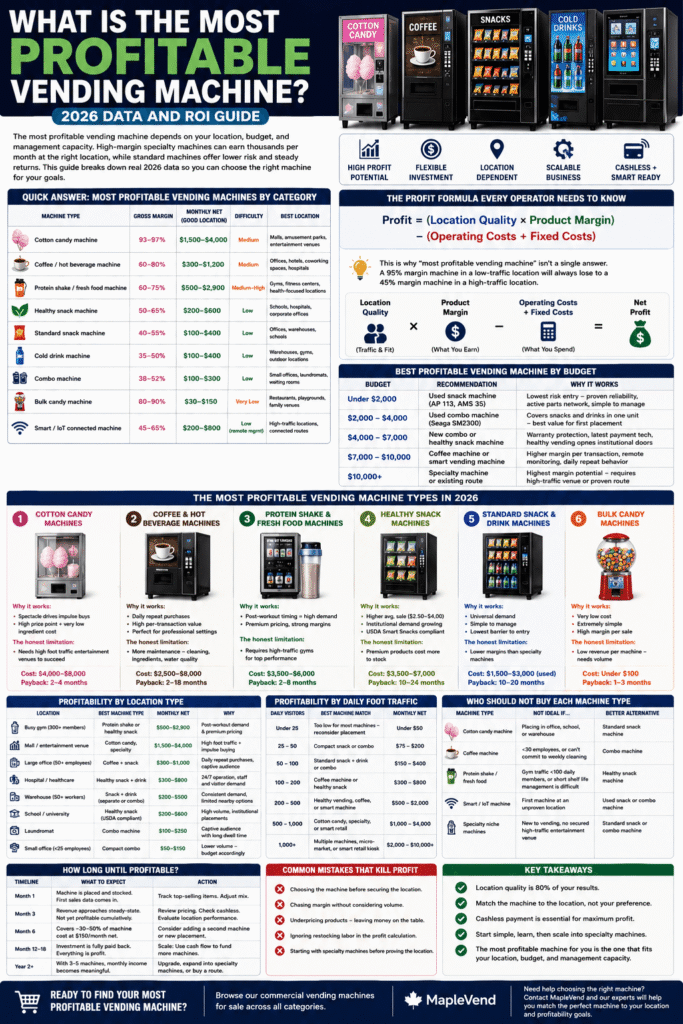
The Most Profitable Vending Machine Types in 2026
1. Cotton Candy Machines — Highest Raw Margins
Cotton candy machines generate the highest gross margins of any vending category — 93.8–97% gross margin, based on a product cost of approximately $0.31 per unit (sugar and stick) against a retail price of $5–$10. At 30–50 daily sales in a high-traffic mall or entertainment venue, monthly revenue runs $4,500–$15,000 with exceptional net margins.
What makes them work: The spectacle of fresh candy being made creates impulse purchases. Customers watch the process, share it on social media, and buy because of the experience as much as the product.
The honest limitation: Cotton candy machines require genuine high-foot-traffic entertainment venues — malls, amusement parks, arcades, family entertainment centers. In an office break room or warehouse, the same machine generates near-zero sales. Location is everything, and premium entertainment placements are competitive and sometimes expensive to secure.
Machine cost: $4,000–$8,000 new. Payback at a strong location: 2–4 months.
2. Coffee and Hot Beverage Machines — Best for Professional Environments
Coffee machines generate 60–80% gross margins on hot beverages and benefit from daily repeat purchase behavior that no other vending category matches. An office worker who buys a $2.50 coffee every working day generates $50/month in revenue from a single customer. Scale that across a 50-person office and the revenue base is significant and predictable.
According to VendSoft’s 2026 investment guide, healthy and fresh-food machines — including coffee — are among the strongest investment categories for 2026, driven by consistent daily demand patterns that other machine types can’t replicate.
What makes them work: Daily repeat behavior, high per-transaction value relative to cost, and placement in professional environments where coffee is part of the workday routine.
The honest limitation: Coffee machines require more maintenance than snack or drink machines — cleaning the brewing system, managing ingredients, and monitoring water quality. The Jofemar coffee machines used in commercial environments are purpose-built for this, but the management overhead is higher than a standard snack machine.
Browse our coffee vending machines for sale for current commercial options.
Machine cost: $2,500–$8,000. Monthly net at a 60-person office: $300–$800. Payback: 6–18 months.
3. Protein Shake and Fresh Food Machines — Highest Revenue Per Location
At the right gym placement, protein shake machines generate extraordinary revenue. According to CottonCandyVending’s location analysis, one operator in California placed a protein shake machine at a 24-hour fitness location and reported 30 shakes daily at $5–$7 each — $150/day revenue, approximately $2,900/month net profit, with payback under 3 months.
What makes them work: Gym members buy post-workout nutrition products at the moment of highest motivation — immediately after exercise. The machine is at exactly the right place at exactly the right time for the buyer.
The honest limitation: This performance requires a high-traffic gym — not every fitness center generates 30 daily protein shake purchases. The machine type is excellent; the location match is critical.
Machine cost: $3,500–$6,000. Monthly net at a strong gym: $500–$2,900.
4. Healthy Snack Machines — Best Consistent Revenue
Healthy vending machines — stocked with protein bars, trail mix, baked chips, low-sugar snacks, and better-for-you beverages — command higher price points than standard snack machines and serve growing institutional demand in schools, hospitals, and corporate wellness programs. USDA Smart Snacks compliant configurations specifically target school placement contracts, which can provide multi-machine, multi-location revenue streams.
What makes them work: Higher average transaction value ($2.50–$4.00 vs $1.25–$1.75 for standard snacks) at comparable locations. Institutional demand for healthier options creates placement opportunities at schools and hospitals where standard snack machines face policy restrictions.
Machine cost: $3,500–$7,000 new. Monthly net at a healthy placement: $200–$600.
5. Standard Snack and Drink Machines — Most Reliable First Investment
Standard snack and drink machines generate $300–$1,500/month at good locations according to VMFS USA’s February 2026 operator analysis, with gross margins of 40–55% on snack products and 35–50% on cold drinks. These are lower margins than specialty categories — but the locations are easier to secure, the machines are simpler to manage, and the used market offers excellent entry-level pricing.
What makes them work: Universal demand, simple management, widely available equipment, and the lowest barrier to entry of any vending category. A used AP 113 snack machine or Dixie Narco 501E drink machine can be purchased and placed within a week of deciding to start.
The case for standard machines as a first investment: Specialty machines generate higher margins — but they require specific high-traffic locations, more management attention, and higher capital. For most first-time operators, a standard snack or combo machine at a reliable office or warehouse location is the lower-risk path to building vending experience and cash flow before moving into specialty categories.
Browse our snack vending machines and drink vending machines for current inventory.
6. Bulk Candy Machines — Lowest Entry, Simplest Operation
Bulk candy machines — gumball dispensers, M&M machines, toy capsule dispensers — offer 80–90% gross margins at $0.25–$1.00 per transaction. A new bulk machine costs under $100 and a refurbished unit can be found for under $50. The barrier to entry is nearly zero.
What makes them work: Extremely low cost, extremely simple operation (no electricity, no payment system, no maintenance beyond restocking), and placement in high-traffic family-friendly environments where the low transaction price drives impulse purchases.
The honest limitation: Very low revenue per machine — $30–$150/month is typical. Meaningful income requires a large number of machines across many locations. Bulk vending is a volume business, not a single-machine business.
Profitability by Location Type
| Location | Best Machine Type | Monthly Net Estimate | Why |
|---|---|---|---|
| Busy gym (300+ members) | Protein shake or healthy snack | $500–$2,900 | Post-workout purchase behavior drives volume and premium pricing |
| Mall or entertainment venue | Cotton candy, specialty | $1,500–$4,000 | High foot traffic + impulse buying + spectacle products |
| Large office (50+ employees) | Coffee machine + snack machine | $300–$1,000 combined | Daily repeat purchases, captive audience, predictable revenue |
| Hospital or healthcare | Healthy snack + drink | $300–$800 | 24/7 operation, staff and visitor demand, institutional volume |
| Warehouse (50+ workers) | Snack + drink (separate or combo) | $200–$500 | Consistent daily demand, limited food options nearby |
| School or university | Healthy snack (USDA compliant) | $200–$600 | High volume of users, institutional placement opportunities |
| Laundromat | Combo machine | $100–$250 | Captive audience with long dwell time |
| Small office (under 25 employees) | Compact combo | $50–$150 | Lower volume — budget accordingly |
Who Should NOT Buy Each Machine Type
| Machine Type | Not Ideal If… | Better Alternative |
|---|---|---|
| Cotton candy machine | You’re placing in an office, school, or warehouse — or can’t secure a mall/entertainment venue | Standard snack machine — reliable returns without location dependency |
| Coffee machine | Location has fewer than 30 employees, or you can’t commit to weekly cleaning and ingredient restocking | Combo machine — no brewing system to maintain, lower management overhead |
| Protein shake / fresh food | Gym traffic is under 100 daily members, or you can’t manage short product expiration cycles | Standard healthy snack machine — longer shelf life, lower management complexity |
| Smart / IoT machine | First machine at an unproven location — the tech premium isn’t justified until volume is established | Used snack or combo machine — prove the location first, then upgrade |
| Specialty niche machines | You’re new to vending and don’t have a secured high-traffic entertainment venue | Standard snack or combo — build experience and cash flow first |
What Actually Makes a Vending Machine Profitable?
Location quality — 80% of the result
Every experienced operator says the same thing: location determines 80% of vending machine profitability. A mediocre machine in a phenomenal location outperforms the best machine in a poor location every time. Before choosing a machine type, secure a location with sufficient daily foot traffic. The minimum viable foot traffic for a standard snack or drink machine to generate meaningful revenue is approximately 30–50 daily users. For specialty machines, you need significantly more.
Product margin and pricing
Higher-priced products with good margins — protein shakes, gourmet coffee, specialty treats — generate more revenue per transaction than low-margin commodity items. Operators who stock premium products at premium prices outperform operators who stock the cheapest items at the lowest prices, even at the same location. Product selection is a meaningful revenue lever.
Cashless payment capability
Machines with cashless payment consistently generate higher revenue than cash-only equivalents at comparable locations — because cashless buyers aren’t constrained by what’s in their wallet at the moment of purchase. For any machine type at any location in 2026, cashless capability is a baseline requirement for maximizing profitability.
Restocking efficiency
A machine that runs out of popular products costs revenue every time it’s empty. Operators who restock on data (IoT alerts, sales tracking) outperform operators who restock on fixed schedules, because they arrive when the machine needs it rather than before or long after.
Profitability by Daily Foot Traffic
| Daily Visitors | Best Machine Match | Monthly Net Estimate |
|---|---|---|
| Under 25 | Too low for most machines — reconsider placement | Under $50 — marginal at best |
| 25–50 | Compact snack machine or combo | $75–$200 |
| 50–100 | Standard snack + drink, or combo | $150–$400 |
| 100–200 | Coffee machine or healthy snack | $300–$800 |
| 200–500 | Healthy vending, coffee, or smart machine | $500–$2,000 |
| 500–1,000 | Cotton candy, specialty, or smart retail | $1,000–$4,000 |
| 1,000+ | Multiple machines, micro-market, or smart retail kiosk | $2,000–$10,000+ |
ROI Comparison: Standard vs Specialty Machines
| Machine Type | Purchase Cost | Monthly Net (Good Location) | Payback Period | Management Level |
|---|---|---|---|---|
| Used snack machine | $1,500–$2,500 | $100–$300 | 10–20 months | Low |
| Used combo machine | $1,800–$3,000 | $100–$250 | 12–20 months | Low |
| New coffee machine | $3,000–$7,000 | $300–$800 | 8–18 months | Medium |
| New healthy snack machine | $4,000–$7,000 | $200–$600 | 10–24 months | Low–Medium |
| Cotton candy machine | $4,000–$8,000 | $1,500–$4,000 | 2–4 months | Medium |
| Protein shake machine | $3,500–$6,000 | $500–$2,900 | 2–8 months | Medium |
How Long Until Your Vending Machine Becomes Profitable?
One of the most common questions from new operators: when does a vending machine actually start making money? Here’s a realistic timeline for a well-placed used snack or combo machine generating $150/month net profit:
| Timeline | What to Expect | Action |
|---|---|---|
| Month 1 | Machine is placed and stocked. First sales data comes in. Customers learn the machine exists. Revenue is often lower than steady-state. | Track which products sell fastest. Adjust mix based on early data. |
| Month 3 | Product mix is optimized. Restocking schedule is established. Revenue approaches steady-state. Machine is not yet profitable on a cumulative basis. | Review pricing. Confirm cashless payment is working correctly. Evaluate whether location is performing as expected. |
| Month 6 | Cumulative net profit covers approximately 30–50% of machine cost at $150/month net. Operation is running smoothly. | Consider adding a second machine at this or a new location. Evaluate product mix expansion. |
| Month 12–18 | For a $2,000 used machine at $150/month net — investment is fully paid back. Everything from this point is profit. | Scale: use cash flow from first machine to fund second and third placements. |
| Year 2+ | With 3–5 machines, monthly net income becomes meaningful. Routes are established, restocking is efficient, and the business has real cash flow. | Evaluate upgrading machines, moving into specialty categories, or acquiring an existing route. |
Common Mistakes That Kill Vending Profitability
- Choosing the machine before securing the location. The most common and most costly mistake. A specialty machine without the right location is an expensive storage problem.
- Chasing margin without considering volume. A 95% margin machine generating 5 sales/day earns less than a 45% margin machine generating 80 sales/day. Both factors matter.
- Underpricing products. Many new operators price at the lowest possible point, thinking it drives volume. At most vending locations, demand is relatively inelastic — raising prices by $0.25–$0.50 rarely reduces sales meaningfully but directly increases margin.
- Ignoring restocking labor in the profit calculation. If restocking takes 3 hours per week at $25/hour equivalent, that’s $300/month in labor cost. Factor it in before declaring a machine profitable.
- Starting with specialty machines before proving the location. Start with a standard snack or combo machine at a new location to prove foot traffic and demand before investing in a $6,000 specialty unit.
Related Guides
- Best Vending Machine for Small Business — which machine type fits your location
- How Much Does It Cost to Stock a Vending Machine? — margin and restocking costs
- Snack vs Combo Vending Machine — choosing the right configuration
- Vending Machine Route for Sale — buying proven revenue
- Cashless vs Traditional Vending Machines — why cashless increases profitability
Frequently Asked Questions
What is the most profitable vending machine?
Based on gross margin, cotton candy machines (93–97%) rank highest. Based on consistent monthly net profit at accessible locations, coffee machines and healthy snack machines at offices and gyms generate the most reliable returns. For most first-time operators, a standard snack or combo machine at a proven location provides the best risk-adjusted profitability.
What vending machine makes the most money per day?
At the right high-traffic location, cotton candy machines ($150–$500/day), protein shake machines ($100–$200/day at busy gyms), and coffee machines ($50–$150/day at large offices) generate the highest daily revenue. Standard snack machines at typical office locations generate $15–$40/day.
What vending machine has the fastest ROI?
Cotton candy machines at mall placements (2–4 months payback) and protein shake machines at high-traffic gyms (2–3 months) have the fastest payback periods. Standard snack machines at proven locations pay back in 10–20 months — slower, but with significantly lower location risk.
Which vending machine is easiest for beginners?
A used snack machine or combo machine from an established brand (Seaga, AMS, or AP) is the easiest starting point — simple operation, widely understood by technicians, lower purchase price, and forgiving of learning-curve mistakes. Specialty machines require specific high-traffic placements and are harder to manage.
Are smart vending machines more profitable?
Smart machines with cashless payment, remote monitoring, and dynamic pricing can increase profitability at established high-traffic locations — primarily by reducing unnecessary service visits and increasing cashless transaction value. They’re not inherently more profitable than standard machines at comparable locations; the data and management tools help optimize performance over time.
Can one vending machine make a full-time income?
Rarely — a single machine at a typical location generates $100–$400/month net. Most operators need 15–30 machines at good locations to approach a full-time income equivalent of $3,000–$6,000/month net.
Is coffee or snack vending more profitable?
Coffee generates higher gross margins (60–80%) and higher per-transaction revenue than standard snacks (40–55%), but requires more management. At a 50-person office, a coffee machine may generate $400–$800/month vs $150–$300/month for a snack machine — but with higher maintenance overhead.
Which vending products have the highest markup?
Fresh-made items (cotton candy, protein shakes, gourmet coffee) have the highest markup — 500–3,000% above ingredient cost. Packaged specialty snacks and healthy options run 100–200% markup. Standard commodity snacks and drinks run 50–100% markup above wholesale cost.
How much profit does a vending machine make per month?
Most profitable vending machines generate $500–$1,500/month net profit at good locations. Top performers in high-traffic entertainment venues can clear $3,000+/month. Standard snack and drink machines at offices and warehouses typically generate $100–$400/month net after product costs, electricity, and site fees.
Is a vending machine business passive income?
Not exactly — it’s active asset management that becomes more passive as you build systems. Restocking, maintenance, and site relationship management require ongoing attention. Most operators describe it as semi-passive — significantly less active than a traditional job, but not zero-effort income.
Ready to find the most profitable vending machine for your location? Browse our commercial vending machines for sale — or contact MapleVend to discuss which machine type matches your location and profitability goals.
