
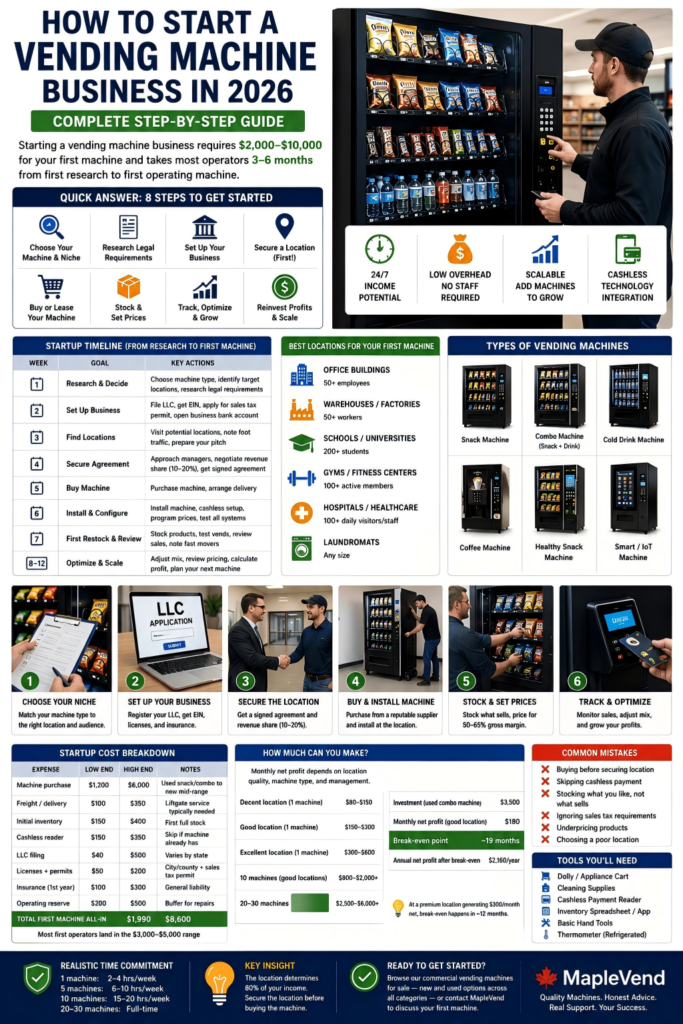
You can start a vending machine business with roughly $2,000–$5,000 for a used commercial machine and basic setup — although new equipment and higher-cost locations can push the investment higher. Most operators reach their first operating machine within 3–6 months of starting research. The business model is accessible, the revenue is recurring, and the path to scale is clear. The key insight that separates successful first-time operators from those who struggle: secure the location before buying the machine, not after.
This guide was prepared by the MapleVend editorial team and reviewed by commercial vending operators with experience placing and maintaining vending equipment in offices, schools, healthcare facilities, and industrial locations. All figures reflect 2026 U.S. market data and operator-reported outcomes.
Quick Answer: How to Start a Vending Machine Business
- Decide on your machine type and target location
- Research legal requirements in your state and city
- Set up your business entity (LLC, EIN, bank account)
- Secure a location — before buying a machine
- Buy or lease your first machine
- Stock your machine and set prices
- Launch, track performance, and optimize
- Reinvest profits and scale to additional machines
What You Need to Start a Vending Machine Business
| Requirement | Typical Starting Range |
|---|---|
| Used commercial machine | $1,200–$3,000 |
| Initial product inventory | $150–$400 |
| Cashless reader (if needed) | $150–$350 |
| Freight / delivery | $100–$350 |
| Business / legal setup | Varies by state — typically $200–$500 |
| Business insurance | $100–$300/year |
| Operating reserve | $200–$500 |
Realistic starting budget: approximately $2,000–$5,000 for a first used commercial machine with full setup. New equipment or premium locations push this higher — most first operators land in the $3,000–$5,000 range all-in.
Vending Machine Business Startup Timeline
| Week | Goal | Key Actions |
|---|---|---|
| Week 1 | Research and decide | Choose machine type, identify target location types, research state legal requirements |
| Week 2 | Set up business entity | File LLC, get EIN from IRS.gov, apply for state sales tax permit, open business bank account |
| Week 3 | Find locations | Visit shortlist of potential locations, note foot traffic and existing machines, prepare pitch |
| Week 4 | Secure placement agreement | Approach location managers, negotiate revenue share (10–20%), get signed agreement |
| Week 5 | Buy machine | Purchase used or new machine from reputable commercial supplier, arrange delivery |
| Week 6 | Install and configure | Accept delivery, install cashless reader if needed, program prices, test all systems |
| Week 7 | First restock and review | Stock machine, run test vends, restock any columns that sold quickly, note which products moved |
| Month 2–3 | Optimize | Adjust product mix based on sales data, review pricing, confirm cashless is capturing transactions |
| Month 4–6 | Evaluate and scale | Calculate monthly net, decide whether to add a second machine or improve location first |
Is a Vending Machine Business Right for You?
According to VendSoft’s 2026 business guide, vending rewards routine, hands-on operators — not passive-income seekers. Before starting, honestly assess whether this business model fits your situation:
| Vending Is a Good Fit If… | Vending Is NOT a Good Fit If… |
|---|---|
| You want to build side income with flexible hours | You expect truly passive income with no ongoing work |
| You can commit to weekly or biweekly restocking visits | You travel frequently and can’t maintain a service schedule |
| You have access to locations with captive foot traffic | You don’t have relationships with potential location owners |
| You’re willing to learn basic troubleshooting and maintenance | You expect machines to run indefinitely without attention |
| You can start with $2,000–$5,000 and build from cash flow | You need immediate full-time income from day one |
Step 1: Choose Your Machine Type and Niche
According to Nav’s March 2026 business guide, your product type and target location must align before anything else. A healthy snack machine belongs in a gym or corporate office — not a budget motel. A traditional snack and drink machine fits a warehouse or school. Start by asking: what locations can I realistically access in my area? Then work backward to determine what those locations need.
| Machine Type | Best Locations | Startup Cost | Monthly Net (Good Location) |
|---|---|---|---|
| Snack machine | Offices, warehouses, schools | $1,200–$3,000 (used) | $90–$200 |
| Combo machine (snack + drink) | Small offices, laundromats, first placement | $1,800–$4,000 | $100–$250 |
| Cold drink machine | Gyms, warehouses, outdoor locations | $1,500–$3,500 (used) | $100–$280 |
| Coffee machine | Offices, hotels, coworking spaces | $2,500–$7,000 | $200–$600 |
| Healthy snack machine | Healthcare, schools, corporate wellness | $3,500–$7,000 | $150–$400 |
| Smart / IoT machine | High-traffic locations, fleet routes | $6,000–$15,000 | $250–$700 |
For most first-time operators: a used or refurbished combo machine or snack machine is the right starting point — lowest capital at risk, simplest operation, and fastest learning curve.
Step 2: Research Legal Requirements
Vending is a regulated business. Requirements vary by state and city, but the standard setup is straightforward. According to AMCOB’s 2026 legal guide:
- Business entity: Register an LLC ($40–$500 depending on state) or sole proprietorship. An LLC provides liability protection — recommended for vending operators.
- EIN (Employer Identification Number): Free from IRS.gov — takes 5 minutes online. Required to open a business bank account and file business taxes.
- General business license: Obtain from your city or county — typically $25–$100/year.
- State sales tax permit: Vending sales are taxable in nearly every state. Register with your state comptroller’s office — free in most states. Failure to collect and remit sales tax is one of the most common and costly compliance mistakes new operators make.
- Per-machine registration: Some states (California, Texas, Florida) require per-machine registration fees or decals. Check your state comptroller website before purchasing machines.
- Food handling permit: Required if you sell fresh or refrigerated food — not typically required for packaged snacks and sealed beverages. Check with your local health department.
Budget $200–$500 for legal setup — LLC filing, licenses, and permits. This is a one-time cost that protects your personal assets and keeps you compliant from day one.
Step 3: Set Up Your Business Infrastructure
- Business bank account. Keep business and personal finances completely separate from day one. Makes accounting, tax filing, and profit tracking dramatically simpler.
- Business insurance. General liability insurance for vending operators costs $100–$300/year and protects against property damage claims and product liability issues at locations. Many location managers require proof of insurance before signing a placement agreement.
- Accounting system. A simple spreadsheet tracking revenue, product cost, site commission, and expenses works for 1–5 machines. QuickBooks Simple Start ($15–$20/month) makes sense at 5+ machines.
- Business cards or one-page placement proposal. When approaching location owners, a professional one-page proposal explaining the machine, the service commitment, and the revenue share offer makes the conversation significantly easier.
Step 4: Secure a Location First
This is the step most first-time operators get wrong — they buy a machine before securing a location, then scramble to find somewhere to put it. Location quality is one of the biggest factors determining vending machine revenue. A good machine in a poor location consistently underperforms a basic machine at an excellent location.
What Makes a Good Vending Location?
- Minimum 30–50 daily users — the baseline for a standard snack or combo machine to generate meaningful revenue
- Captive audience — people who are present for extended periods without easy access to alternative food options
- No existing machine — or an existing machine that is consistently empty, poorly stocked, or in poor condition (an opportunity, not a barrier)
- Location manager open to a placement agreement — typically a revenue share of 10–20% of gross sales
Best Location Types for First-Time Operators
| Location | Minimum Users | Approach | Revenue Share |
|---|---|---|---|
| Office building (50+ employees) | 50 | Office manager or facilities manager | 10–15% |
| Warehouse / factory (50+ workers) | 50 | Operations manager or HR | 10–20% |
| School (public or private) | 200+ students | Principal or district facilities | 15–25% |
| Gym / fitness center | 100+ active members | Owner or general manager | 10–20% |
| Hospital / healthcare | 100+ daily visitors/staff | Facilities or food services department | 15–25% |
| Laundromat | Any size | Owner directly | 10–15% |
How to Pitch a Location
Keep the pitch simple: you install a vending machine at no cost to them, you handle all restocking and maintenance, and they receive a percentage of sales. The location owner takes no risk — the machine is yours, the service is yours, and the revenue share is paid monthly. Most location managers respond well to this framing because there is genuinely nothing to lose on their side.
Step 5: Buy or Lease Your First Machine
Once you have a location secured (or close to secured), choose your machine. The two main options:
Buy a Used or Refurbished Machine
For most first-time operators, a used or refurbished machine from a reputable commercial supplier is the right starting point. Cost: $1,200–$3,000 for a snack or combo machine. Lower capital at risk if the location underperforms — and your first location is always a learning experience.
Before buying any used machine, inspect four things: compressor condition (on refrigerated units), bill validator function, MDB compatibility for cashless payment, and parts availability for the specific model. See our full used vending machine inspection guide.
Buy a New Machine
New machines cost $3,000–$6,000 for standard snack, drink, or combo units. They come with full manufacturer warranty, current cashless payment technology, and known condition. The right choice for a proven high-traffic location where reliability and warranty matter.
Browse our commercial vending machines for sale — new and used options across all major brands.
Lease a Machine
Leasing preserves capital and includes maintenance in some agreements, but you pay more over the machine’s life and don’t build equity. Best for operators who need to minimize upfront cost and are placing at a proven high-traffic location. See our vending machine leasing vs buying guide for a full comparison.
Step 6: Stock Your Machine and Set Prices
Product Selection
Stock what your location’s users want — not what you like. Observe the location for a week before your first restock: what age group are the users? What are their likely preferences? A warehouse with mostly male manual workers has different demand than a corporate office with mixed demographics. Start with a core range of 15–20 proven sellers and expand based on actual sales data in the first 30–60 days.
Pricing Strategy
Most new operators underprice. At captive locations — offices, warehouses, schools — demand is relatively inelastic. Users will pay $2.00–$2.50 for a bag of chips rather than walk to a store two blocks away. Price to a 50–65% gross margin as a starting point, then test increases of $0.25 and monitor volume. Price increases almost never reduce volume at captive locations as much as operators expect.
Cashless Payment
Cashless transactions now represent the majority of vending sales at most commercial locations — operators consistently report significantly higher revenue after adding card and mobile payment capability. A cash-only machine misses a large share of potential sales. If your machine doesn’t have a cashless reader, budget $150–$350 for a Cantaloupe ePort or Nayax VPOS Touch retrofit — it pays back within 2–3 months at most locations.
Step 7: Track Performance and Optimize
Your first machine is as much a learning tool as a revenue source. Track these metrics from day one:
- Monthly gross revenue — total sales before any costs
- Product cost (COGS) — what you paid for the products sold
- Site commission paid — your revenue share to the location owner
- Monthly net profit — what you keep after all costs
- Sales by column — which products sell, which don’t
- Cashless vs cash split — confirm cashless is working and capturing transactions
Optimize your planogram — the product layout — every 30 days for the first 90 days. Remove slow sellers and replace with proven items. Raise prices on your top sellers by $0.25 and monitor volume. These two actions consistently improve monthly net profit at most locations — often significantly.
Step 8: Reinvest and Scale
The right time to add a second machine is when your first machine is consistently profitable and generating $150+/month net. Use that cash flow — not new capital — to fund the second machine. Each machine you add should be evaluated independently on location quality before purchase.
| Stage | Machines | Monthly Net (Estimate) | Time Investment |
|---|---|---|---|
| Getting started | 1 | $80–$200 | 3–5 hrs/week |
| Side income | 3–5 | $300–$800 | 8–12 hrs/week |
| Meaningful income | 10 | $800–$2,000 | 15–20 hrs/week |
| Full-time equivalent | 20–30 | $2,500–$6,000 | Full-time or near full-time |
Startup Cost Breakdown
| Expense | Low End | High End | Notes |
|---|---|---|---|
| Machine purchase | $1,200 | $6,000 | Used snack/combo to new mid-range machine |
| Freight / delivery | $100 | $350 | Liftgate service typically needed |
| Initial product inventory | $150 | $400 | First full stock of the machine |
| Cashless reader (if needed) | $150 | $350 | Skip if machine already has cashless |
| LLC filing | $40 | $500 | Varies by state |
| Business license + permits | $50 | $200 | City/county license + state sales tax permit |
| Insurance (first year) | $100 | $300 | General liability for vending operators |
| Operating reserve | $200 | $500 | Buffer for repairs and unexpected costs |
| Total first machine all-in | $1,990 | $8,600 | Most first operators land in the $3,000–$5,000 range |
How Much Time Does a Vending Machine Business Take?
Vending is not passive income — but it is time-efficient income compared to most businesses. Here’s a realistic weekly time commitment at different route sizes:
| Route Size | Weekly Time | What That Time Covers |
|---|---|---|
| 1 machine | 2–4 hours/week | 1 restock visit, product purchasing, basic tracking |
| 3–5 machines | 6–10 hours/week | 2–3 restock visits, product sourcing, route planning, minor maintenance |
| 10 machines | 15–20 hours/week | Daily service visits, product purchasing in volume, maintenance management, location relationship upkeep |
| 20–30 machines | Full-time (35–45 hrs/week) | Daily route operations, driver coordination, accounting, location development, equipment management |
The time commitment per machine decreases as your route grows denser — grouping machines in the same geographic area reduces drive time per restock visit significantly. An operator with 10 machines clustered in a 5-mile radius spends far less time per machine than an operator with 10 machines spread across a 30-mile radius.
Break-Even Example: What to Expect
Here’s a concrete break-even calculation for the most common first-machine scenario — a used combo machine at a decent office or warehouse location:
| Item | Amount |
|---|---|
| Machine purchase (used combo, refurbished) | $2,500 |
| Delivery + cashless retrofit + initial stock | $600 |
| LLC + licenses + insurance (first year) | $400 |
| Total first-year investment | $3,500 |
| Expected monthly net (good location) | $180 |
| Break-even point | ~19 months |
| Annual net profit after break-even | $2,160/year |
At a premium location (warehouse, hospital, large gym) generating $300/month net, the same $3,500 investment breaks even in approximately 12 months. Location quality is the single biggest variable in your break-even timeline.
Common Mistakes First-Time Operators Make
- Buying the machine before securing the location. The most common and most costly mistake. A machine without a placement earns nothing — and good locations take time to find and negotiate.
- Skipping cashless payment. Cashless transactions now represent the majority of vending sales at most commercial locations. A cash-only machine misses a significant share of potential revenue. Always confirm cashless capability before purchasing.
- Stocking what you like instead of what sells. Track sales by column from day one. Replace slow sellers within 60 days — don’t wait for months hoping they’ll pick up.
- Ignoring sales tax. Vending sales are taxable in nearly every state. Register for a sales tax permit before your first sale — back-tax bills compound quickly and can erase months of profit.
- Underpricing products. Most new operators price too low. Captive audience demand is inelastic — users will pay $2.25 rather than walk to a store 10 minutes away. Price to margin, not to what feels cheap.
- Choosing a poor location. A great machine in a low-traffic location generates minimal revenue regardless of product mix or pricing. Location quality is the single most important variable — don’t compromise on it to get started faster.
Related Guides
- Where to Buy a Vending Machine — complete buyer’s guide with red flags
- Most Profitable Vending Machine — which type makes the most money
- How Much Money Can a Vending Machine Make? — realistic income projections
- Vending Machine Maintenance Guide — keeping your machine running
Frequently Asked Questions
How much does it cost to start a vending machine business?
Most first-time operators spend $2,000–$5,000 all-in for their first machine — including the machine, delivery, initial inventory, cashless reader, and basic legal setup. The low end (used machine, minimal licensing) is around $1,990. The high end (new mid-range machine with full setup) is $6,000–$8,600.
Is a vending machine business profitable?
Yes — vending machines are profitable when placed at good locations with the right product mix and consistent management. A well-placed machine generates $80–$200/month net in year one. Profitability scales with route size — 10 machines at good locations generates $800–$2,000/month net.
Do I need a license to start a vending machine business?
Yes — at minimum, you need a business license and a state sales tax permit. Some states require per-machine registration. If you sell fresh or refrigerated food, a food handling permit and health inspection may be required. Requirements vary by state and city — check your state comptroller’s website and local government site before starting.
Where should I place my first vending machine?
Offices with 50+ employees, warehouses with 50+ workers, gyms with 100+ active members, and laundromats are the most accessible first placements for new operators. Hospitals and schools offer the highest revenue but require more formal approval processes. Always secure the location before buying the machine.
How long does it take to pay back a vending machine?
A $2,000 used machine generating $150/month net pays back in approximately 13 months. A $4,000 new machine at the same location takes approximately 27 months. Premium locations generating $300+/month net can achieve payback in 7–14 months even on new equipment.
Can I start a vending machine business with $1,000?
$1,000 is tight but possible for a used snack machine from a private seller — though the risk is higher without the buffer for repairs or cashless retrofit. A more realistic minimum for a safe start is $1,500–$2,000, which covers a used machine from a reputable supplier, basic legal setup, and initial inventory.
How many vending machines do you need to make $100k a year?
To make $100,000 per year net from vending machines, you need approximately 40–50 machines at average locations generating $150–$200/month net each, or 15–20 machines at premium locations (hospitals, large warehouses, universities) generating $400–$600/month net each. Most operators reach this income level after 3–5 years of consistent scaling — starting with one machine, proving the location, and reinvesting cash flow into additional machines rather than taking on debt to grow quickly.
Are vending machines a good investment in 2026?
Yes — vending machines are a strong investment in 2026 when placed at good locations. A $2,000 used machine generating $120/month net delivers a 72% annual ROI after payback. The machine cost is one-time, the income is recurring, and well-maintained commercial machines last 15–25 years. The risk is not the machine — it’s placing at a poor location or failing to manage the operation actively. Operators who treat vending as a managed asset business consistently outperform those who treat it as passive income.
Can you legally put a vending machine anywhere?
No — you cannot place a vending machine anywhere without permission. You need a signed placement agreement with the property owner or manager for every location. Some locations require additional permits — schools need USDA Smart Snacks compliance, healthcare facilities may require vendor credentialing, and some cities require per-machine permits for machines in public spaces. Always secure written permission from the location owner before placing any machine.
What is a disadvantage of owning a vending machine?
The main disadvantages are: it requires consistent hands-on management rather than truly passive income; revenue depends heavily on location quality which takes time to find and secure; machines break down and repairs cost money; and poor locations generate minimal revenue regardless of machine quality. The operators who struggle most are those who buy a machine before securing a good location, skip cashless payment, or underestimate the ongoing time commitment required to run the route profitably.
How much does a vending machine cost under $1,000?
Commercial-grade vending machines under $1,000 are occasionally available through private sellers on Craigslist and Facebook Marketplace — but at this price point expect significant hidden problems: worn motors, failed control boards, non-functional bill validators, or missing keys. A $700 machine that needs $600 in repairs is not a deal. The realistic minimum for a safe used commercial machine from a reputable supplier is $1,200–$1,500. Bulk candy and gumball machines are the only category where reliable equipment is genuinely available under $1,000 ($50–$300 new).
Can you run a vending machine without an LLC?
Yes — you can operate vending machines as a sole proprietor without an LLC. However, an LLC is strongly recommended because it protects your personal assets from business liability claims, makes it easier to open a business bank account, and is required by many location managers before they will sign a placement agreement. LLC filing costs $40–$500 depending on your state and is a one-time expense. Most operators treat it as a non-negotiable part of their startup cost.
How to start a vending machine business for free?
Starting a vending machine business completely free is not realistic — machines cost money. However, you can minimize upfront cost significantly: use a vending machine route acquisition (buying an existing route with machines already placed), partner with a location owner who co-invests in the machine in exchange for a lower commission, or start with a bulk candy machine ($50–$300) to generate initial capital. Some operators also negotiate deferred payment terms with private machine sellers. The realistic minimum to start safely with a commercial machine is $1,500–$2,000 — but with creative financing, upfront cash can be reduced significantly.
How to start a vending machine business in Texas?
Starting a vending machine business in Texas follows the same core steps — LLC registration ($300 via Texas Secretary of State), sales tax permit from the Texas Comptroller, and an annual coin-operated machine occupation tax decal per machine. Texas has no state income tax, which means vending operators keep more of their earnings compared to higher-tax states. Strong placement opportunities exist in Houston’s medical complex, Dallas–Fort Worth corporate offices, Austin tech campuses, and San Antonio military facilities. See our complete vending machines for sale in Texas guide for state-specific regulations, startup costs, and best locations.
How to start a vending machine business in Florida?
Florida vending operators need a sales tax registration from the Florida Department of Revenue, a food vending permit from the Florida Department of Agriculture and Consumer Services (FDACS), and local county health permits where applicable. Florida has no state income tax and year-round warm weather drives strong cold drink demand — conditions that support healthy vending revenue year-round. Top placement opportunities include Miami hotels and resorts, Orlando tourism facilities, Tampa healthcare facilities, and Jacksonville warehouses. See our complete vending machines for sale in Florida guide for full regulatory details and startup costs.
How to start a vending machine business in California?
California has more complex vending regulations than most states — operators need a CDTFA seller’s permit, city-level business license and per-machine fees (which vary by city), and county health permits for food vending. California’s $800 annual LLC minimum franchise tax is a notable additional cost vs Texas or Florida. The upside: California’s tech sector, healthcare market, and health-conscious consumer base create strong demand for premium vending products at higher price points. See our complete vending machines for sale in California guide for full regulatory details, startup costs, and best cities.
How to start a vending machine business with no money?
Starting a vending machine business with zero money is extremely difficult — but low-money options exist. The most realistic approaches: (1) start with a bulk candy machine ($50–$300 new) and reinvest profits into a commercial machine; (2) find a silent partner or co-investor who funds the machine in exchange for a revenue share; (3) use a 0% APR intro credit card to cover the first machine cost and pay it off within 12–18 months; (4) buy an existing vending route on payment terms from an operator who is exiting the business. A $1,500–$2,000 starting budget is the realistic minimum for a safe entry into commercial vending.
Ready to start your vending machine business? Browse our commercial vending machines for sale — new and used options across all categories — or contact MapleVend to discuss which machine fits your first location and budget.
