
Are vending machines profitable? Yes — but not in the way most “passive income” content describes. According to VendSoft’s June 2026 profit analysis, a well-placed vending machine generates $150–$400/month gross and $75–$150/month net at average locations. Good locations generate $150–$350/month net. Premium placements at hospitals, large warehouses, and universities generate $350–$800+/month net. The difference between profitable and unprofitable vending comes down to three variables: location quality, product mix, and how consistently the operator manages the machine. This guide gives you the honest numbers — including what works, what doesn’t, and what it realistically takes to build meaningful vending income.
This guide was prepared by the MapleVend editorial team and reviewed by commercial vending operators with experience across offices, schools, healthcare facilities, and industrial locations. All figures reflect 2026 U.S. operator data.
Browse our commercial vending machines for sale — new and used options across all categories.
Quick Answer: Are Vending Machines Profitable?
- ✅ Yes — vending machines are profitable when placed at good locations with the right product mix
- ✅ Average net profit: $75–$150/month per machine at standard locations
- ✅ Good locations: $150–$350/month net per machine
- ✅ Premium locations: $350–$800/month net per machine
- ✅ Net profit margin: 15–35% on well-managed machines
- ✅ Payback period: 12–24 months on most first machines
- ❌ Not passive income — requires consistent restocking, maintenance, and location management
- ❌ Poor locations generate minimal revenue regardless of machine quality or product mix
The Honest Vending Profit Formula
Vending profitability follows a straightforward formula — but most new operators focus only on gross revenue and miss the costs that determine actual take-home income:
| Revenue / Cost Item | Average Location | Good Location | Premium Location |
|---|---|---|---|
| Monthly gross revenue | $300 | $600 | $1,200 |
| Product cost (40% of gross) | −$120 | −$240 | −$480 |
| Site commission (15%) | −$45 | −$90 | −$180 |
| Card processing (2%) | −$6 | −$12 | −$24 |
| Electricity + maintenance | −$25 | −$30 | −$40 |
| Monthly net profit | $104 | $228 | $476 |
| Net margin | 35% | 38% | 40% |
Are Vending Machines Profitable by Location Type?
Location quality is the single most important variable in vending profitability. The same machine and same products generate dramatically different revenue depending on where the machine is placed:
| Location Type | Monthly Gross | Monthly Net | Profitability Rating |
|---|---|---|---|
| Hospital / healthcare (24/7) | $800–$2,500 | $300–$1,000 | ⭐⭐⭐⭐⭐ Excellent |
| Large warehouse / factory (100+ workers) | $600–$1,500 | $220–$600 | ⭐⭐⭐⭐⭐ Excellent |
| University / campus | $500–$1,200 | $180–$500 | ⭐⭐⭐⭐⭐ Excellent |
| Large office (60+ employees) | $400–$900 | $150–$380 | ⭐⭐⭐⭐ Good |
| Gym / fitness center | $300–$800 | $110–$320 | ⭐⭐⭐⭐ Good |
| School | $250–$600 | $80–$240 | ⭐⭐⭐⭐ Good |
| Mid-size office (30–60 employees) | $200–$500 | $70–$200 | ⭐⭐⭐ Average |
| Laundromat | $150–$400 | $55–$160 | ⭐⭐⭐ Average |
| Small office (under 30 employees) | $100–$250 | $35–$100 | ⭐⭐ Below average |
| Poor traffic location | Under $100 | Barely covers costs | ⭐ Poor — move the machine |
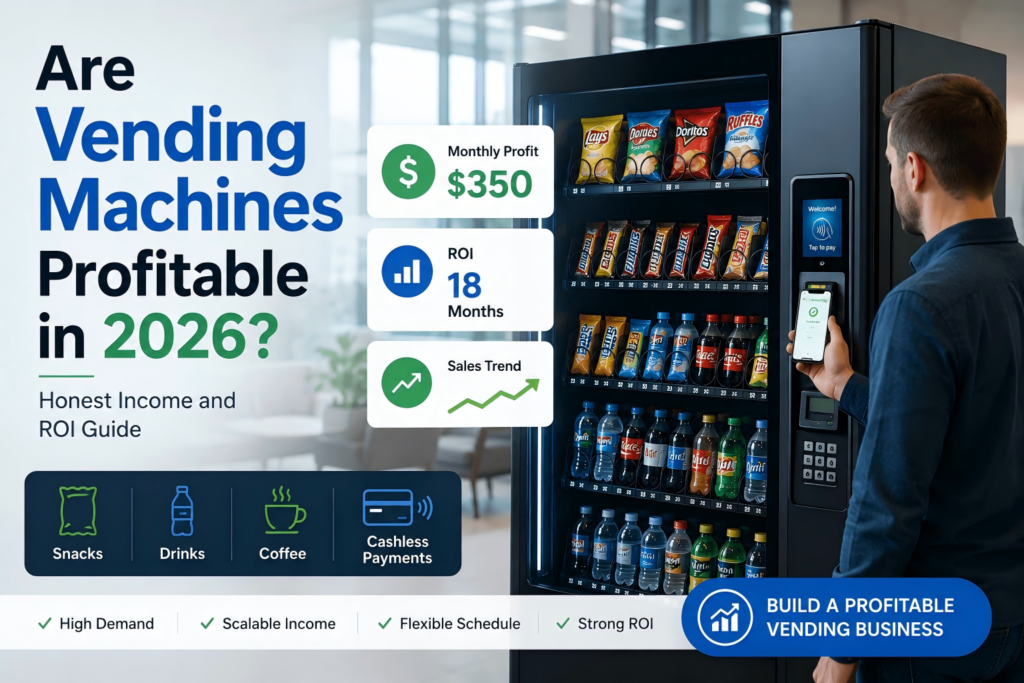
Vending Machine Profitability by Machine Type
| Machine Type | Avg Monthly Net | Profit Margin | Best Profitability Driver |
|---|---|---|---|
| Coffee machine | $200–$600 | 60–80% | Highest margin in vending; daily repeat buyers |
| Healthy snack machine | $150–$500 | 40–60% | Premium pricing accepted; low competition at health-focused locations |
| Combo machine | $100–$350 | 30–45% | Covers two categories; best first-machine profitability |
| Cold drink machine | $100–$400 | 35–50% | High volume; strong at gyms and warehouses |
| Snack machine | $80–$300 | 30–50% | Reliable; best ROI at high-capacity locations |
| Smart / IoT machine | $250–$700 | 35–55% | Dynamic pricing, data optimization, lower stockout rate |
For a detailed breakdown of which machine type generates the best return, see our most profitable vending machine guide.
Vending Machine ROI: Break-Even Examples
Scenario 1: Used Snack Machine, Average Office
| Item | Amount |
|---|---|
| Machine cost (used AP 113) | $2,000 |
| Setup costs (delivery, cashless, inventory) | $600 |
| Total investment | $2,600 |
| Monthly net profit | $104 |
| Break-even | ~25 months |
Scenario 2: New Combo Machine, Good Warehouse
| Item | Amount |
|---|---|
| Machine cost (new Seaga combo) | $4,500 |
| Setup costs | $700 |
| Total investment | $5,200 |
| Monthly net profit | $280 |
| Break-even | ~19 months |
Scenario 3: Refurbished Drink Machine, Hospital
| Item | Amount |
|---|---|
| Machine cost (refurbished Royal Vendors) | $3,000 |
| Setup costs | $600 |
| Total investment | $3,600 |
| Monthly net profit | $480 |
| Break-even | ~8 months |
How Profitable Is a Vending Machine Route?
Individual machine profitability is just the starting point. The real income potential of vending is in route scaling — adding machines at proven locations and using cash flow from existing machines to fund new ones:
| Route Size | Monthly Gross | Monthly Net | Annual Net |
|---|---|---|---|
| 1 machine (first placement) | $300–$600 | $80–$200 | $960–$2,400 |
| 5 machines | $1,500–$3,000 | $400–$1,000 | $4,800–$12,000 |
| 10 machines | $3,000–$6,000 | $800–$2,000 | $9,600–$24,000 |
| 20 machines | $6,000–$15,000 | $1,800–$5,000 | $21,600–$60,000 |
| 40+ machines (full-time route) | $15,000–$30,000+ | $4,500–$10,000+ | $54,000–$120,000+ |
What Makes a Vending Machine More Profitable?
1. Location Quality
Location accounts for 70–80% of a machine’s revenue potential. A great machine at a poor location underperforms a basic machine at an excellent location every time. Prioritize minimum 50 daily users, captive audience (no easy alternatives nearby), and a location manager open to a fair commission structure. See our best vending machine locations guide for a full breakdown.
2. Cashless Payment
84% of vending transactions are cashless in 2026. A cash-only machine gives up 30–40% of potential revenue immediately. Every machine should have cashless payment enabled — retrofits cost $150–$350 and pay back within 2–3 months at most locations.
3. Product Mix Optimization
Stock what your location’s users actually buy — not what you think they should want. Track sales by column from day one. Replace slow sellers within 60 days. Price to a 50–65% gross margin as a starting point. The operators who consistently earn above-average margins review their planogram monthly and act on the data.
4. Pricing Strategy
Most new operators underprice. Captive location demand is price-inelastic — users will pay $2.25 rather than walk 10 minutes to a store. A $0.25 price increase across your top 10 sellers adds $25–$60/month net at no additional cost. Test price increases quarterly.
5. Route Density
The time cost of servicing machines is the primary labor expense in vending. Clustering machines geographically — all within a 5–10 mile radius — reduces drive time per machine and increases the effective hourly value of your route time.
Are Vending Machines Still Profitable in 2026?
The U.S. vending market is projected to generate $7.9 billion in operator revenue in 2026, according to IBISWorld’s 2026 vending machine operators industry report. According to VendSoft’s June 2026 profit analysis, gross revenue per machine runs $150–$400/month at standard locations — consistent with pre-pandemic benchmarks. Profitability has been maintained through cashless payment adoption (which increases transaction volume), smart inventory systems (which reduce stockouts and waste), and rising product prices (which expand gross margins at locations where operators have pricing power).
The operators who report declining profitability in 2026 share a common profile: cash-only machines at low-traffic locations with no planogram optimization. The operators who report growing profitability share a different profile: cashless on every machine, data-driven product selection, geographically dense routes, and disciplined location standards.
Is Vending Passive Income?
No — and this is the most important honest answer in this guide. Vending is not passive income. It is time-efficient income. A 5-machine route requires 8–10 hours per week of real, in-person work: restocking, maintenance, product purchasing, route driving, and location relationship management. The income is recurring and the hours are flexible — but the work is real and ongoing.
The operators who treat vending as a managed asset business — tracking performance, optimizing product mix, maintaining machines proactively, and holding their locations to a standard — consistently out-earn those who treat it as set-and-forget.
Common Mistakes That Reduce Vending Profitability
- Accepting poor locations. Low-traffic placements generate low revenue regardless of machine quality or product mix. Location quality is non-negotiable.
- Operating cash-only machines. 84% of vending transactions are cashless in 2026. Cash-only machines immediately give up 30–40% of potential revenue.
- Failing to adjust the product mix. Slow sellers sitting in columns for months represent lost revenue and tied-up inventory capital. Review and adjust monthly.
- Underpricing products. Captive audience locations support higher price points than operators typically charge. Test $0.25 increases on your top sellers.
- Ignoring machine maintenance. Machines that jam, reject bills, or display errors lose sales immediately. Proactive monthly maintenance prevents 80% of service issues.
- Spreading machines too far geographically. Wide geographic spread increases route time and fuel costs, reducing effective net income per hour of work.
Related Guides
- How Much Money Can a Vending Machine Make? — detailed income benchmarks by location
- How to Start a Vending Machine Business — step-by-step launch guide
- Vending Machine Business Plan — financial projections template
- Where to Buy a Vending Machine — sourcing your first machine
Frequently Asked Questions
Are vending machines profitable?
Yes — vending machines are profitable at good locations with the right product mix and consistent management. Average machines net $40–$120/month. Premium placements at hospitals, large warehouses, and universities net $200–$800+/month. The primary variable in profitability is location quality, not machine type or brand.
How much profit does a vending machine make per month?
At average locations, $75–$150/month net after product cost, commission, electricity, and maintenance. At good locations (large offices, gyms, schools), $150–$350/month net. At premium locations (hospitals, large warehouses, universities), $350–$800+/month net. A 10-machine route generates $750–$2,000/month net combined.
What is the profit margin on a vending machine?
Net profit margins on well-managed vending machines run 15–35% after all expenses. Coffee machines achieve the highest margins at 60–80% gross. Healthy snack machines achieve 40–60% gross. Standard snack and drink machines achieve 30–50% gross. Net margin after commission, electricity, and maintenance typically lands at 20–35% for operators managing their routes actively.
How many vending machines do I need to make a living?
To replace a $50,000/year income, you need approximately 20–25 machines at good locations generating $175–$200/month net each. To replace a $100,000/year income, you need 40–50 average machines or 15–20 premium placements. Most operators build to this scale over 3–5 years starting from one or two machines.
Are vending machines a good investment?
Yes — a $2,000 used machine generating $120/month net delivers a 72% annual ROI after payback. The investment case is strong at good locations: the machine cost is one-time, the income is recurring, and well-maintained machines last 15–25 years. The risk is not the machine — it’s placing at a poor location or failing to manage the operation actively.
Is the vending machine business saturated?
No — while premium downtown locations are competitive, the broader market has significant underserved demand. Vending machines maintain a success rate of over 80% — significantly higher than most small business categories. The operators who struggle typically have poor locations or inactive management, not too much competition.
Is buying a used vending machine more profitable?
Yes — in most cases, a used machine generates faster payback than a new machine because the upfront investment is 40–60% lower. A used snack machine at $1,800 generating $120/month net pays back in 15 months. A new machine at $4,500 at the same location takes 37 months. The trade-off is condition risk and potentially no warranty — always purchase from a reputable commercial supplier who inspects and tests before selling.
How often should vending machines be restocked?
Most machines at standard locations need restocking weekly or biweekly. High-traffic locations (hospitals, large warehouses) may need 2–3 restock visits per week. Low-traffic locations may only need monthly restocking. Use sales data from your cashless reader or management software to determine actual restock frequency by column — over-restocking wastes time; under-restocking costs sales.
Which vending products have the highest profit margins?
Coffee and hot beverages achieve the highest gross margins — 60–80%. Healthy snacks (protein bars, mixed nuts, premium items) achieve 40–60%. Energy drinks achieve 45–55%. Standard chips and candy achieve 30–50%. Products with perceived premium value at captive locations — where the customer has no convenient alternative — consistently support the highest price points and margins.
How much does card processing reduce vending profits?
Card processing fees run 1.5–3% of cashless sales. On a machine generating $400/month in cashless revenue, that’s $6–$12/month in fees. The cost is far outweighed by the revenue gain from cashless adoption — operators who add cashless payment consistently report 20–35% higher transaction volume. The math strongly favors cashless even after fees.
Are smart vending machines worth the extra cost?
At high-traffic locations, yes. Smart machines with IoT connectivity, remote inventory monitoring, and dynamic pricing reduce stockouts, lower route labor costs, and enable data-driven product optimization. The premium ($6,000–$12,000 vs $3,000–$5,000 for a standard machine) is justified at locations generating $400+/month net where the technology improvement meaningfully affects revenue. At lower-traffic locations, a standard machine with a cashless reader achieves most of the benefit at a fraction of the cost.
Ready to start a profitable vending machine operation? Browse our commercial vending machines for sale — new and used across all categories — or contact MapleVend to discuss which machine and location type fits your income goals.
