
Vending machine maintenance is the single most controllable variable in vending profitability. A well-maintained machine generates more revenue, lasts longer, requires fewer emergency repairs, and keeps location managers happy enough to renew your placement contracts. According to VendSoft’s May 2026 maintenance guide, most breakdowns aren’t random they come from a handful of repeat issues: dust, sticky spills, worn parts, loose connections, and ignored early warning signs like slow bill acceptance, weak cooling, and intermittent card reader errors. This guide gives you a complete, operator-friendly maintenance checklist for snack machines, drink machines, and combo units organized by frequency so you can build a routine rather than react to problems.
This guide was prepared by the MapleVend editorial team using operator maintenance records, manufacturer service documentation, and 2026 industry maintenance guides from VendSoft, VendHub, and GeniusVend.
How We Prepared This Guide
This guide combines manufacturer service manuals from AMS, AP, Seaga, Dixie Narco, Royal Vendors, and Wittern; operator maintenance records from commercial vending routes; service recommendations from U.S. vending parts suppliers; and 2026 best practice guides from VendSoft, VendHub, and GeniusVend. Every recommended interval and cost figure reflects real-world commercial deployment rather than manufacturer-only specifications. Where operator experience and manufacturer recommendations differ, we have noted both.
For related guidance, see our how to fix a vending machine troubleshooting guide and our vending machine lifespan guide.
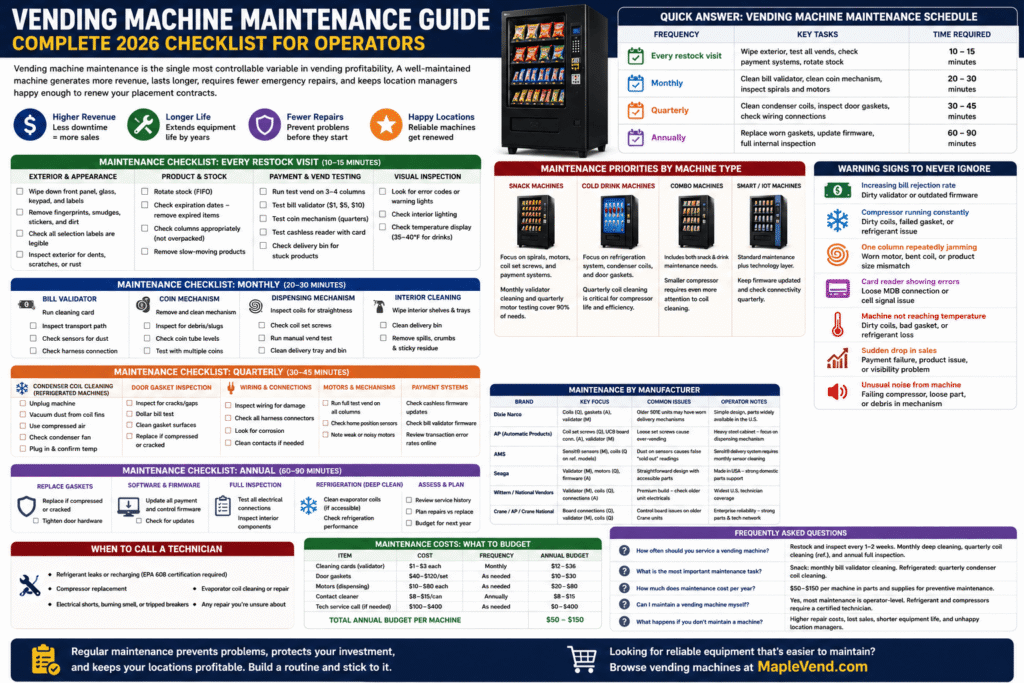
Quick Answer: Vending Machine Maintenance Schedule
| Frequency | Key Tasks | Time Required |
|---|---|---|
| Every restock visit | Wipe exterior, test all vends, check payment systems, rotate stock | 10 15 minutes |
| Monthly | Clean bill validator, clean coin mechanism, inspect spirals and motors | 20 30 minutes |
| Quarterly | Clean condenser coils, inspect door gaskets, check wiring connections | 30 45 minutes |
| Annually | Replace worn gaskets, update firmware, full internal inspection | 60 90 minutes |
Why Maintenance Is the Most Important Vending Business Decision
According to GeniusVend’s January 2026 operator guide, there are two types of vending operators: those who wait for a problem and those who prevent it. Waiting costs more emergency service calls run $100 $400, location managers lose confidence in unreliable machines, and every hour of downtime is lost revenue. A machine generating $400/month gross loses $13/day when offline. A 3-day repair wait costs $40 in lost sales on top of the repair bill.
Preventive maintenance has a measurable ROI:
- Regular condenser coil cleaning extends compressor life by 3 5 years saving $350 $900 in replacement costs
- Monthly bill validator cleaning eliminates 80% of rejection complaints saving refund labor and location manager friction
- Quarterly motor inspection catches failing motors before they cause stuck product incidents which cost both the repair and customer goodwill
- Annual gasket replacement ($40 $120) prevents compressor overwork that accelerates wear costing 10x more to repair
Maintenance Checklist: Every Restock Visit
These tasks take 10 15 minutes and should happen every time you service the machine whether that’s weekly, biweekly, or on demand.
Exterior and Appearance
- Wipe down the front panel, glass, keypad, and selection labels with a soft cloth and mild non-abrasive cleaner
- Remove fingerprints, smudges, stickers, and visible dirt from all external surfaces
- Check that all selection labels are legible faded or missing labels reduce sales on affected columns
- Inspect the machine exterior for dents, scratches, or rust that may affect customer perception
Product and Stock
- Rotate stock move older product to the front, newer product to the back (FIFO)
- Check all product expiration dates remove and dispose of expired items immediately
- Confirm all columns are stocked to appropriate capacity without overpacking
- Remove slow-moving products from columns that haven’t sold since the last visit
Payment and Vend Testing
- Run a test vend on at least 3 4 columns including columns that have had issues recently
- Test the bill validator with a $1, $5, and $10 bill
- Test the coin mechanism with quarters and confirm correct change return
- Test the cashless reader with a card or contactless payment confirm transaction completes and credit registers
- Check the delivery bin for stuck products from previous vend cycles
Visual Inspection
- Look for any error codes or warning lights on the display
- Check that interior lighting is functioning dark machines see lower sales
- On refrigerated machines, confirm the temperature display reads within target range (35 40 degreesF for cold drink machines)
Maintenance Checklist: Monthly
These tasks take 20 30 minutes and should be completed once per month regardless of whether you’ve noticed any issues. Most problems that result in service calls are preventable with consistent monthly attention.
Bill Validator Cleaning
- Run a cleaning card through the validator this is the single highest-impact monthly maintenance action
- Inspect the validator transport path for torn bill fragments or foreign objects
- If rejection rates have increased, inspect the validator sensors with a flashlight for dust accumulation
- Check the harness connection between the validator and control board for looseness
Coin Mechanism
- Remove the coin mechanism and clean the coin path with compressed air
- Inspect for foreign objects, slugs, or debris that may cause jams
- Check coin tube levels full tubes cause rejection of that denomination even on a functioning mechanism
- Reinstall and test with multiple coin denominations
Dispensing Mechanism (Snack Machines)
- Inspect all spiral coils for straightness bent spirals cause jams and failed vends
- Check coil set screws on every motor tighten any that are loose (loose set screws cause over-vending)
- Run a manual vend test through the service menu on any column that has reported issues
- Clean the product delivery tray and bin of crumbs and debris
Interior Cleaning
- Wipe down interior shelves and product trays with a food-safe cleaner
- Clean the delivery bin thoroughly this is the most visible internal surface to customers
- Remove any spilled product, sticky residue, or crumb accumulation from column bases
Maintenance Checklist: Quarterly
These tasks take 30 45 minutes and represent the most impactful preventive maintenance actions for machine longevity particularly on refrigerated units.
Condenser Coil Cleaning (Refrigerated Machines)
- Unplug the machine before beginning
- Locate the condenser coils (typically at the rear or bottom of the machine behind the access panel)
- Vacuum accumulated dust and debris from the coil fins using a brush attachment work gently to avoid bending the fins
- Follow with compressed air to remove fine dust from between fins
- Check that the condenser fan spins freely and is not blocked by debris
- Plug back in and confirm the machine reaches target temperature within 30 minutes
This is the single most important maintenance action for refrigerated machines. Dirty condenser coils force the compressor to work harder, generating more heat, accelerating wear, and ultimately shortening compressor life from 12 15 years to 6 8 years. Clean coils quarterly without exception.
Door Gasket Inspection
- Inspect door gaskets on all sides for cracks, compression, or gaps
- Test seal quality: close a dollar bill in the door if it pulls out with minimal resistance, the gasket isn’t sealing properly
- Clean gasket surfaces with a damp cloth dirt and product residue prevent proper sealing
- If gaskets are compressed or cracked, order replacements a $40 $120 gasket prevents far more expensive compressor wear
Wiring and Connection Inspection
- With power off, visually inspect all visible wiring harnesses for fraying, pinching, or heat damage
- Check all harness connectors at the control board, bill validator, coin mechanism, and card reader for secure seating
- Look for corrosion on any metal contacts clean with electrical contact cleaner if found
Motor and Mechanism Check
- Run full test vend cycle on every column through the service menu
- Note any columns with slow, stuttering, or incomplete motor response these are failing motors to monitor
- Check the home position sensors on snack machine motors a motor that doesn’t stop cleanly at home position over-vends
Payment System Update Check
- Log into your cashless reader management portal (Cantaloupe 365 or Nayax IRIS) and check for firmware updates
- Check bill validator manufacturer site for firmware updates updated firmware recognizes new currency series
- Review transaction error rates in your cashless management portal increasing decline rates indicate a reader issue before it becomes a customer complaint
Maintenance Checklist: Annual
Annual maintenance is a full machine review the equivalent of an annual physical for your equipment. It takes 60 90 minutes per machine and should be scheduled during a low-traffic period at each location.
- Replace door gaskets if they show any compression or cracking don’t wait for a failed dollar bill test
- Inspect and tighten all interior panel screws and mounting hardware
- Update all payment firmware cashless reader, bill validator, and control board where applicable
- Test all electrical connections with a multimeter if you have basic electrical knowledge or have a technician do it
- Clean the evaporator coils on refrigerated machines (requires accessing the interior refrigeration section more involved than condenser cleaning)
- Review the machine’s service history for the year identify any component that has required repair twice or more and budget for replacement
- Assess the machine’s overall condition: cabinet integrity, cosmetic presentation, payment technology currency and make a repair vs replace decision if significant issues are found
Maintenance by Machine Type
Snack Machine Maintenance Priorities
Snack machines are mechanically simpler than refrigerated units the primary maintenance focus is the dispensing mechanism (spirals, motors, coil set screws) and payment systems (bill validator, coin mechanism, cashless reader). Monthly cleaning card use and quarterly full motor testing cover 90% of snack machine maintenance needs.
Cold Drink Machine Maintenance Priorities
Cold drink machines have the same payment system needs as snack machines, plus the refrigeration system. Quarterly condenser coil cleaning is non-negotiable. Door gasket integrity directly affects compressor load. Any sign of the machine struggling to hold temperature should trigger an immediate inspection refrigeration issues compound quickly.
Combo Machine Maintenance Priorities
Combo machines combine the maintenance needs of both snack and drink machines in a single unit with a smaller compressor. Because the compressor is smaller and runs under more continuous load than a dedicated drink machine, condenser cleaning is even more critical do it quarterly without exception. Monitor the compressor temperature and cooling performance closely at high-traffic locations.
Smart / IoT Machine Maintenance
Smart machines add a technology layer to the standard maintenance checklist. Quarterly firmware updates, cellular connectivity checks, and touchscreen cleaning are specific to these units. The physical machine maintenance requirements are identical to standard equipment the technology layer doesn’t replace mechanical upkeep.
Maintenance Recommendations by Manufacturer
Each major vending machine brand has design characteristics that affect maintenance priorities. Here’s what operators should know for the most common commercial brands:
| Brand | Key Maintenance Focus | Common Issues | Operator Notes |
|---|---|---|---|
| Dixie Narco | Condenser coils (quarterly), door gaskets (annually), bill validator (monthly) | Older 501E units may have worn delivery mechanisms on high-volume columns | Simple mechanical design makes DIY maintenance accessible; parts widely available from U.S. suppliers |
| AP (Automatic Products) | Coil set screws (quarterly), UCB control board connections (annually), bill validator (monthly) | Set screw loosening on older units causes over-vending; UCB board upgrades on pre-2010 units | Heavy-gauge steel construction means cabinet needs minimal attention; focus maintenance on dispensing mechanism |
| AMS | Sensit(R) delivery sensor cleaning (monthly), condenser coils on refrigerated models (quarterly) | Sensit(R) sensors can accumulate dust causing false “sold out” readings clean monthly | Sensit(R) delivery guarantee system requires sensor maintenance that other brands don’t factor into schedule |
| Seaga | Bill validator (monthly), motor inspection (quarterly), firmware updates (annually) | Straightforward design with accessible parts; Made in USA means domestic parts availability is strong | Most accessible brand for new operators simple layout and good documentation support self-maintenance |
| Wittern / National Vendors | Bill validator (monthly), condenser coils (quarterly), electrical connections (annually) | Premium construction means fewer mechanical failures; electrical connections on older units should be checked annually | Widest U.S. service technician network when professional service is needed, Wittern has the best coverage |
| Crane / AP / Crane National | Control board connections (quarterly), bill validator (monthly), condenser coils (quarterly) | Control board issues on older Crane units check connections quarterly; parts availability strong through Crane’s network | Enterprise-grade reliability; professional technician access recommended for control board diagnostics |
Warning Signs to Never Ignore
| Warning Sign | What It Likely Means | Action |
|---|---|---|
| Increasing bill rejection rate | Dirty validator sensors or outdated firmware | Run cleaning card immediately; check firmware |
| Compressor running constantly | Dirty coils, failed gasket, or refrigerant issue | Clean coils, inspect gaskets; call technician if persists |
| One column repeatedly jamming | Worn motor, bent coil, or product size mismatch | Inspect coil and motor; change product if oversized |
| Card reader showing intermittent errors | Loose MDB connection or cellular signal issue | Check MDB harness; test signal strength at machine location |
| Machine not reaching temperature | Dirty coils, bad gasket, or refrigerant loss | Clean coils and check gaskets; call technician if no improvement |
| Sudden drop in sales at a location | Payment system failure, product issue, or machine visibility problem | Test all payment systems; check product freshness and column stocking |
| Unusual noise from machine | Failing compressor, loose component, or debris in mechanism | Identify source before next service visit; address immediately |
Building a Maintenance Log
A maintenance log is the single most underused tool in vending operations. Operators who track what they did, when they did it, and what they found at each service visit are able to:
- Identify patterns a column that jams every 6 weeks has a systematic problem, not a random one
- Make better repair vs replace decisions a machine with 4 repair entries in 12 months is telling you something
- Train new staff or drivers efficiently a documented process is faster to transfer than verbal instructions
- Demonstrate maintenance history to location managers who ask why a machine is offline
A basic maintenance log entry needs: date, machine ID, location, tasks completed, issues found, and parts replaced. A simple spreadsheet or notes app works the format doesn’t matter, the habit does.
Vending Machine Repair Costs: What to Budget
Understanding repair costs helps operators make informed repair vs replace decisions and budget accurately. These figures reflect 2026 U.S. commercial vending repair pricing from parts suppliers and service technicians:
| Component | Average Repair Cost | DIY Possible? | Notes |
|---|---|---|---|
| Bill validator replacement | $150 $400 | Yes | Swap in most machines is straightforward; confirm MDB compatibility before ordering |
| Coin mechanism replacement | $80 $250 | Yes | Remove, inspect, clean, or replace; coin mechs are modular on most commercial machines |
| Dispensing motor replacement | $25 $90 per motor | Yes | Individual column motor swap is operator-level; confirm motor model from service manual |
| Cashless card reader replacement | $150 $450 | Yes | Cantaloupe ePort and Nayax VPOS Touch are self-installable; confirm MDB port availability |
| Door gasket replacement | $40 $120 | Yes | Peel and stick or clip-on installation on most models; order by machine model number |
| Control board replacement | $200 $700 | Partial | Physical swap is possible; diagnosis of which board is faulty typically requires a technician |
| Compressor replacement | $350 $900 | No | Requires refrigeration certification; never attempt without proper credentials |
| Refrigerant recharge | $150 $350 | No | EPA Section 608 certification required; illegal to handle refrigerant without certification |
| Touchscreen / display replacement | $200 $600 | Partial | Physical replacement possible on some models; software calibration may require technician |
When to Call a Vending Machine Technician
Most vending machine maintenance and many repairs are operator-level tasks. But some issues require a licensed technician either for safety reasons, certification requirements, or diagnostic complexity that exceeds what visual inspection can determine.
Always call a technician for:
- Refrigerant leaks or recharging. Handling refrigerant without EPA Section 608 certification is illegal. Any suspected refrigerant issue machine won’t cool despite clean coils and good gaskets requires a licensed HVAC/refrigeration technician.
- Compressor replacement. The compressor is the heart of any refrigerated machine. Replacement requires refrigeration system expertise and proper certification. A botched compressor installation creates refrigerant and electrical hazards.
- Electrical shorts or burning smell. Any sign of burning smell, sparking, or tripped circuit breakers on a machine is a safety issue unplug immediately and call a qualified electrician or vending technician before returning the machine to service.
- Control board diagnosis. Identifying which board component has failed requires diagnostic equipment and expertise. Physical board replacement is operator-level; knowing which board to replace typically isn’t.
- Evaporator coil cleaning or repair. Unlike condenser coils (accessible and safe to clean yourself), evaporator coils are inside the refrigeration system and require expertise to access without causing refrigerant system damage.
- Any repair you’re unsure about. A $100 $150 technician diagnostic call is far less expensive than a botched repair on a $400 control board or a $700 compressor.
Maintenance Costs: What to Budget
| Item | Cost | Frequency | Annual Budget |
|---|---|---|---|
| Cleaning cards (bill validator) | $1 $3 each | Monthly | $12 $36/machine |
| Door gaskets | $40 $120/set | As needed (typically 3 5 years) | $10 $30/machine/year |
| Dispensing motors | $10 $80 each | As needed | $20 $80/machine/year (budget) |
| Electrical contact cleaner | $8 $15/can | Annually | $8 $15/machine |
| Technician service call (if needed) | $100 $400 | As needed | $0 $400/machine/year |
| Total annual maintenance budget | Per machine, well-maintained | $50 $150/machine/year | |
Operators who budget $50 $150/machine/year for preventive maintenance consistently spend less on emergency repairs than those who service reactively. The math is straightforward: one emergency compressor call ($350 $900) costs more than 5 10 years of preventive maintenance supplies.
Related Guides
- How to Clean a Vending Machine full cleaning guide inside and out
- Dixie Narco Vending Machine Reviews simple design, easy to maintain
- AP Vending Machine Reviews most durable snack machine cabinet
Frequently Asked Questions
How often should you service a vending machine?
At minimum, vending machines should be restocked and visually inspected every 1 2 weeks at active locations. Monthly deep cleaning of the bill validator and coin mechanism, quarterly condenser coil cleaning on refrigerated machines, and annual full inspections are the four maintenance frequencies that cover most preventive needs.
What is the most important vending machine maintenance task?
For snack machines: monthly bill validator cleaning with a cleaning card it prevents 80% of rejection complaints. For refrigerated drink and combo machines: quarterly condenser coil cleaning it extends compressor life by years and prevents the most expensive single repair in vending.
How much does vending machine maintenance cost per year?
A well-maintained machine costs $50 $150/year in parts and supplies for preventive maintenance. Emergency repairs add $100 $900 when they occur operators who maintain consistently spend significantly less on emergency calls than those who service reactively.
Can I maintain a vending machine myself?
Yes the majority of vending machine maintenance is operator-level work requiring no specialized tools or certifications: cleaning validators, inspecting spirals, tightening set screws, cleaning condenser coils, and replacing gaskets. The only tasks requiring a certified technician are refrigerant handling, compressor replacement, and complex electrical diagnosis.
What happens if you don’t maintain a vending machine?
Neglected machines experience higher bill rejection rates (lost sales and customer complaints), faster compressor wear on refrigerated units (expensive repairs), increased jam frequency (lost sales and location manager friction), and shorter overall machine lifespan. The revenue lost to downtime and repairs on a neglected machine typically far exceeds the time cost of a consistent maintenance routine.
How much is maintenance for a vending machine?
A well-maintained machine costs $50 $150/year in parts and supplies for preventive maintenance validator cleaning cards, condenser coil cleaner, door gaskets, and miscellaneous fasteners. Emergency repairs add $100 $900 when they occur: bill validator replacement ($150 $400), compressor service ($350 $900), motor replacement ($80 $200), control board repair ($100 $300). Operators who follow a preventative maintenance schedule consistently spend less on total annual maintenance than those who only address problems reactively.
How often should a vending machine be serviced?
The standard preventative schedule is: weekly visual inspection during every restock visit; monthly bill validator and coin mechanism cleaning; quarterly condenser coil cleaning on refrigerated machines; semi-annual spiral/motor inspection on snack machines; and annual full inspection covering wiring, gaskets, payment system firmware, and all moving parts. High-traffic machines at 100+ daily user locations benefit from more frequent bill validator cleaning heavy cash use accelerates dirt buildup and rejection rates.
How to become a vending machine repairman?
Most vending machine technicians start as operators who learn their own machines through troubleshooting and repair guides. Formal training is available through vending industry trade associations and some community colleges. EPA Section 608 certification is required to legally handle refrigerants for refrigerated machine repair. Most operators handle 80 90% of their own maintenance without any formal certification only refrigerant work and complex electrical diagnosis reliably require a certified technician.
How much do vending machine technicians make per hour?
Employed vending machine technicians typically earn $18 $28/hour depending on experience, location, and employer. Senior technicians at large vending companies earn $28 $40/hour. Independent vending technicians billing service calls charge $75 $150/hour for labor. Most commercial vending operators handle routine maintenance themselves and only hire outside technicians for compressor work, refrigerant handling, and complex control board repairs where the labor cost is offset by avoiding more expensive machine downtime.
What is the failure rate of vending machines?
Commercial vending machines from established brands have low failure rates when properly maintained. The most common failure modes are: bill validator rejection (addressable with monthly cleaning not a true failure); product jams from worn or bent spirals (typically caught during routine inspection); compressor failure on refrigerated machines (most common after 8 12 years of heavy use); and control board failures on older machines with outdated electronics. Machines from AP, AMS, Wittern, Dixie Narco, and Royal Vendors have the lowest reported failure rates and the most accessible U.S. repair networks.
Is vending machine a good side hustle?
Yes and maintenance is one of the key reasons. Most vending maintenance is operator-level work that takes 30 60 minutes per machine per month on a preventive schedule. A 3-machine side hustle generating $300/month net requires approximately 10 15 hours/week total including restocking, purchasing, and maintenance. The time per machine decreases as the route grows denser geographically. Operators who build maintenance into their regular restock visits cleaning the bill validator at every visit, checking spirals while restocking add almost no extra time to the operation.
Are vending machines a good investment in 2026?
Yes particularly from a maintenance cost perspective. A well-maintained AP or Wittern snack machine costs $50 $150/year to maintain and lasts 15 25 years. Over a 20-year lifespan at $100/month net, a $2,000 machine generates $24,000 in net income after a $2,000 $3,000 total maintenance cost over its life. The low maintenance cost relative to total net income is one of the reasons snack machines in particular deliver high total return on investment no refrigeration system, no compressor, no refrigerant handling.
Looking for reliable commercial equipment that’s easier to maintain? Browse our commercial vending machines for sale from established manufacturers with active U.S. parts networks or contact MapleVend to discuss which machine type fits your operation.
