
A vending machine is an automated retail device that dispenses products snacks, drinks, coffee, personal care items, electronics, and more when a customer inserts payment. The transaction requires no human operator: the customer pays, makes a selection, and the machine delivers the product automatically. Vending machines operate 24 hours a day, 7 days a week, in locations ranging from office break rooms and hospital corridors to airports, schools, and factory floors.
This guide was prepared by the MapleVend editorial team using manufacturer documentation, industry research, and commercial vending deployment records from 2026.
Quick Answer: What Is a Vending Machine?
- Definition: An automated retail device that dispenses products in exchange for payment, without human intervention
- Payment methods: Coins, bills, credit/debit cards, contactless (NFC), mobile wallets, QR codes
- Common products: Snacks, cold drinks, coffee, healthy food, personal care, electronics
- Industry size: $18.2 billion in U.S. revenue (2023); growing with smart and cashless technology
- Most vending machines per capita: Japan approximately one machine per 23 people
- First vending machine: Designed by Hero of Alexandria around 215 BC to dispense holy water
How Does a Vending Machine Work?
According to Wendor’s June 2026 guide on vending machine mechanics, modern vending machines follow a sophisticated 4-step process: payment verification, product selection, dispensing, and inventory update. Here’s what happens at each stage:
Step 1: Payment Verification
The customer inserts payment coins, bills, or a cashless method. The machine verifies the payment through one of two systems:
- Cash validation: Coin validators check diameter, thickness, and metal composition using electromagnets. Bill validators scan notes for security features including size, color, watermark patterns, and magnetic ink.
- Cashless validation: Card readers, NFC readers, and mobile payment systems communicate with payment processors in real time to authorize transactions. Most modern machines use MDB (Multi-Drop Bus) protocol to connect payment devices to the machine’s control board.
Step 2: Product Selection
The customer selects a product via keypad, touchscreen, or selection buttons. The selection sends a product code to the machine’s internal control board, which identifies the corresponding dispensing mechanism a specific motor-driven spiral coil for snack machines, or a channel for drink machines.
Step 3: Dispensing
The control board activates the appropriate dispensing mechanism:
- Snack machines: A motor rotates the spiral coil, pushing the product forward until it falls into the delivery bin. A home position sensor stops the motor after one full vend cycle.
- Drink machines: A channel or belt mechanism releases a single can or bottle into the delivery chute.
- Coffee machines: A brewing system grinds beans or mixes ingredients and dispenses the prepared drink into a cup.
Step 4: Inventory and Data Update
On smart and IoT-connected machines, the completed transaction is logged in real time updating inventory counts, transmitting sales data to management software, and triggering restocking alerts when a column falls below a set threshold. On traditional machines, inventory tracking is manual.
Types of Vending Machines
| Type | Products | Best Locations | Typical Price (New) |
|---|---|---|---|
| Snack vending machine | Chips, candy, crackers, protein bars, nuts | Offices, warehouses, schools | $3,000 $5,000 |
| Cold drink / beverage machine | Canned and bottled drinks, water, sports drinks | Gyms, warehouses, outdoor locations | $4,000 $6,000 |
| Combo machine | Snacks and drinks in one unit | Small offices, laundromats, waiting rooms | $4,000 $7,000 |
| Coffee / hot beverage machine | Espresso, cappuccino, hot chocolate, tea | Offices, hotels, coworking spaces | $3,000 $8,000 |
| Healthy / fresh food machine | Salads, sandwiches, fruit, yogurt | Healthcare, schools, corporate wellness | $4,500 $8,000 |
| Smart / IoT vending machine | Any product type with connected management | High-traffic locations, enterprise accounts | $6,000 $15,000+ |
| Bulk candy / gumball machine | Gum, candy, toy capsules | Restaurants, playgrounds, family venues | $50 $300 |
| Specialty vending machine | Electronics, PPE, medicine, beauty products | Airports, hospitals, hotels | $5,000 $20,000+ |
Advantages and Disadvantages of Vending Machines
| Advantages | Disadvantages |
|---|---|
| Open 24/7 no staffing required | Requires regular restocking and maintenance |
| Low overhead vs staffed retail | Repairs can be costly compressors, control boards |
| Small physical footprint | Good locations are competitive and sometimes expensive to secure |
| Cashless and contactless capable | Initial machine investment required ($1,200 $15,000+) |
| Real-time sales data on smart machines | Revenue depends heavily on foot traffic poor locations underperform |
| Scalable add machines to grow income | Product mix must be managed wrong products reduce sales |
| Serves customers when no staff are available | Machine downtime means lost revenue until repaired |
Who Uses Vending Machines?
Vending machines serve two distinct groups: the businesses and institutions that place them, and the customers who use them daily.
Businesses and Institutions That Place Vending Machines
- Schools and universities student-facing snack and drink machines; USDA Smart Snacks compliance required in K 12
- Hospitals and healthcare facilities 24/7 demand from staff, patients, and visitors; one of the highest-revenue placements in commercial vending
- Hotels and hospitality guest convenience at any hour; supplements room service without labor cost
- Airports and transit hubs high-volume, time-pressured customers; premium pricing accepted
- Factories and warehouses shift workers with limited nearby food options; reliable daily demand
- Corporate offices employee convenience; coffee machines particularly strong in professional environments
- Gyms and fitness centers post-workout purchases; premium health product pricing accepted
- Apartment buildings resident convenience; lower volume than commercial placements
- Laundromats captive audience with extended dwell time
Individual Operators Who Run Vending Businesses
Independent vending operators from part-time side-income operators with 1 5 machines to full-time route operators running 25 100+ machines make up a significant share of the U.S. vending market. For guidance on starting a vending business, see our how to start a vending machine business guide.
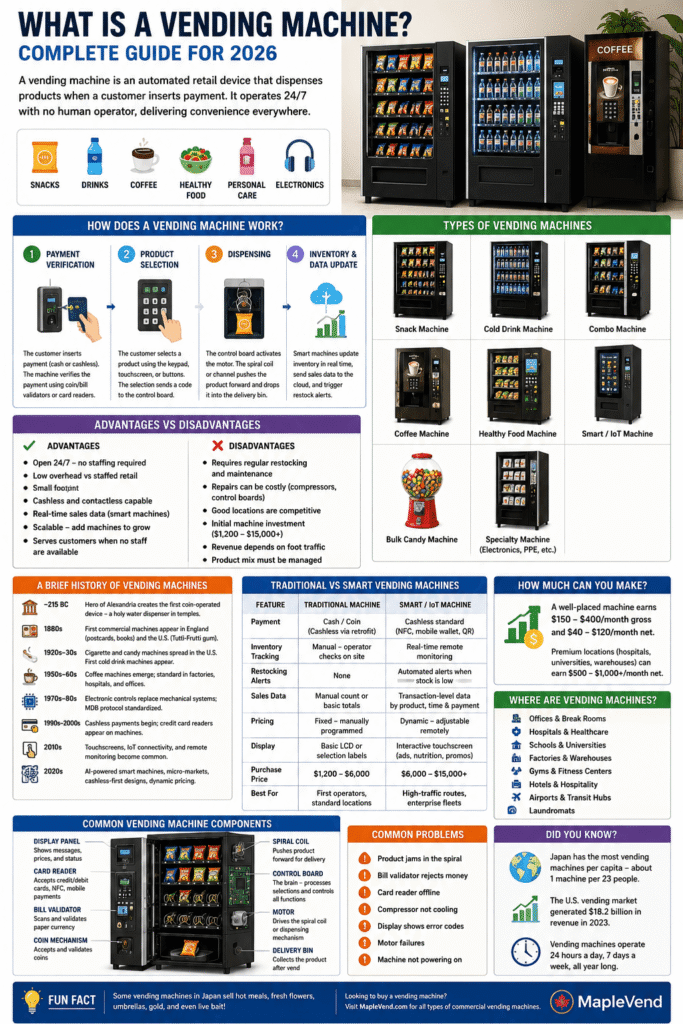
A Brief History of Vending Machines
Vending machines have a longer history than most people realize. According to EBSCO’s research overview on vending machines, the first vending machine was developed by the Greek engineer Hero of Alexandria around 215 BC a coin-operated device in Egyptian temples that dispensed a fixed amount of holy water when a coin was inserted into a slot that triggered a counterbalanced valve.
| Era | Development |
|---|---|
| ~215 BC | Hero of Alexandria designs the first coin-operated device a holy water dispenser in Egyptian temples |
| 1880s | First commercial vending machines appear in England, dispensing postcards and books; Tutti-Frutti gum machines appear in New York subway stations |
| 1920s 1930s | Cigarette and candy vending machines spread across the U.S.; first cold drink machines appear |
| 1950s 1960s | Coffee vending machines emerge; machines become standard in factories, hospitals, and office buildings |
| 1970s 1980s | Electronic controls replace mechanical systems; MDB protocol standardized for payment device connectivity |
| 1990s 2000s | Cashless payment integration begins; first credit card readers appear on commercial machines |
| 2010s | Touchscreen machines, IoT connectivity, and remote monitoring become commercially available |
| 2020s | AI-powered smart machines, micro-markets, cashless-first designs, and dynamic pricing emerge as the new standard |
What Do Vending Machines Sell?
Modern vending machines sell far more than snacks and drinks. In 2026, vending machines dispense:
- Food and beverages snacks, cold drinks, coffee, fresh meals, healthy options, alcohol (where legally permitted)
- Personal care toiletries, OTC medicine, feminine hygiene products, sunscreen, first aid items
- Electronics and accessories phone chargers, earbuds, power banks, USB cables
- PPE and safety supplies masks, gloves, safety glasses (common in manufacturing environments)
- Office supplies pens, notepads, USB drives, staplers (airports, libraries, schools)
- Tickets and tokens transit passes, event tickets, parking tokens
- Specialty items gold coins (luxury airports), fresh pizza, fresh ramen, live bait (fishing locations)
Where Are Vending Machines Located?
Vending machines are placed wherever a captive audience needs convenient access to products without a staffed retail environment. Common placement locations include:
| Location | Most Common Machine Type | Why It Works |
|---|---|---|
| Office break rooms | Snack + coffee machine | Daily repeat buyers; no nearby food alternatives during work hours |
| Hospitals and healthcare | Snack + drink + fresh food | 24/7 operation; staff on overnight shifts; visitors with limited food access |
| Schools and universities | Healthy snack machine | High volume; institutional placement opportunities; USDA compliance requirements |
| Warehouses and factories | Snack + drink machine | Shift workers with no nearby food; high caloric demand; break room captive audience |
| Gyms and fitness centers | Protein bar + sports drink | Post-workout purchase behavior; premium product pricing accepted |
| Hotels and hospitality | Snack + drink + coffee | Guests want convenience at any hour; machines supplement room service |
| Airports and transit hubs | Full-line + specialty | High foot traffic; travelers with time pressure; premium pricing accepted |
| Laundromats | Combo machine | Captive audience with 30 60 minute dwell time; impulse purchase opportunity |
Traditional vs Smart Vending Machines
| Feature | Traditional Machine | Smart / IoT Machine |
|---|---|---|
| Payment | Cash and coin (cashless via retrofit) | Cashless standard; NFC, mobile wallet, QR code |
| Inventory tracking | Manual operator checks on site | Real-time remote monitoring via management software |
| Restocking alerts | None operator estimates when to restock | Automated alerts when columns reach minimum threshold |
| Sales data | Manual count or basic totals | Transaction-level data by product, time, and payment type |
| Pricing | Fixed manually programmed | Dynamic adjustable remotely; supports time-based pricing |
| Display | Basic LCD or selection labels | Interactive touchscreen with ads, nutrition info, promotions |
| Purchase price | $1,200 $6,000 | $6,000 $15,000+ |
| Best for | First operators, standard locations, tight budget | High-traffic routes, enterprise accounts, fleet operators |
How Much Does a Vending Machine Cost?
Vending machine costs vary significantly by type, condition, and technology. Here’s a quick overview for full pricing detail see our dedicated price guides:
| Machine Type | New Price | Used / Refurbished |
|---|---|---|
| Snack machine | $3,000 $5,000 | $1,200 $2,500 |
| Cold drink machine | $4,000 $6,000 | $1,500 $3,000 |
| Combo machine | $4,000 $7,000 | $1,800 $3,500 |
| Coffee machine | $3,000 $8,000 | $1,500 $4,000 |
| Smart machine | $6,000 $15,000+ | $3,500 $7,000 |
For a complete breakdown, see our guides on how much a snack vending machine costs and how much a drink vending machine costs.
How Much Money Can a Vending Machine Make?
A well-placed vending machine at a good commercial location generates $150 $400/month gross and $40 $120/month net after product costs, site commission, electricity, and maintenance. Premium placements at hospitals, universities, and large warehouses generate significantly more $500 $1,000+/month net. For a complete income breakdown see our guide on how much money a vending machine can make.
Are Vending Machines a Good Business?
Vending machines are a legitimate business model with real income potential but they are not passive income in the way often advertised. A well-run vending route requires consistent restocking, maintenance, location management, and ongoing optimization. The operators who build meaningful vending income treat it as a managed asset business, not a set-and-forget investment.
For a complete guide to starting a vending machine business, see our how to start a vending machine business guide linked in the Related Guides section below.
Vending Machines Around the World
According to EBSCO’s research overview, Japan has the highest per capita rate of vending machines globally approximately one machine per 23 people. Japanese vending machines are notably advanced, dispensing hot meals, fresh flowers, and even umbrellas alongside standard snacks and drinks. The U.S. vending market generated $18.2 billion in revenue in 2023 and continues growing with smart technology adoption. Other significant vending markets include Europe (particularly Germany, France, and the UK), Australia, and South Korea.
Popular Vending Machine Brands
Several established manufacturers dominate the U.S. commercial vending market. Each brand has distinct strengths:
| Brand | Known For | Best For |
|---|---|---|
| AMS | Sensit(R) delivery guarantee, healthy vending | Schools, healthcare, corporate wellness |
| AP (Automatic Products) | Heavy-gauge steel, most durable snack cabinet | Warehouses, high-traffic snack locations |
| Seaga | Made in USA, affordable new machines | First operators, combo machines, budget buyers |
| Wittern / National Vendors | 90+ year manufacturer, widest U.S. service network | Long-term reliability, combo machines |
| Dixie Narco | Simple design, best used drink machine value | Cold drink vending, value-focused operators |
| Royal Vendors | Coke, Pepsi, Dr. Pepper certified; Energy Star | Beverage vending, bottler partnerships |
| Crane (Crane Convenience) | Enterprise-grade, VendMax software, BevMax glass-front | Fleet operators, premium locations |
| Jofemar | Heavy-duty Spanish engineering, coffee machines | Coffee vending, demanding environments |
Related Guides
- Most Profitable Vending Machine which type makes the most money
- Where to Buy a Vending Machine complete buyer’s guide
- How Long Do Vending Machines Last? lifespan by type and brand
- Smart Vending Machines for Sale browse current connected machines
Frequently Asked Questions
What is a vending machine?
A vending machine is an automated retail device that dispenses products snacks, drinks, coffee, personal care items, and more when a customer inserts payment. It operates without a human operator, 24 hours a day, and accepts coins, bills, credit cards, contactless payments, and mobile wallets.
How does a vending machine work?
Modern vending machines follow a 4-step process: payment verification (cash or cashless), product selection via keypad or touchscreen, dispensing via spiral coil or channel mechanism, and inventory update (automated on smart machines, manual on traditional machines).
What was the first vending machine?
The first vending machine was designed by the Greek engineer Hero of Alexandria around 215 BC a coin-operated device that dispensed a fixed amount of holy water in Egyptian temples when a coin was inserted and triggered a counterbalanced valve.
What does a vending machine sell?
Modern vending machines sell snacks, cold drinks, coffee, fresh food, personal care items, electronics and accessories, PPE, office supplies, transit tickets, and specialty items. The product range has expanded significantly beyond snacks and drinks over the past two decades.
How much does a vending machine cost?
New commercial snack machines cost $3,000 $5,000. New drink machines cost $4,000 $6,000. Used machines cost $1,200 $3,000. Smart IoT machines cost $6,000 $15,000+. Used machines from reputable commercial suppliers represent the best value for first-time operators.
Which country has the most vending machines?
Japan has the highest per capita rate of vending machines in the world approximately one machine per 23 people. Japanese machines are notably advanced, dispensing everything from hot meals and fresh flowers to cold drinks and umbrellas.
What is the purpose of a vending machine?
A vending machine serves two purposes depending on who you ask. For the customer, it provides immediate access to products food, drinks, personal care items without waiting in line, interacting with a cashier, or finding an open store. For the operator, it generates recurring revenue from a location 24 hours a day without staffing costs. Vending fills the gap between traditional retail and immediate product availability particularly at locations (warehouses, hospitals, schools) where full retail is impractical but demand is consistent.
What is a reverse vending machine?
A reverse vending machine (RVM) is a machine that accepts empty containers bottles, cans, and sometimes cups rather than dispensing products. Customers insert used containers and receive a cash refund, voucher, or loyalty points in return. Reverse vending machines are most common in states and countries with bottle deposit return systems (California’s CRV program, Scandinavian deposit systems, German Pfand). They serve an environmental function by incentivizing recycling and keeping containers out of landfills.
What is a vending machine route?
A vending machine route is a collection of machines placed across multiple locations that a single operator services on a regular schedule. The operator visits each location in sequence restocking products, collecting cash from bill validators, performing basic maintenance, and checking for problems. Routes are organized geographically to minimize drive time between stops. A route of 10 30 machines is typical for a side-income operator; 50 100+ machines is common for full-time vending businesses. Routes can be built machine by machine or purchased as an existing business from an exiting operator.
Do vending machines count as retail?
Yes vending machines are classified as automated retail. Vending sales are subject to sales tax in nearly every U.S. state (the same as traditional retail sales). Vending machine operators are required to register for a state sales tax permit, collect sales tax on applicable products, and remit it to the state comptroller on a regular basis. Food vending may also require health department permits depending on state and product type. The IRS classifies vending machine income as business income subject to federal income tax.
What products sell best in vending machines?
In standard commercial snack machines, the top sellers are: chips (Lay’s, Doritos, Cheetos), candy bars (Snickers, Reese’s, Kit Kat), crackers (Cheez-It, Goldfish), and granola bars (Nature Valley). In drink machines, bottled water consistently leads by volume, followed by Coca-Cola, Pepsi, and energy drinks (Red Bull, Monster). At health-focused locations (gyms, corporate offices, healthcare), mixed nuts, KIND bars, and protein bars increasingly compete with traditional snacks. The most-sold item varies by location type track column-by-column sales for the first 60 days at any new location and adjust based on actual data.
Does owning a vending machine make money?
Yes when placed at good locations. A vending machine at an average commercial location generates $40 $120/month net after product cost, location commission, electricity, and maintenance. At premium locations (hospitals, large warehouses, universities), $200 $600+/month net is achievable. A $2,000 used machine generating $100/month net pays back in 20 months and generates $1,200/year indefinitely thereafter. The primary variable is location quality a poorly placed machine generates minimal revenue regardless of machine quality or product mix.
What are the downsides of vending machines?
The main downsides from an operator perspective are: machines require consistent restocking and maintenance rather than truly passive income; revenue depends heavily on location quality; poor placements generate minimal income regardless of machine type; machines break down and repairs cost money; and some locations require health permits, per-machine registration fees, or liability insurance before allowing placement. From a consumer perspective, vending machines offer limited product variety compared to retail, prices are typically higher than store prices, and machine malfunctions occasionally result in product jams or payment issues.
What is replacing vending machines?
Micro-markets open-shelf self-checkout retail setups are replacing traditional vending at large corporate locations with 200+ employees. Smart vending machines with touchscreens and AI-powered inventory management are upgrading traditional machines at premium placements. Mobile ordering with locker pickup is emerging at some locations. However, for the vast majority of commercial placements offices under 100 employees, warehouses, schools, gyms, laundromats traditional vending machines remain the most cost-effective automated retail solution and are not being meaningfully displaced.
What is the failure rate of vending machines?
Commercial vending machines from established brands (AP, AMS, Wittern, Crane, Dixie Narco, Royal Vendors) have low mechanical failure rates when properly maintained. The most common issues are bill validator rejections (addressable with monthly cleaning), product jams from worn spirals (caught during regular inspection), and compressor wear on refrigerated machines after 8 12 years of heavy use. Machines from unknown or discontinued brands have significantly higher failure rates and are harder to repair due to limited parts availability which is one of the strongest arguments for buying established brands regardless of purchase price.
Looking to buy a commercial vending machine? Browse our commercial vending machines for sale across all types and price points or contact MapleVend to discuss which machine fits your location and budget.
