
A vending machine business plan is the document that forces your idea into a real operation. According to VendSoft’s March 2026 business plan guide, every effective vending plan answers three questions you’ll keep returning to as you grow: Where will the money come from? What will it cost to earn it? What’s your next move when reality looks different from the plan? This guide gives you a complete, operator-friendly business plan structure with real numbers, sample language, and financial projection templates you can fill in for your own operation.
This guide was prepared by the MapleVend editorial team and reviewed by commercial vending operators with experience building single-machine startups and multi-machine routes across offices, schools, healthcare facilities, and industrial locations.
Looking for commercial vending machines to include in your business plan? Browse our commercial vending machines for sale — or contact MapleVend to discuss equipment options for your operation.
Who Needs a Vending Machine Business Plan?
You need a business plan in three situations:
- Applying for financing. SBA Microloans, equipment financing, and business credit cards all require a business plan. A lender-ready plan needs executive summary, market analysis, operations plan, financial projections, and funding request — formatted to show repayment ability.
- Pitching a premium location. Hospitals, universities, and large corporate accounts sometimes require a formal business overview before signing a placement agreement. A one-page plan summary demonstrates professionalism and commitment.
- Forcing your own numbers to work. Even if you’re self-funding and pitching small locations, writing a business plan forces you to confront whether your projected revenue actually covers your costs — before you’ve spent a dollar.
Vending Machine Business Plan: Complete Structure
A complete vending machine business plan has seven sections. Here’s what goes in each one, with sample language and real numbers:
Section 1: Executive Summary
The executive summary is written last but appears first. It should be 1–2 pages maximum and cover:
- Business name and owner: [Your Business Name], owned by [Your Name], registered as an LLC in [State].
- Business model: We operate commercial vending machines at [target location types — e.g., offices, warehouses, schools] in [geographic area]. We generate revenue through product sales at each machine location, paying a [10–20%] revenue commission to location owners.
- Machines and locations: Year one target: [X] machines at [X] locations. Year two target: [X] machines.
- Revenue projection: Year one projected gross revenue: $[X]. Year one projected net income: $[X].
- Startup capital required: Total startup investment: $[X], funded by [personal savings / equipment loan / investor].
- Competitive advantage: [e.g., focus on healthy vending in healthcare settings where competitor machines carry only standard snacks; or: geographic focus in [city] industrial corridor where vending service is underserved].
Sample executive summary opening:
[Business Name] is a commercial vending machine operation based in [City, State]. We place and service snack and drink vending machines at offices, warehouses, and schools in [geographic area], providing convenient food access for employees and students while generating revenue through automated retail. We plan to deploy [X] machines in year one, targeting net income of $[X]/month by month 12.
Section 2: Company Overview
| Element | Your Information |
|---|---|
| Business name | [Your LLC name] |
| Business structure | LLC (recommended) or sole proprietorship |
| State of registration | [State] |
| EIN | [From IRS.gov — free] |
| Business address | [Home office address or commercial address] |
| Owner(s) | [Name(s)] |
| Founded | [Year] |
| Mission statement | [e.g., “To provide reliable, well-stocked vending services to businesses and institutions in [area], with a focus on product quality, machine uptime, and service consistency.”] |
Section 3: Market Analysis
Industry Overview
According to VendSoft’s 2026 industry analysis, the global vending machine market was valued at over $72 billion in 2024 and is projected to reach nearly $99 billion by 2033 — driven by cashless payment adoption, IoT connectivity, and growing demand for convenient food access. The U.S. vending market generated $18.2 billion in 2023 and continues growing. U.S. vending machine operators are projected to generate approximately $7.9 billion in revenue in 2026.
Target Market
Fill in this section with your specific geographic market and target location types:
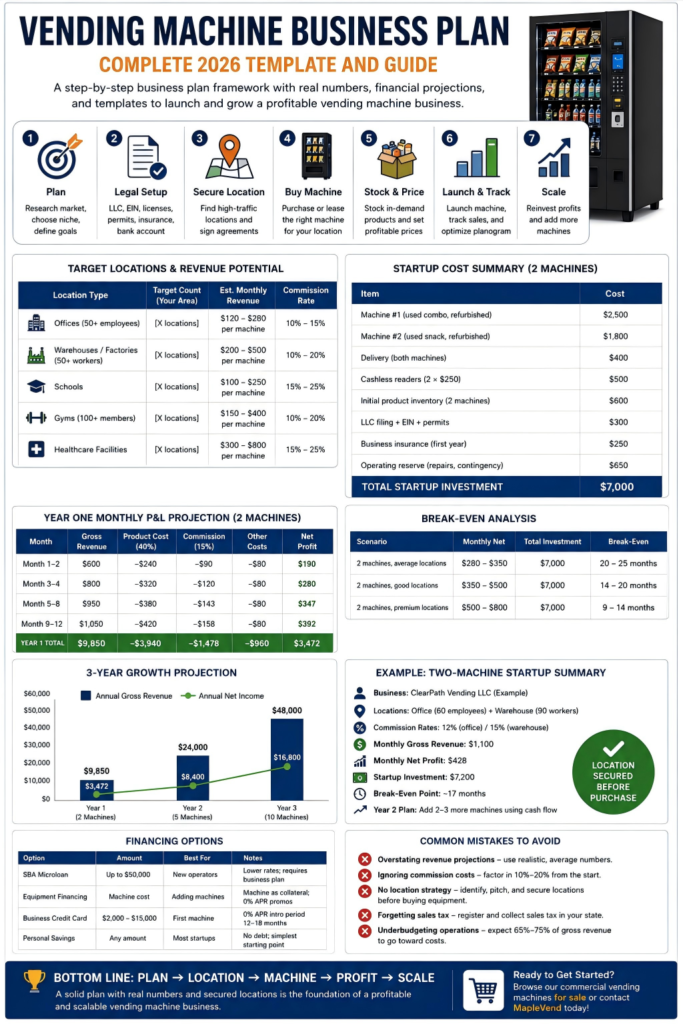
| Location Type | Target Count in Your Area | Estimated Monthly Revenue | Commission Rate |
|---|---|---|---|
| Offices (50+ employees) | [X locations] | $120–$280/machine | 10–15% |
| Warehouses / factories (50+ workers) | [X locations] | $200–$500/machine | 10–20% |
| Schools | [X locations] | $100–$250/machine | 15–25% |
| Gyms (100+ members) | [X locations] | $150–$400/machine | 10–20% |
| Healthcare facilities | [X locations] | $300–$800/machine | 15–25% |
Competitive Analysis
Identify the current vending operators in your target area:
- Existing operators: [Name any known route operators or vending companies in your area]
- Their weaknesses: Common competitor weaknesses include poor machine maintenance, infrequent restocking, outdated cash-only payment systems, and limited product variety
- Your competitive advantage: [e.g., cashless payment on every machine from day one; weekly restocking guarantee; healthy product options; faster response to machine issues]
Section 4: Products and Services
Machine Types You Will Operate
| Machine Type | Target Locations | Machine Count (Year 1) | Avg Monthly Net |
|---|---|---|---|
| Snack machine | Offices, warehouses | [X] | $90–$200 |
| Combo machine (snack + drink) | First placements, laundromats | [X] | $100–$250 |
| Cold drink machine | Gyms, warehouses | [X] | $100–$280 |
| Healthy snack machine | Healthcare, schools | [X] | $150–$400 |
Product Strategy
Describe your product sourcing approach: where you will buy products (Costco, Sam’s Club, Restaurant Depot, wholesale distributors), your target gross margin (40–55% for standard snacks, 50–65% for healthy options), and how you will determine your planogram for each location type.
Payment Systems
All machines will accept cashless payment from day one via [Cantaloupe ePort / Nayax VPOS Touch / other]. This is a baseline requirement — 84% of vending transactions are cashless in 2026, and cash-only machines give up 30–40% of potential revenue.
Section 5: Operations Plan
Location Acquisition Process
- Identify target locations via in-person scouting, Google Maps, LinkedIn outreach to facilities managers
- Assess foot traffic — minimum 30–50 daily users for snack machine; 50–100 for combo/drink
- Pitch location manager with one-page proposal: machine at no cost, all service provided, revenue share paid monthly
- Negotiate commission rate (target 10–15% for offices and warehouses; accept up to 20% for premium healthcare or school placements)
- Sign placement agreement — include machine removal clause, service commitment, and commission payment terms
Restocking Schedule
Machines will be restocked on a [weekly / biweekly] basis initially, adjusted to a data-driven schedule based on sales velocity by column once the first 30 days of sales data is available. Route will be organized geographically — all machines within a [X]-mile radius serviced on the same day to minimize drive time.
Maintenance Protocol
Monthly bill validator cleaning, quarterly condenser coil cleaning on refrigerated units, annual full machine inspection. Emergency repair response within 24 hours. See our vending machine maintenance guide for the full preventative schedule.
Suppliers
- Machines: MapleVend — new and used commercial vending equipment
- Products: [Costco Business / Sam’s Club / Restaurant Depot / regional wholesale distributor]
- Payment hardware: Cantaloupe or Nayax for cashless readers
- Parts and repairs: [Local vending parts supplier + Crane/AMS/Seaga parts network]
Section 6: Financial Projections
Startup Cost Summary
| Item | Cost |
|---|---|
| Machine #1 (used combo, refurbished) | $2,500 |
| Machine #2 (used snack, refurbished) | $1,800 |
| Delivery (both machines) | $400 |
| Cashless readers (2 × $250) | $500 |
| Initial product inventory (2 machines) | $600 |
| LLC filing + EIN + permits | $300 |
| Business insurance (first year) | $250 |
| Operating reserve (repairs, contingency) | $650 |
| Total startup investment | $7,000 |
Year One Monthly P&L Projection (2 Machines)
| Month | Gross Revenue | Product Cost (40%) | Commission (15%) | Other Costs | Net Profit |
|---|---|---|---|---|---|
| Month 1–2 | $600 | −$240 | −$90 | −$80 | $190 |
| Month 3–4 | $800 | −$320 | −$120 | −$80 | $280 |
| Month 5–8 | $950 | −$380 | −$143 | −$80 | $347 |
| Month 9–12 | $1,050 | −$420 | −$158 | −$80 | $392 |
| Year 1 total | $9,850 | −$3,940 | −$1,478 | −$960 | $3,472 |
Break-Even Analysis
| Scenario | Monthly Net | Total Investment | Break-Even |
|---|---|---|---|
| 2 machines, average locations | $280–$350 | $7,000 | 20–25 months |
| 2 machines, good locations | $350–$500 | $7,000 | 14–20 months |
| 2 machines, premium locations | $500–$800 | $7,000 | 9–14 months |
3-Year Growth Projection
| Year | Machines | Annual Gross Revenue | Annual Net Income |
|---|---|---|---|
| Year 1 | 2 | $9,850 | $3,472 |
| Year 2 | 5 | $24,000 | $8,400 |
| Year 3 | 10 | $48,000 | $16,800 |
Projections assume average location performance ($150–$200/month net per machine). Premium location mix can significantly improve these figures. For income benchmarks see our vending machine income guide.
Section 7: Funding Request (If Applicable)
If you are applying for financing, include this section. If self-funding, skip it.
- Amount requested: $[X]
- Use of funds: [e.g., $5,000 for machine purchases; $1,000 for initial inventory; $500 for licenses and insurance; $500 operating reserve]
- Repayment plan: Projected monthly net income of $[X] beginning in month [X], sufficient to service [loan payment] monthly beginning in month [X].
- Collateral: Vending machines (commercial equipment) valued at $[X] as purchased.
Financing Options for Vending Operators
| Option | Amount | Best For | Notes |
|---|---|---|---|
| SBA Microloan | Up to $50,000 | New operators needing startup capital | Requires business plan; lower rates than conventional loans |
| Equipment financing | Machine cost | Established operators adding machines | Machine serves as collateral; often 0% APR promotional periods |
| Business credit card | $2,000–$15,000 | First machine, small startup | 0% APR intro period can cover machine cost if paid within 12–18 months |
| Personal savings | Any amount | Most first-time operators | No debt service; simplest starting point for a 1–2 machine operation |
For a full breakdown of financing options, see our vending machine leasing vs buying guide.
Example: Vending Machine Business Plan for a Two-Machine Startup
Here is a condensed sample business plan for a first-time operator launching two machines. Use this as a reference when filling in your own plan.
Business Name: ClearPath Vending LLC
Owner: [Operator Name] | State: Texas | Founded: 2026
Mission: To provide reliable, well-stocked snack and drink vending services to offices and warehouses in the Dallas–Fort Worth metro area, with cashless payment on every machine and weekly restocking guaranteed.
Machines: 2 machines in year one — one refurbished combo machine at a 60-person accounting firm; one used snack machine at a 90-worker warehouse facility.
Location strategy: Both locations secured before machine purchase. Commission rate: 12% at the office, 15% at the warehouse. Placement agreements signed for 12-month initial term with 30-day termination notice.
Year 1 financial summary:
| Metric | Office Machine | Warehouse Machine | Combined |
|---|---|---|---|
| Monthly gross revenue | $420 | $680 | $1,100 |
| Product cost (40%) | −$168 | −$272 | −$440 |
| Commission | −$50 | −$102 | −$152 |
| Card fees + electricity + maintenance | −$35 | −$45 | −$80 |
| Monthly net profit | $167 | $261 | $428 |
Total startup investment: $7,200 (machines, delivery, cashless readers, inventory, LLC, insurance, operating reserve)
Break-even: $7,200 ÷ $428/month = approximately 17 months
Year 2 plan: Add 2–3 additional machines funded from year one cash flow. Target a gym and a school to diversify location type and revenue base.
Common Business Plan Mistakes to Avoid
- Overstating revenue projections. Using best-case numbers in your financial projections creates a plan that looks good on paper but fails in reality. Use the average location performance figures ($90–$200/month net per machine) as your baseline, not the premium location numbers.
- Ignoring commission costs. Many first-time business plans omit site commissions or underestimate them. A 20% commission on $500/month gross costs $100/month — factor it in from the start.
- No location strategy. A business plan that says “we will place machines at high-traffic locations” without identifying specific target location types, how you will secure them, and what you will pay in commission is not a plan — it’s a wish.
- Forgetting sales tax. Vending sales are taxable in nearly every state. Your financial projections must account for sales tax collection and remittance — it affects both your pricing strategy and your net income calculation.
- Underbudgeting for operations. Product cost, commission, card processing fees, electricity, maintenance, and restocking labor together take 65–75% of gross revenue. A business plan that projects 60% net margins is not grounded in operating reality.
DIY vs AI vs Professional Consultant: Which Approach Is Right?
| Approach | Cost | Time | Quality | Best For |
|---|---|---|---|---|
| DIY using a template (like this guide) | Free | 4–8 hours | Good — if you fill in real numbers | Self-funded startups, first-time operators |
| AI business plan generator | Free–$50 | 30–60 minutes | Variable — requires careful review of all financial figures | Quick first draft to refine manually |
| Professional business plan consultant | $500–$2,500 | 1–2 weeks | Excellent — lender-ready format | SBA loan applications, investor presentations |
| SCORE mentor (free) | Free | 1–3 sessions | Very good — experienced business mentors | First-time operators wanting expert feedback at no cost |
For most first-time vending operators, a DIY plan using a structured template (filled in with real location-specific numbers) is sufficient. A professional consultant is only worth the cost if you’re applying for an SBA Microloan above $20,000 or presenting to investors.
Related Guides
- How to Start a Vending Machine Business — step-by-step launch guide
- Most Profitable Vending Machine — which machine type to include in your plan
- Where to Buy a Vending Machine — sourcing equipment for your plan
- Vending Machine Route for Sale — buying an existing operation instead of starting from scratch
Frequently Asked Questions
Do I need a business plan for a vending machine business?
You need a formal business plan if you’re applying for financing (SBA Microloan, equipment loan) or pitching a premium location (hospital, university, corporate campus). For self-funded single-machine startups, a simplified one-page plan covering your location strategy, startup costs, and projected monthly income is sufficient — but always run the numbers before spending money.
What should be included in a vending machine business plan?
A complete vending machine business plan includes seven sections: executive summary, company overview, market analysis, products and services, operations plan, financial projections, and funding request (if applicable). The financial projections section is the most important — it should include a startup cost breakdown, monthly P&L for year one, break-even analysis, and a 3-year growth forecast.
What do banks look for in a vending machine business plan?
Lenders focus on three things: repayment ability (does your projected net income cover the loan payment with margin to spare?), collateral (machines serve as equipment collateral), and operator credibility (do you have a clear location strategy, realistic revenue projections, and evidence you understand the business?). Use average location performance benchmarks and show conservative break-even timelines — lenders discount best-case projections.
Can I use this business plan for an SBA loan?
Yes — the seven-section structure in this guide matches the SBA’s standard business plan format. For SBA Microloan applications (up to $50,000), you’ll need all seven sections plus supporting documents: personal financial statement, 3 years of personal tax returns (if available), and bank statements. Search the SBA website for Microloan intermediaries in your state.
How long should a vending machine business plan be?
For a lender or investor: 10–15 pages covering all seven sections. For a location pitch: 1–2 pages. For your own planning: 5–8 pages covering your financial projections and location strategy.
What financial projections should a vending business plan include?
Startup cost breakdown, monthly P&L projection for year one (gross revenue, product cost, commission, other expenses, net profit), break-even analysis, and a 3-year growth projection showing machine count, revenue, and net income at each stage.
What financial statements should I include?
For a lender-ready plan include: a projected income statement (monthly for year one, annual for years 2–3), a cash flow projection, and a startup cost schedule. If you have an existing operation, include actual bank statements and tax returns. For a brand-new startup, projected statements are sufficient — label them clearly as projections.
How much revenue should I project per vending machine?
Use $150–$400/month gross and $40–$120/month net as your baseline for average locations. For premium placements (hospitals, large warehouses, universities), $500–$1,000+/month gross is realistic. Never project best-case numbers in a plan used for financing — lenders and experienced readers will discount it.
How many vending machines do I need to make $5,000 per month?
At average location performance ($120–$200/month net per machine), you need 25–42 machines. At good location performance ($200–$350/month net), you need 15–25 machines. At premium locations (hospitals, large warehouses), 10–15 well-placed machines can reach this level. Most operators take 3–5 years of consistent scaling to reach $5,000/month net starting from one machine.
Can I get a loan to start a vending machine business?
Yes — SBA Microloans (up to $50,000), equipment financing, and business credit cards are the most common funding sources for new vending operators. A formal business plan with financial projections is required for SBA Microloans. Equipment financing uses the machines as collateral and often requires less documentation.
How often should I update my business plan?
Review and update your business plan annually — or whenever a significant change occurs: adding machines, changing location strategy, applying for new financing, or bringing in a partner. Updating the plan with real performance data makes year-two projections significantly more accurate and lender-credible.
What should a sample business plan for a vending machine include?
A complete sample vending machine business plan covers seven sections: executive summary (one page summarizing the business), company description (legal structure, machine type, target locations), market analysis (location-level demand and competition), organization and management (operator background and responsibilities), product and service line (machine types and product selection strategy), financial projections (startup costs, monthly P&L, break-even, 3-year growth), and funding requirements if applicable. For a self-funded first machine, a simplified 2–3 page version covering startup costs, location strategy, and monthly income projections is sufficient.
Is there a free vending machine business plan PDF or template?
Several free vending machine business plan templates are available from SCORE (score.org), the SBA (sba.gov), and vending industry associations. These templates provide the structural framework but require you to fill in your own numbers — your specific machine type, target locations, startup costs, and financial projections. A template with someone else’s numbers is not a business plan; it’s a sample document. The value of a business plan comes from working through your own location, cost, and revenue assumptions before spending money.
What is a food vending machine business plan?
A food vending machine business plan follows the same structure as a standard vending plan but adds sections specific to food service: health permit and food handler certification requirements, product sourcing (fresh vs packaged vs refrigerated), food safety compliance, shelf life management and waste cost, and any USDA Smart Snacks compliance requirements for school placements. Food vending machines — fresh food, refrigerated snacks, healthy options — have higher regulatory requirements and more complex product logistics than standard packaged snack machines, which should be reflected in the startup cost and operational sections of the plan.
What should a vending machine marketing plan include?
A vending machine marketing plan focuses on location acquisition rather than consumer marketing — because your customers are captive at the placement location, not searching for your machine online. The marketing plan section should cover: your target location type and why it fits your machine, your pitch strategy for approaching property managers, your revenue share offer and how it compares to alternatives, your follow-up process, and your plan for generating referrals from existing location managers once you’ve proven the service. Digital marketing is rarely relevant for a vending business at the route level — location relationships are the primary growth driver.
Bottom Line: Your Vending Machine Business Plan in Six Steps
The goal of a vending machine business plan isn’t a perfect document — it’s a set of numbers and decisions you’ve been forced to confront before spending money. If your plan works on paper, you have a foundation to build from. If it doesn’t, you’ve saved yourself from a costly mistake before it happened.
- Build your plan. Work through all seven sections. Fill in real numbers for your target market — not industry averages, but the specific locations you can actually access in your area.
- Secure your location first. A plan with a confirmed placement is worth far more than a plan with projected placements. The location is the business — the machine is just the tool.
- Validate your financial projections. Run a break-even calculation. If your projected monthly net doesn’t cover your costs and generate a return within a reasonable timeframe, adjust your assumptions — machine cost, location type, or commission rate.
- Choose the right equipment. Match the machine to the location, not the other way around. A high-capacity smart machine is overkill for a 40-person office; a compact combo machine is the right fit.
- Start with one machine. Prove the location, learn the operation, and build your first 6 months of real performance data before committing to a second machine.
- Scale using cash flow. Use net profit from machine one to fund machine two. This approach keeps you debt-free, forces you to prove each location before expanding, and builds a route that’s genuinely profitable rather than just large.
Ready to buy your first machine? Browse our commercial vending machines for sale — new and used options across all brands and categories — or contact MapleVend to discuss which machine fits your business plan and budget.
